
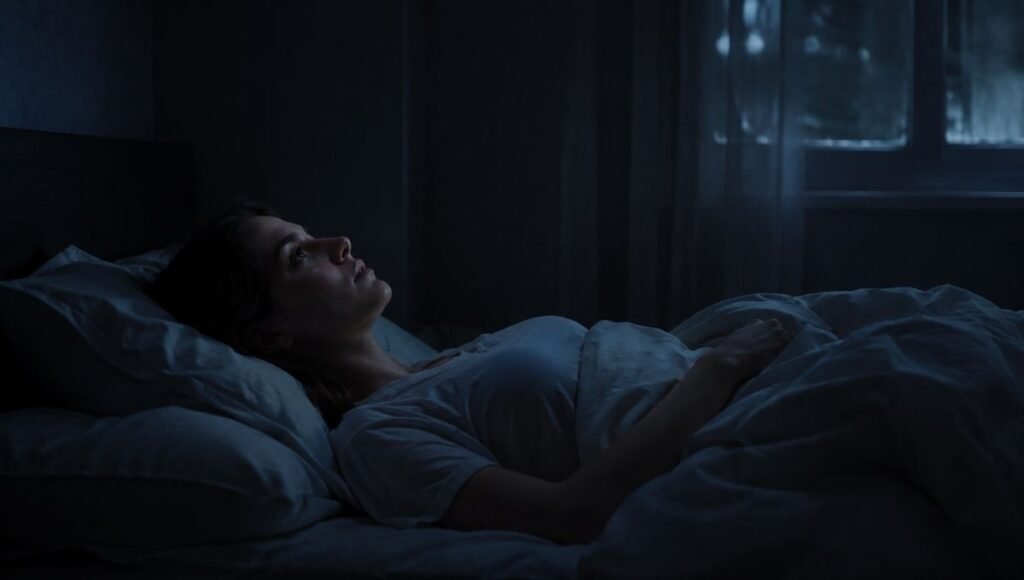
You’ve been fine all day. Functional, even. And then the lights go off, the house goes quiet, and something shifts. The mind that was perfectly manageable at 2pm becomes something else entirely at 11pm — faster, louder, harder to redirect. Worries that felt containable during the day feel urgent now. Sleep, which should be automatic, feels like something you have to earn.
If this is your pattern, you’re in very large company. Anxiety at night is one of the most commonly reported sleep complaints among adults — and one of the least effectively addressed, because most standard sleep advice treats the anxiety as a side issue rather than the central problem.
This guide covers everything: why anxiety specifically gets worse at night, the different forms it takes, the mechanisms that sustain it, and the complete range of approaches that actually interrupt it. It’s meant to be a reference — something you can return to depending on what’s happening for you on a given night, and something that links you to the deeper guides for each specific situation you’re navigating.
Key Takeaways
- Anxiety at night is not imagined and not a weakness — it follows predictable neurological and behavioral patterns that can be understood and changed.
- The Anxiety and Depression Association of America estimates 40 million American adults live with anxiety disorders; disrupted sleep is among the most universally reported symptoms.
- Research from UC Berkeley found that sleep deprivation increases amygdala reactivity — the brain’s fear center — by up to 60%, creating a bidirectional loop: anxiety disrupts sleep, and poor sleep intensifies anxiety.
- Most nighttime anxiety responds better to daytime interventions than bedtime ones. The anxiety that arrives at midnight was largely built between 8am and 8pm.
- CBT-I (Cognitive Behavioral Therapy for Insomnia) is the most evidence-based non-drug treatment for anxiety-driven insomnia and is more effective than sleep medication in long-term outcomes.
Why Anxiety Gets Worse at Night
This is the question most people ask first, and it deserves a real answer — not “stress causes it” but the actual mechanism.

The distraction buffer disappears
During the day, your nervous system is occupied. The continuous flow of tasks, conversations, decisions, and movement provides a natural interruption pattern that breaks up anxious thought before it can develop into a full spiral. The anxiety was present throughout the day — it just kept getting interrupted.
At night, those interruptions disappear simultaneously. The environment goes quiet, external demands drop away, and the mind fills the silence with whatever it’s been carrying. This is why people who describe themselves as “not particularly anxious” during the day can experience significant anxiety at night. The capacity for anxiety was always there. The day just kept getting in the way.
Cortisol doesn’t fall as it should
Under healthy conditions, cortisol — the body’s primary stress hormone — follows a predictable daily rhythm: highest in the morning, declining through the day, lowest in the middle of the night. This nighttime trough is part of what allows the nervous system to rest and recover.
Chronic stress disrupts this rhythm. Cortisol stays elevated later into the evening, or begins its morning rise earlier than it should. Elevated evening cortisol keeps the nervous system in a state of low-level activation — not dramatically stressed, but alert enough that genuine rest is difficult. From the inside, this doesn’t feel like “my cortisol is elevated.” It feels like anxiety. It feels like the sense that something needs attention, even when nothing specific does.
REM sleep accumulates emotional residue
REM sleep — concentrated in the final hours of the night — serves a critical function in emotional regulation. During REM, the emotional charge of experiences from the previous day is processed and reduced. This is sometimes described as overnight therapy: difficult experiences remain in memory, but their intensity diminishes.
When sleep is regularly cut short, or when the second half of the night is fragmented by anxiety-driven waking, this processing doesn’t complete. Emotional content from previous days carries its full weight forward. Anxiety that feels disproportionate to current circumstances often reflects this accumulation — not irrational sensitivity, but unprocessed emotional residue from nights of insufficient REM.
The nervous system hasn’t received a stand-down signal
Your nervous system doesn’t switch off on command. It deactivates gradually, through a series of environmental and behavioral cues that signal the high-demand period has ended. If those cues are absent — if you’ve gone from a demanding evening directly into bed with no transition — the nervous system remains in its activated state. You lie down tired but physiologically alert, which is the characteristic profile of anxiety at night.
The Different Forms Anxiety at Night Takes
Nighttime anxiety isn’t one experience. It presents differently depending on its drivers, and recognizing which version you’re dealing with shapes which approaches are most useful.

The thought spiral
The most common presentation: lying awake with a mind that generates content at high speed. Replaying conversations, anticipating problems, planning for contingencies that may never arise, circling the same worries without resolution. The thoughts themselves may be mundane — a work situation, a family concern, a health question — but they feel urgent in a way that’s hard to interrupt.
This is cognitive hyperactivation, and it’s the primary target of most behavioral interventions for nighttime anxiety. It responds well to approaches that redirect attention or offload the cognitive load that’s fueling the spiral.
The physical anxiety
Some people experience nighttime anxiety primarily as physical rather than cognitive: elevated heart rate, chest tightness, muscle tension, shallow breathing, a vague sense of physical unease that they can’t attach to a specific thought. The body is in a mild stress response, and the mind may or may not be generating anxious content to explain it.
This presentation often responds better to body-first approaches — progressive muscle relaxation, extended-exhale breathing, cold water — before cognitive techniques can get traction.
The 3am waking
A common pattern: sleep comes relatively easily, but waking occurs consistently in the early morning hours — often 2, 3, or 4am — with a mind that is immediately and fully active. This timing corresponds to the point in the night when sleep architecture shifts toward lighter REM-dominant stages and when the body’s cortisol curve begins its morning rise.
For people whose cortisol rises too early due to chronic stress, this produces what feels like an internal alarm — a physiological waking that has nothing to do with external noise or the need for the bathroom. The mind fills the waking moment with anxiety content, and returning to sleep becomes difficult.
The conditioned response
After enough nights of lying awake with anxiety, the bed itself becomes a trigger. The nervous system has learned, through repeated experience, that getting into bed is followed by anxiety. Eventually, bedtime itself becomes a source of anticipatory dread — anxiety about the anxiety that’s coming.
This conditioned arousal pattern is one of the most important things to understand about chronic nighttime anxiety because it explains why the anxiety can persist even after the original stressor has resolved. The pattern has become self-sustaining.
What Makes Nighttime Anxiety Worse
Understanding the amplifiers helps you remove them — which is often easier than trying to directly reduce the anxiety itself.
Alcohol. Widely used as a sleep aid, alcohol metabolizes into a stimulating compound 4–5 hours after consumption. For someone who drinks in the evening, this metabolite peaks at 2–3am — exactly when sleep is lightest and anxiety has the most leverage. Alcohol suppresses the REM sleep that processes emotional content, and then delivers a physiological stimulant at the most vulnerable point in the night.
Screen use close to bedtime. The issue isn’t primarily blue light — it’s content. News, social media, work email, and emotionally activating entertainment maintain cognitive and emotional arousal that takes time to settle. The nervous system doesn’t distinguish between real and fictional threats; it responds to both.
No transition between day and night. Going directly from demanding evening activity into bed without a decompression period asks the nervous system to stand down without giving it a signal that it’s safe to do so. The anxiety that appears at 11pm was often set in motion by the absence of a genuine transition.
Clock-watching. Checking the time after waking activates a calculation sequence — how much sleep remains, how impaired tomorrow will be — that is reliably anxiety-amplifying. The information is never useful at 3am. It only adds to the activation that’s already present.
Trying to force sleep. Effort activates the sympathetic nervous system. The harder you try to make sleep happen, the more physiologically incompatible you become with the state sleep requires. This is one of the cruelest features of anxiety-driven insomnia: the solution everyone reaches for — trying harder — makes the problem worse.
The Complete Approach to Anxiety at Night
Effective management of nighttime anxiety works on three levels simultaneously: reducing the daytime load that generates the anxiety, creating the conditions that support the transition to sleep, and having specific tools for when anxiety arrives at night anyway.

Level 1: Reduce the load during the day
This is where most of the real work happens. Bedtime interventions address symptoms. Daytime interventions address causes.
Physical movement. Exercise is one of the most efficient cortisol regulators available. A 20–30 minute walk in the morning or early afternoon shifts the evening cortisol level and directly improves sleep architecture. It doesn’t have to be intense — it has to happen consistently.
A deliberate workday shutdown ritual. Without a clear ending signal, the nervous system stays in work mode indefinitely. Writing tomorrow’s priorities, closing devices intentionally, and creating a physical transition — even a brief walk outside — tells the nervous system that the high-demand period has ended.
Structured worry time. Setting aside 15 minutes in the early evening to write down current worries and possible next steps gives the anxious mind its designated processing time. When worries surface later at night, there’s an honest response available: “I already gave that its time today.” This isn’t suppression — it’s scheduling.
Level 2: Create the right transition
The 60–90 minutes before bed are not just “winding down.” They’re the period in which the nervous system needs to shift from sympathetic activation to parasympathetic dominance. This doesn’t happen automatically. It requires the right conditions.
Dim the lights. Stop consuming stimulating content. Allow the environment to become genuinely quieter. A warm bath or shower 60–90 minutes before bed accelerates the core temperature drop that triggers sleep onset. Write tomorrow’s specific tasks to offload the cognitive load from working memory.
The specific activities matter less than their consistency. A repeated pre-sleep sequence becomes a conditioned signal — the nervous system begins to recognize the pattern and prepares for sleep before you’ve gotten into bed.
Level 3: Tools for when anxiety arrives anyway
Extended-exhale breathing. In for 4 counts, out for 6 or 8. Repeat 8–10 cycles. When the exhale is longer than the inhale, it directly stimulates the vagus nerve and shifts the nervous system toward parasympathetic dominance. Effects begin within 60–90 seconds.
Cognitive defusion. Instead of engaging with anxious thoughts or trying to suppress them, observe them: “I’m having the thought that…” The slight distance this creates reduces the urgency and physiological grip of the thought without requiring you to solve or dismiss it.
The 20-minute rule. If you’ve been awake for more than 20 minutes, get out of bed. Go somewhere dim and quiet. Do something low-stimulation. Return to bed when genuinely drowsy. This is stimulus control therapy — it protects the bed’s association with sleep rather than wakefulness, which is the central behavioral intervention for conditioned arousal.
Cold water on the face and wrists. Activates the dive reflex, producing a rapid parasympathetic shift. More abrupt than breathing exercises, and often more effective for acute anxiety spikes.
The Sleep-Anxiety Loop: Why It Self-Sustains
One of the most important things to understand about nighttime anxiety is that it doesn’t just disrupt sleep — it creates the conditions for more anxiety.
Research from UC Berkeley found that sleep deprivation increases amygdala reactivity by up to 60% while simultaneously reducing the prefrontal cortex’s ability to regulate that response. In plain terms: poor sleep makes you more anxious the following day, which makes sleep harder the following night, which produces more anxiety, which produces worse sleep.
This loop runs automatically without deliberate interruption. Recognizing it doesn’t stop it — but it does change the strategy. Rather than asking “how do I stop being anxious at night,” the more productive question is “where in this loop can I most effectively intervene?”
For most people, the highest-leverage entry points are daytime stress management (which reduces the load that reaches the evening) and consistent behavioral sleep practices (which rebuild the conditions for restorative sleep). Both are addressed in the detailed guides below.
Who Nighttime Anxiety Affects Most
Working professionals under sustained pressure. The workday that never really ends, the constant context-switching, the decisions made under time pressure — all of this maintains the sympathetic nervous system in a state of elevated activation that can persist into the night. The anxiety that arrives at 11pm was built between 9am and 9pm.
New parents. Postpartum anxiety and the hypervigilance of new parenthood keep the nervous system in monitoring mode even when the environment is quiet. For new mothers specifically, hormonal changes compound this, and the fragmented sleep of the newborn period prevents the REM processing that would normally regulate emotional tone.
Perimenopausal and menopausal women. Estrogen decline affects neurotransmitter systems that regulate mood and anxiety, while night sweats fragment the sleep architecture that processes emotional content. The convergence of hormonal and sleep disruption during this transition makes nighttime anxiety particularly common and particularly difficult to address with standard approaches.
People with high-responsibility roles. Caregivers, leaders, anyone whose days involve sustained vigilance and responsibility for others — the habit of alertness is deeply grooved, and the nervous system doesn’t easily release it at bedtime.
Anyone in a sustained difficult period. Grief, relationship difficulty, financial stress, health anxiety — periods of acute life difficulty maintain chronic stress activation that directly elevates nighttime anxiety. The anxiety isn’t irrational in these contexts. It’s a reasonable response to genuinely difficult circumstances, running in an environment (dark, quiet, no action possible) where it can’t be discharged.
The Guides That Go Deeper
This pillar covers the complete landscape. For specific situations, these guides go into the detail that a single overview can’t:
If you want to understand why nighttime anxiety happens neurologically: → Why Do I Get Anxious at Night? — The four biological and psychological mechanisms behind why anxiety is worse at night than during the day.
If sleep deprivation itself is making your anxiety worse: → Can Lack of Sleep Cause Anxiety? — The UC Berkeley research on amygdala reactivity and the bidirectional loop explained in full.
If anxiety is preventing you from falling asleep: → How to Sleep With Anxiety — The complete behavioral framework for breaking the anxiety-insomnia cycle from the sleep side.
If you need specific in-the-moment tools for when anxiety arrives at night: → How to Calm Anxiety at Night — Extended-exhale breathing, cognitive defusion, PMR, and the 20-minute rule, organized by when and how to use them.
If anxiety specifically spikes in the hour before bed: → Anxiety Before Bed — Why pre-sleep anxiety forms, how it becomes conditioned, and the transition practices that interrupt it.
If racing thoughts and overthinking are the primary problem: → How to Stop Overthinking at Night — The ironic rebound effect explained, cognitive defusion in practice, and the research-backed brain dump technique.
When to Seek Professional Support
Most nighttime anxiety responds to consistent behavioral practice over 2–4 weeks. But there is a threshold at which self-management isn’t sufficient — and knowing where that threshold is matters.
Consider speaking with a healthcare provider or therapist if:
- Nighttime anxiety has persisted for more than three months despite genuine consistent effort with behavioral approaches
- Anxiety is significantly present during the day — affecting work, relationships, or daily function — not only at night
- You experience panic attacks: sudden, intense physical symptoms (racing heart, chest tightness, a sense of unreality or danger) that feel dramatically different from ordinary anxiety
- The anxiety comes with persistent low mood, hopelessness, or difficulty experiencing pleasure that doesn’t lift
- You’re managing with alcohol or other substances to get through the nights
CBT-I (Cognitive Behavioral Therapy for Insomnia) is the first-line evidence-based treatment for anxiety-driven insomnia and is more effective than sleep medication in long-term outcomes. It’s available through sleep medicine therapists and increasingly through validated digital programs.
CBT for anxiety addresses the upstream patterns — the thought distortions, the avoidance behaviors, the hypervigilance — that generate the content of nighttime anxiety. When daytime anxiety is significant, this is often the intervention that produces the most sleep improvement.
You don’t have to manage this indefinitely on your own. Effective help exists and works.
Frequently Asked Questions
Is it normal to have anxiety at night?
Occasional nighttime anxiety during high-stress periods is common and expected. Most adults experience it at some point. It becomes clinically significant when it occurs most nights, significantly disrupts sleep, causes distress, or persists for more than three months despite behavioral management. At that point it’s not a sign of weakness — it’s a pattern that warrants direct attention.
Why is my anxiety so much worse at night?
Four primary reasons: daytime distractions disappear and leave the mind unoccupied, cortisol doesn’t fall as deeply as it should in chronically stressed individuals, REM sleep deficit leaves emotional content unprocessed, and the nervous system hasn’t received a clear signal that the high-demand period has ended. None of these is a personal failing. All of them are addressable.
What is the fastest way to stop anxiety at night?
For acute anxiety: extended-exhale breathing (in 4, hold if possible, out 6–8) produces measurable physiological shifts within 60–90 seconds by stimulating the vagus nerve. Cold water on the face and wrists activates the dive reflex for a rapid parasympathetic reset. For the cognitive component, a written brain dump — writing down what’s circling without trying to solve it — reduces the mind’s urgency to keep processing.
Can anxiety at night go away on its own?
Sometimes, when the underlying stressor resolves. But when nighttime anxiety has been running for weeks or months, it often develops self-sustaining behavioral components — conditioned arousal, anticipatory anxiety about sleep, the bed-wakefulness association — that persist even after the original trigger has passed. At that point, behavioral intervention is more effective than waiting.
Does melatonin help with nighttime anxiety?
Melatonin regulates sleep timing — signaling darkness and promoting sleep onset — but doesn’t directly address anxiety. It can help some people fall asleep faster, which reduces the window during which nighttime anxiety can develop. For anxiety that’s already active, melatonin won’t calm it. The behavioral approaches in this guide address the anxiety itself more directly.
What’s the difference between nighttime anxiety and a panic attack?
Nighttime anxiety is characterized by worry, racing thoughts, and mild to moderate physiological activation — elevated heart rate, tension, difficulty relaxing. Panic attacks are sudden, intense, and physically overwhelming: racing heart, chest tightness, shortness of breath, a sense of unreality or impending danger, intense fear. Panic attacks typically peak within 10 minutes and then subside. If you’re experiencing what feels like panic attacks at night, this warrants evaluation by a healthcare provider.
The Honest Bottom Line
Anxiety at night is not a character flaw. It’s not evidence that you’re too sensitive or too stressed or fundamentally unable to manage your mind. It’s a predictable pattern with identifiable causes, and most of those causes are addressable.
The approaches that work aren’t dramatic. They’re mostly small, consistent, boring: a walk in the morning, a task list before bed, the willingness to get out of bed rather than lie awake, extended-exhale breathing done every night whether or not you’re anxious. None of these feel like enough when the anxiety is loud. All of them work when done consistently over time.
The goal isn’t to eliminate every anxious thought before sleep. It’s to stop giving those thoughts the physiological conditions in which they thrive — and to build, gradually, the conditions in which sleep does.
For the complete guide to sleeping when anxiety is the primary barrier, start with how to sleep with anxiety. And if you’re also struggling with middle-of-the-night waking, our guide on waking up in the middle of the night covers all the fixable causes.
References
- Simon, E. B., Rossi, A., Harvey, A. G., & Walker, M. P. (2020). Overanxious and underslept. Nature Human Behaviour, 4(1), 100–110.
- Yoo, S. S., Gujar, N., Hu, P., Jolesz, F. A., & Walker, M. P. (2007). The human emotional brain without sleep — a prefrontal amygdala disconnect. Current Biology, 17(20), R877–R878.
- Anxiety and Depression Association of America. (2023). Facts and statistics about anxiety disorders. https://adaa.org/understanding-anxiety/facts-statistics
- Morin, C. M., & Benca, R. (2012). Chronic insomnia. The Lancet, 379(9821), 1129–1141.
- Harvey, A. G. (2002). A cognitive model of insomnia. Behaviour Research and Therapy, 40(8), 869–893.
- National Institute of Mental Health. (2023). Anxiety disorders. https://www.nimh.nih.gov/health/topics/anxiety-disorders
NourishDAO publishes sleep and wellness content for informational purposes only. This article is not a substitute for professional medical advice, diagnosis, or treatment. If you are experiencing persistent anxiety or sleep difficulty, please consult a qualified healthcare provider.