
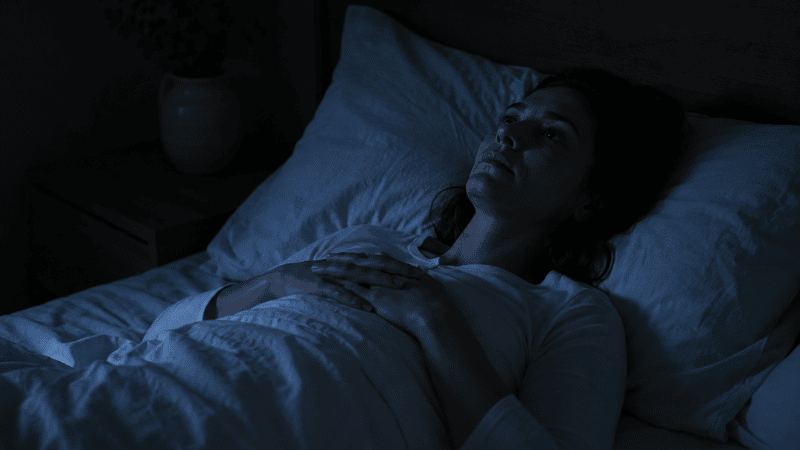
You know exactly what tonight looks like. You’re tired — genuinely, physically tired. You get into bed at a reasonable hour. You close your eyes. And then it starts.
Not dramatic thoughts. Not catastrophizing. Just a low-level hum: tomorrow’s meeting, the email you forgot to send, the way that conversation went, a worry about something you can’t control. Your body is horizontal but your mind is running a review of the day that nobody asked for. You shift position. You check the time. You tell yourself to stop thinking, which somehow produces more thinking. By the time you finally drift off, it’s an hour later than it should be, and you’re already bracing for tomorrow.
This is anxiety-driven sleep difficulty — and it affects roughly 40 million Americans, making anxiety the most common mental health condition in the country, according to the Anxiety and Depression Association of America. Most of them also experience some form of sleep disruption. The connection is not coincidental. Anxiety and sleep problems share the same neurobiological substrate, and each one reliably makes the other worse.
The good news: this cycle is not permanent. It’s learned — which means it can be unlearned. This guide explains how.
Key Takeaways
- Anxiety and sleep problems exist in a bidirectional cycle: anxiety disrupts sleep, and poor sleep increases anxiety the following day, creating a self-reinforcing pattern that gets worse without deliberate intervention.
- The primary physiological driver of anxiety-related insomnia is elevated cortisol and sympathetic nervous system activation at bedtime — a state that is directly counteracted by extended-exhale breathing, progressive muscle relaxation, and behavioral sleep techniques.
- Cognitive Behavioral Therapy for Insomnia (CBT-I) is the most evidence-based non-drug treatment for anxiety-driven insomnia, with effects that exceed sleep medication in long-term outcomes and specifically target the learned associations that sustain the cycle.
- Research from the Journal of Experimental Psychology shows that writing a “to-do list for tomorrow” before bed significantly reduces time to sleep onset compared to journaling about completed tasks — one of the most practically useful findings in sleep research.
- Most anxiety-sleep interventions require 2–3 weeks of consistent practice before producing reliable results; expecting overnight change is itself a source of anxiety that worsens the pattern.
Why Anxiety Makes Sleep So Hard: The Neurobiological Loop
Understanding what’s actually happening makes it easier to address the right thing — and to stop blaming yourself for a problem that is physiological, not personal.
When you experience anxiety, your body activates the sympathetic nervous system — the fight-or-flight system that governs emergency responses. Cortisol and adrenaline rise. Heart rate increases. Muscle tone increases. Breathing becomes shallower and faster. Attention narrows to threat-related cues. All of this is adaptive in a genuine emergency. In a quiet bedroom at 11pm, it is profoundly counterproductive.
Sleep requires the opposite neurological state: parasympathetic dominance, falling core body temperature, declining cortisol, and a mind that has released the need to monitor and problem-solve. Anxiety and the conditions required for sleep are not just different — they are physiological antagonists. Your nervous system cannot fully inhabit both states simultaneously.
The loop that follows is predictable: anxiety prevents sleep → sleep deprivation increases cortisol and emotional reactivity → higher baseline anxiety the next day → worse sleep the next night. Without deliberate interruption, this loop tightens over weeks and months into what clinicians call psychophysiological insomnia — where the bed itself has become conditioned to trigger arousal, and sleep difficulty persists as a learned pattern even when the original anxiety has reduced.
This is why general advice like “just relax” or “stop worrying” doesn’t help. The pattern is neurological, and it requires neurological intervention.
How to Sleep With Anxiety: The Evidence-Based Approaches

Address the anxiety where it actually lives — during the day
This is the most counter-intuitive but most important principle: the most effective interventions for nighttime anxiety happen during the day, not at bedtime.
Cortisol follows a daily rhythm — highest in the morning, lowest at night. When chronic stress keeps cortisol chronically elevated throughout the day, the nighttime trough becomes shallower. The evening cortisol level is largely determined by the daytime pattern — which means that daytime stress regulation directly affects whether you can fall asleep at night.
The most effective daytime levers:
Physical movement. Exercise is one of the most efficient cortisol regulators available. Even a 20–30 minute brisk walk in the morning or early afternoon shifts the cortisol curve and improves sleep architecture that night. Late-evening vigorous exercise can be counterproductive for some people by elevating cortisol at the wrong time; morning or early afternoon exercise has the clearest sleep benefit.
A deliberate workday shutdown ritual. For people whose anxiety is work-driven, the workday often has no clear ending — emails arrive at 9pm, thoughts about tomorrow begin at 8pm. Creating a deliberate closing ritual — writing tomorrow’s top three priorities, closing the laptop intentionally, saying “I’m done for today” — creates a psychological boundary that the brain learns to respect. Without this boundary, the mind continues in “open loop” mode all evening.
Structured worry time. This sounds counterintuitive but is well-supported by research. Set aside 15 minutes in the early evening — not at bedtime — to write down your worries and possible next steps. When worries arise later at night, the knowledge that they’ve been given their dedicated time gives the brain partial permission to defer them. You’re not suppressing the worries; you’re filing them.
Use the pre-sleep window deliberately
The 60–90 minutes before bed are not just “winding down” — they’re an active nervous system transition that requires specific conditions to work.
Light. Bright overhead lighting in the hour before bed signals the brain that the day is still active. Dim the lights, switch to lamps, and avoid overhead lighting from sunset onward if possible. This isn’t aesthetic preference — it supports the melatonin production that signals sleep onset.
Screens. The issue isn’t primarily blue light (though that is a minor factor). The larger problem is cognitive activation — news, social media, work email, and most video content produce the exact neurological state that anxiety-driven insomnia requires you to move away from. The content activates the threat-monitoring system that you’re trying to quiet. Put screens down 45–60 minutes before bed, or at minimum engage only with genuinely low-stimulation content.
Temperature. Sleep onset is linked to a small drop in core body temperature. A cool bedroom (65–68°F / 18–20°C) supports this drop. A warm bath or shower 60–90 minutes before bed counterintuitively accelerates the drop by drawing blood to the skin’s surface, which then radiates heat outward.
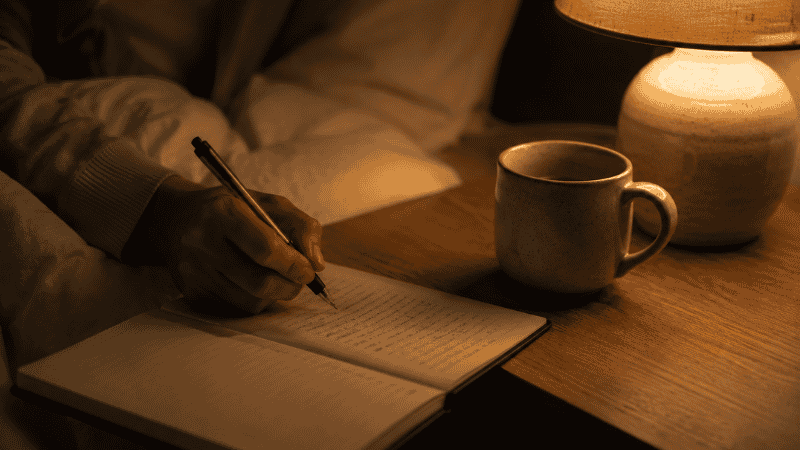
The pre-sleep brain dump. Research published in the Journal of Experimental Psychology (Scullin et al., 2018) found that writing a specific to-do list for tomorrow — not journaling about today — significantly reduced time to sleep onset compared to controls. The proposed mechanism: by offloading the task-tracking burden from active working memory to paper, the brain’s felt need to continue processing decreases, and physiological preparation for sleep can proceed. Five minutes. A notepad, not your phone. Tomorrow’s tasks, not today’s recaps.
Breathing techniques that directly counteract anxiety
The extended exhale is the fastest available intervention for acute nighttime anxiety. When the exhale is longer than the inhale, it directly stimulates the vagus nerve, slowing heart rate and shifting the nervous system toward parasympathetic dominance — often within 90 seconds.
The 4-7-8 method:
- Exhale completely through your mouth
- Inhale through the nose for 4 counts
- Hold for 7 counts
- Exhale completely through the mouth for 8 counts
- Repeat 3–4 cycles
The extended hold and exhale produce a stronger parasympathetic response than simple slow breathing. If holding for 7 counts feels uncomfortable initially, reduce proportionally (try 4:5:6) and work toward the full ratio.
If the counting itself feels activating, try box breathing instead: 4 counts in, 4 counts hold, 4 counts out, 4 counts hold. The equal counts are simpler to maintain when cognitive load is high.
If you wake at 3am with a racing mind, the most important first step is not to reach for your phone. Instead: 10 slow extended-exhale breaths first, then a decision about whether to stay in bed or get up.
Progressive muscle relaxation for physical anxiety
Many people with anxiety carry tension in specific areas — jaw, neck, shoulders, chest, stomach — without being fully aware of it. This physical tension maintains sympathetic activation even when anxious thoughts have subsided. Progressive muscle relaxation (PMR) addresses this by deliberately tensing and releasing each muscle group, producing a contrast effect that allows deeper release than voluntary relaxation alone.
Abbreviated PMR sequence for bedtime (8–10 minutes):
For each area: inhale and tense firmly for 5 seconds, exhale and release for 20–30 seconds.
- Feet (curl toes) → calves → thighs → glutes → stomach → hands (clench) → upper arms → shoulders (raise toward ears) → face (scrunch everything)
The release time is as important as the tension time — don’t rush through it. The parasympathetic response builds in the release phase.
Break the bed-wakefulness association
One of the most powerful — and most counter-intuitive — interventions for anxiety-driven insomnia is getting out of bed when you can’t sleep.
This is called stimulus control therapy, and it’s the behavioral core of CBT-I. The rationale: when you lie awake in bed — anxious, watching the ceiling, checking the time — you’re training your brain to associate the bed with wakefulness and worry rather than sleep. This association develops quickly and is remarkably durable. Once established, the mere act of getting into bed can trigger arousal.
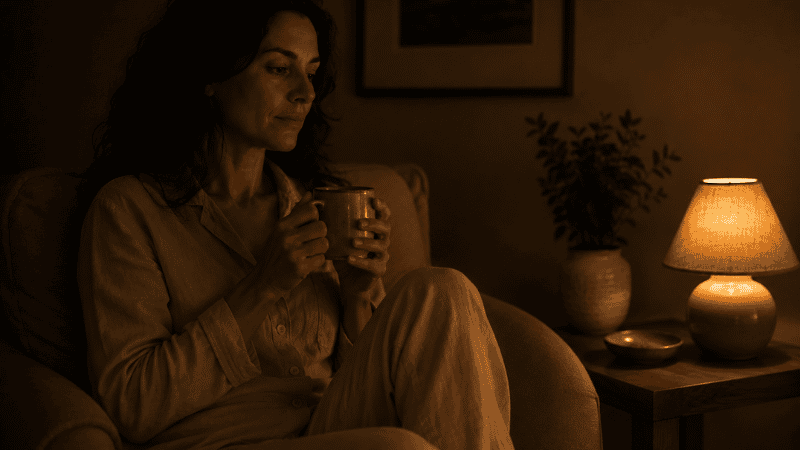
The intervention: if you haven’t fallen asleep within 20 minutes, or if you wake in the night and haven’t returned to sleep within 20 minutes, get out of bed. Go somewhere dim and quiet. Do something genuinely low-stimulation — read something unengaging, sit with a warm drink, practice slow breathing. Return to bed only when you feel genuinely drowsy.
This feels counterproductive when you’re exhausted. The instinct is to stay in bed and try harder. But trying harder is exactly what deepens the conditioned arousal. Getting up, doing something calm, and returning when drowsy gradually reverses the association — typically over 2–3 weeks of consistent application.
Cognitive restructuring: addressing what you think about sleep
Anxiety about sleep is not just a feeling — it’s often built on a set of specific beliefs that amplify the problem:
- “If I don’t get 8 hours I won’t be able to function tomorrow”
- “There must be something wrong with me”
- “Every night of bad sleep is doing permanent damage”
- “I’ve tried everything and nothing works”
These beliefs generate secondary anxiety about sleep itself — which elevates cortisol, which makes sleep harder, which confirms the belief. CBT-I directly targets this layer through cognitive restructuring: examining each belief for accuracy, identifying the distortion, and developing a more accurate (and less activating) replacement.
A starting point: most people can function reasonably well after a poor night of sleep — not optimally, but adequately. The catastrophic predictions most anxious sleepers make about tomorrow rarely come true at the predicted severity. Recognizing this — gently, without dismissing the real difficulty — is the beginning of breaking the cognitive component of the cycle.
If You Only Have 10 Minutes Tonight
Do just this:
Take a notepad (not your phone) and spend three minutes writing down what’s circling in your mind — tomorrow’s tasks, worries, anything that’s open. Don’t analyze, don’t solve. Just write and close the notebook.
Then: exhale completely, and breathe in for 4 counts, hold for 7, out for 8. Do it five times.
Dim the room. Put your phone face-down, out of reach.
These three steps take under ten minutes and address three of the four primary drivers of anxiety-driven sleep difficulty: cognitive load (the brain dump), physiological arousal (the breathing), and environmental activation (the light and screen). Done consistently every night for two weeks, most people notice a meaningful shift in how they transition to sleep.
When to Seek Professional Help
Sleep difficulty driven by anxiety is very treatable — but there’s a threshold at which self-directed approaches are no longer sufficient.
Consider speaking with a healthcare provider or therapist if:
- Sleep difficulty has persisted for more than 3 months despite consistent behavioral effort
- Anxiety is significantly present during the day — affecting work, relationships, or daily function — not only at bedtime
- You’re experiencing panic attacks at night, which feel dramatically different from ordinary anxiety: sudden onset, intense physical symptoms (racing heart, feeling of choking or unreality), intense fear
- Low mood or depression accompanies the sleep and anxiety difficulties — these conditions interact with each other and typically need direct treatment
- Behavioral approaches haven’t produced improvement after 4+ weeks of genuine consistent application
CBT-I is the first-line recommended non-drug treatment for anxiety-driven insomnia and is more effective than sleep medication in long-term outcomes. It’s available through therapists trained in behavioral sleep medicine and increasingly through validated digital programs.
Therapy for anxiety — particularly Cognitive Behavioral Therapy (CBT) — is the most evidence-based treatment for anxiety disorders and directly addresses the cognitive patterns that feed into sleep difficulty.
You don’t have to manage this alone, and seeking help isn’t a sign that the behavioral tools have “failed.” It’s a recognition that the pattern has become entrenched enough to benefit from structured professional support.
Frequently Asked Questions
Why does anxiety get worse at night?
During the day, your brain is occupied with tasks, conversations, and external stimulation that provide natural distraction from anxious thoughts. At night, those distractions disappear, and the mind fills the silence with whatever it’s been holding. Simultaneously, the normal nighttime cortisol drop doesn’t occur as deeply in chronically anxious people, meaning the physiological preparation for sleep is less complete. The combination of an unoccupied mind and a partially activated nervous system is the characteristic profile of nighttime anxiety.
How do I stop my mind from racing when I’m trying to sleep?
The most effective immediate tools: a written brain dump (writing down what’s circling, without trying to solve it), extended-exhale breathing (4 counts in, 6–8 counts out), and if thoughts continue after 20 minutes, getting out of bed rather than lying awake. The instinct to stay still and try harder typically makes it worse. Redirecting attention — through breathing or body scan meditation — is more effective than suppression.
Can anxiety cause insomnia?
Yes, directly. Anxiety activates the sympathetic nervous system, elevating cortisol and adrenaline in ways that are physiologically incompatible with sleep initiation. It also produces the cognitive hyperactivation (racing thoughts, worry loops) that prevents the mental disengagement sleep requires. Over time, the conditioned association between bed and wakefulness compounds the problem — creating chronic insomnia that persists even when the triggering anxiety has reduced.
Is it safe to take sleep medication for anxiety-related insomnia?
Some medications are effective for both anxiety and sleep in the short term, but most come with dependency risk, tolerance development, or side effects that make long-term use complex. This is precisely why CBT-I is recommended as first-line treatment — it produces durable effects without these risks. If you’re considering medication, a healthcare provider can assess your specific situation and recommend the most appropriate approach. Don’t self-medicate with over-the-counter sleep aids for ongoing anxiety-driven insomnia.
How long does it take to break the anxiety-insomnia cycle?
Most people who engage consistently with behavioral approaches — particularly the 15-minute rule, consistent wake time, and pre-sleep brain dump — notice meaningful improvement within 2–3 weeks. The conditioned arousal component of the pattern typically takes the longest to shift: the bed-wakefulness association can take 3–4 weeks of stimulus control practice to reverse. Full resolution of a well-established anxiety-insomnia cycle often takes 6–8 weeks of consistent behavioral work — which is exactly the typical duration of a CBT-I course.
Does melatonin help with anxiety-related sleep problems?
Melatonin primarily regulates sleep timing — signaling that darkness has arrived — rather than directly addressing anxiety or arousal. It can help with sleep onset if the primary issue is circadian timing (falling asleep at the wrong time), but it does not counteract the sympathetic activation that drives anxiety-related insomnia. For most people with anxiety-driven sleep difficulty, behavioral and relaxation approaches address the actual problem more directly than melatonin does.
The Loop Can Be Broken
Anxiety-driven sleep difficulty is one of the most common and most uncomfortable experiences in modern adult life. It’s also one of the most treatable — not through willpower, and not by trying harder to sleep, but through specific, consistent, evidence-based approaches that directly address the neurobiological pattern.
The cycle was learned. The bed became associated with wakefulness gradually, over weeks of lying awake. The evening cortisol pattern developed gradually, under accumulated stress. Both of these can be reversed — also gradually, also over weeks of consistent alternative practice.
Start with the brain dump and the breathing tonight. Add the 20-minute rule this week. Give it two weeks before judging whether it’s working.
You will sleep again. Not tonight maybe, not without effort, but genuinely, eventually — better than this.
For the full evening approach that creates the right conditions for these techniques to work, read our guide on building a night routine for better sleep. And if waking at the same time every night has become a fixed pattern, our guide on why you keep waking up at 3am explains the conditioned arousal mechanism and what breaks the cycle.
References
- Anxiety and Depression Association of America. (2023). Facts and statistics about anxiety disorders. https://adaa.org/understanding-anxiety/facts-statistics
- Scullin, M. K., Krueger, M. L., Ballard, H. K., Pruett, N., & Bliwise, D. L. (2018). The effects of bedtime writing on difficulty falling asleep: A polysomnographic study comparing to-do lists and completed activity lists. Journal of Experimental Psychology: General, 147(1), 139–146.
- Morin, C. M., & Benca, R. (2012). Chronic insomnia. The Lancet, 379(9821), 1129–1141.
- Harvey, A. G. (2002). A cognitive model of insomnia. Behaviour Research and Therapy, 40(8), 869–893.
- National Institute of Mental Health. (2023). Anxiety disorders. https://www.nimh.nih.gov/health/topics/anxiety-disorders
NourishDAO publishes sleep and wellness content for informational purposes only. This article is not a substitute for professional medical advice, diagnosis, or treatment. If you are experiencing symptoms of an anxiety disorder or persistent sleep difficulty, please consult a qualified healthcare provider.