
You fall asleep without much trouble. That’s not the problem. The problem is what happens two, three, four hours later — when your eyes open and the ceiling is right there again, and you know with a sinking certainty that the next hour or two could go either way. Sometimes you drift back. Sometimes you don’t.
Waking in the middle of the night is one of the most common and most frustrating sleep complaints among adults. Unlike the difficulty falling asleep in the first place, middle-of-the-night waking is often harder to trace because it happens while you’re asleep — you can’t observe it, you can’t control it in the moment, and by the time you’re aware of it, the window for easy return to sleep is already narrowing.
The good news: most causes of nighttime waking are identifiable, and most of them are addressable without medication. This guide covers everything — the science of why we wake, the specific causes that disrupt sleep maintenance, and the complete set of strategies that actually work. It’s structured as a reference you can come back to, not a list of tips to try once and forget.
Key Takeaways
- The CDC recommends adults sleep at least 7 hours per night; waking repeatedly and failing to return to sleep meaningfully reduces the restorative value of time spent in bed.
- Middle-of-the-night waking is biologically normal at the transition between sleep cycles — the problem is not the waking itself but the inability to return to sleep quickly afterward.
- The most common fixable causes are: alcohol timing, bedroom temperature, stress-driven cortisol, inconsistent sleep schedule, light exposure, and conditioned arousal — most of which are addressable with behavioral changes.
- Cognitive Behavioral Therapy for Insomnia (CBT-I) is the most evidence-based treatment for chronic sleep maintenance insomnia and is more effective than sleep medication in long-term outcomes.
- If nighttime waking is accompanied by loud snoring, gasping, or morning headaches, sleep apnea should be evaluated — it is both common and very treatable.
Why You Wake Up in the Middle of the Night: The Basic Biology
Sleep is not a continuous flat state. It moves through cycles of approximately 90 minutes each, progressing through light sleep, deep slow-wave sleep, and REM sleep. Each complete cycle ends with a brief transition back toward lighter sleep — a natural, biologically programmed moment of partial arousal.
Most people don’t remember these transitions because they pass through them quickly and return to sleep seamlessly. But when something disrupts the threshold — internal signals like cortisol or blood sugar fluctuations, or external ones like noise, temperature, or light — these transitions become full wakenings.
The second half of the night is particularly vulnerable. Deep slow-wave sleep dominates the first half of the night; the later cycles contain progressively more REM sleep, which is both lighter and more sensitive to disruption. This is why nighttime waking most often happens between 2 and 5am — not because something goes wrong at that hour specifically, but because the sleep architecture in that window provides the least resistance to arousal.
Understanding this changes how you approach the problem. The goal isn’t to eliminate waking entirely — it’s to reduce what triggers the waking and to make returning to sleep easier when it does happen.
The Most Common Reasons You Can’t Sleep Through the Night
Alcohol — The Most Underestimated Disruptor
Alcohol is the single most common cause of middle-of-the-night waking in adults who drink — and the least recognized, because alcohol reliably helps with falling asleep, which makes it feel like a sleep aid rather than a sleep disruptor.
The mechanism: alcohol metabolizes into acetaldehyde, a stimulating compound, roughly 4–5 hours after consumption. For someone who has a drink at 9 or 10pm, this metabolite peaks at 2–3am — exactly when sleep architecture is most vulnerable. The result is lighter sleep, more frequent waking, and often an inability to return to deep sleep for the rest of the night.
Even two drinks within three hours of sleep measurably alters sleep architecture for most people. The practical fix is simple: move your last drink to at least three hours before sleep, or test a week without evening alcohol and observe the difference in your nighttime waking pattern.
Bedroom Temperature Too Warm
Sleep is tightly coupled to core body temperature. Sleep onset requires a small drop in core temperature, and sustained deep sleep — particularly in the second half of the night — requires the body to continue radiating heat outward efficiently. A bedroom that’s too warm prevents this and keeps sleep in lighter, more fragile stages.
The research-supported optimal range is 65–68°F (18–20°C) — cooler than most people’s default. If you regularly wake in the early hours feeling warm or with the sheets pushed aside, temperature is a very likely contributor.
This is especially relevant for perimenopausal women, whose thermoregulatory system is already dysregulated by hormonal changes, making them particularly sensitive to even modest room temperature elevation.
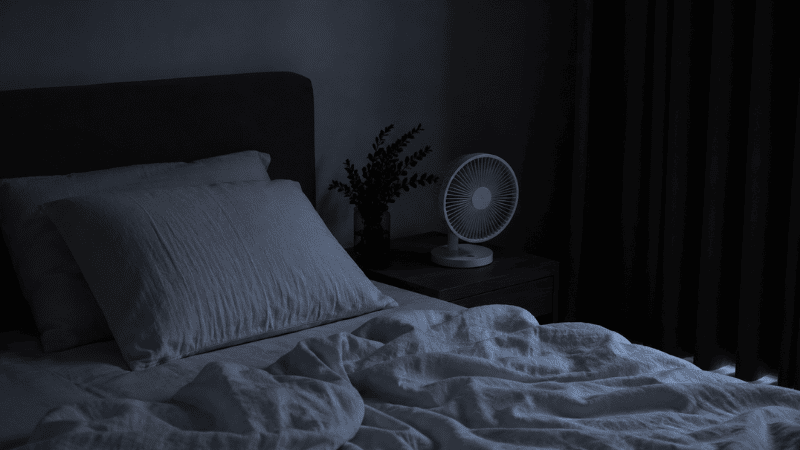
Practical adjustments: lower the thermostat, use a fan, switch to more breathable bedding (bamboo or linen rather than heavy synthetic), or keep one foot outside the covers — the feet are primary heat-dissipation surfaces.
Stress and Cortisol Rising Too Early
Cortisol follows a natural daily rhythm, lowest in the middle of the night and beginning to rise in the early morning hours to prepare the body for waking. Under chronic stress, this curve shifts earlier — cortisol begins its morning rise at 2 or 3am instead of 5 or 6am, producing a physiological “alert signal” hours before it’s wanted.
This produces the characteristic anxiety-driven waking: eyes open, mind immediately active, thoughts moving quickly without a clear reason to be awake. The waking feels internal and purposeless, which is disorienting and often frustrating.
The fix here is largely daytime-based. Evening cortisol level — and by extension the 3am cortisol curve — is determined by the cumulative stress load of the day. Physical movement during the day, a deliberate workday shutdown ritual, and reducing stimulating evening content all help moderate this pattern more effectively than any bedtime intervention.
An Inconsistent Sleep Schedule
Your circadian rhythm is anchored by consistent timing — primarily the wake time, which sets the schedule for the entire day’s hormonal and neurological pattern. When wake times vary significantly (sleeping in on weekends, staying up late some nights), the circadian system becomes imprecise, and sleep becomes shallower and more fragmented throughout the week.
Social jet lag — the common pattern of sleeping differently on weekends than weekdays — measurably increases nighttime waking and reduces sleep quality even when total sleep hours appear adequate.
The most effective single intervention for sleep maintenance: a fixed wake time, maintained within 30 minutes, seven days a week. Not a fixed bedtime — you can’t force yourself to feel sleepy at a particular hour. But a consistent anchor wake time will, over 1–2 weeks, begin to restructure the entire sleep pattern, including nighttime waking frequency.
Light Exposure During Sleep
Even low levels of light during the second half of the night shift sleep into lighter stages. Ambient light from streetlights through thin curtains, a charging device, a television on standby, or a digital clock all contribute — individually small, collectively meaningful, especially during the REM-dominant second half of the night when sleep is already lightest.
Blackout curtains or a sleep mask address this directly. Removing or covering light-emitting devices in the bedroom is a simple change with consistent evidence behind it.
Caffeine Timing
Caffeine has a half-life of approximately 5–6 hours, meaning half of the caffeine from a 3pm coffee is still active at 8–9pm. For most adults, caffeine consumed after 2pm can measurably affect sleep architecture — not necessarily preventing sleep onset, but reducing deep sleep and increasing the likelihood of nighttime waking.
Individual sensitivity varies, but if nighttime waking is a persistent problem, cutting caffeine off before noon for two weeks is a clean test.
Blood Sugar Fluctuations
When blood glucose drops during the night — which can happen after a high-sugar evening meal, an early dinner, or no dinner — the body releases cortisol and adrenaline to compensate. These are alerting hormones, and they’re often enough to produce a waking at 2–4am accompanied by mild anxiety or restlessness.
A small, balanced snack before bed — something with both protein and complex carbohydrate — can stabilize overnight blood glucose for people who notice this pattern. The effect is most relevant for people who eat early, skip dinner, or have blood sugar regulation challenges.
Conditioned Arousal
After weeks or months of waking at a particular time, the brain begins to anticipate it. Your arousal system starts preparing before the trigger fires — waking you even on nights when the original trigger (alcohol, cortisol, noise) isn’t present. The pattern has become conditioned, and it sustains itself independently.
This is why addressing the original cause doesn’t always immediately stop the waking. And it’s why the behavioral component of treatment — specifically, changing what you do when you wake and how you relate to the bed — is often as important as addressing the trigger itself.
How to Sleep Through the Night: The Complete Strategy

Fix the Environment First
These changes have the most immediate, measurable impact:
Temperature: Lower the bedroom to 65–68°F. If that’s not possible, use a fan, lighter bedding, and keep feet uncovered.
Light: Blackout curtains or a sleep mask. Cover or remove any light-emitting devices including charging cables, clock displays, and standby indicators.
Sound: A consistent background sound — white noise, pink noise, or a fan — masks variable environmental sounds that can trigger waking. Pink noise specifically has been shown to enhance slow-wave sleep activity.
Phone: Charge it outside the bedroom, or at minimum face-down and on Do Not Disturb. The phone is a source of light, sound, and the temptation to check the time or scroll — all of which extend waking episodes.
Anchor Your Wake Time
Pick one time and hold it every day — including weekends — for two weeks. Even on bad nights. Even when you’re tired.
This is the single most powerful behavioral lever for improving sleep maintenance. A consistent wake time builds sleep pressure reliably each day, stabilizes the circadian system, and gradually reduces both the frequency and duration of nighttime waking. It works slowly and it requires consistency, but it works more reliably than any supplement or sleep aid.
Address Alcohol Timing
If you drink alcohol, move your last drink to at least three hours before sleep and hold this for two weeks. Track your nighttime waking during this period. For many people, this single change produces a dramatic reduction in middle-of-the-night waking.
Apply the 20-Minute Rule When You Wake
When you wake in the night, give yourself a genuine 20 minutes to drift back to sleep — eyes closed, body still, no clock-watching, no phone. Many nighttime wakings resolve on their own within this window.
If you’re still awake after 20 minutes, get out of bed. This is the behavioral core of stimulus control therapy — one of the most evidence-supported components of CBT-I. The reasoning: lying awake in bed trains your brain to associate the bed with wakefulness. Getting up, doing something genuinely calm in a dim room, and returning to bed when drowsy gradually reverses that association.
What to do when you get up:
- Sit somewhere quiet with dim lighting
- Read something genuinely unengaging (a dry book, a magazine)
- Practice slow extended-exhale breathing (in for 4, out for 6–8)
- Write down whatever is circling in your mind — not to solve it, just to park it
- Make a warm non-caffeinated drink if you’d like
Do not turn on bright lights. Do not check your phone. Do not start solving problems.
Return to bed when you feel genuinely drowsy. Repeat as many times as needed.
Don’t Watch the Clock
Clock-watching after waking is one of the most consistently documented behaviors that prolongs waking episodes. Checking the time immediately activates a sequence: calculating remaining sleep time, frustration about the waking, anticipatory anxiety about tomorrow. Each of these elevates cortisol and makes return to sleep harder.
Turn the clock away from the bed. Remove it from the room if possible. The time is not useful information at 3am.
Build a Consistent Wind-Down
The 60–90 minutes before bed set the physiological conditions for the sleep that follows — including its depth and continuity. A warm bath or shower 60–90 minutes before bed accelerates the core temperature drop that triggers sleep onset. Dim lighting supports melatonin production. Screens off removes cognitive activation. A consistent sequence of these signals conditions the nervous system to expect sleep — a conditioned response that improves over weeks of repetition.
The specific wind-down activities matter less than the consistency and the absence of stimulation. What you’re protecting is the transition from sympathetic (alert) to parasympathetic (calm) nervous system dominance — which is the prerequisite for both falling asleep and staying asleep.
Manage Stress During the Day, Not Just at Bedtime
For cortisol-driven nighttime waking, the most effective interventions happen during the day. Physical movement is the most efficient cortisol regulator available — even a 20-minute walk in the morning or early afternoon meaningfully shifts the evening cortisol level. A deliberate workday shutdown ritual creates a psychological boundary that reduces nighttime rumination. Structured worry time — 15 minutes in the early evening to write down concerns and possible next steps — reduces the brain’s felt need to process those concerns at 3am.
Bedtime relaxation techniques help, but they’re more effective at maintaining a low arousal level than at bringing a high one down. The groundwork is laid during the day.
If You’ve Tried Everything and Still Can’t Sleep Through the Night
If you’ve consistently applied the adjustments above for 4–6 weeks without meaningful improvement, a few things are worth considering.
Sleep apnea is the most commonly missed cause of persistent nighttime waking. It can occur without dramatic snoring — some people have it silently, waking with mild gasping or simply feeling unrested without understanding why. If you snore, wake with headaches, or feel excessively sleepy despite adequate time in bed, a sleep study is worth pursuing. Sleep apnea is very treatable and frequently resolves the nighttime waking it causes.
Restless legs syndrome causes uncomfortable sensations in the legs at night that create an irresistible urge to move, disrupting sleep. It’s often underdiagnosed, responds to specific treatment, and is worth mentioning to a doctor if leg discomfort is part of your nighttime waking picture.
Medications — including certain antidepressants, beta-blockers, corticosteroids, and decongestants — can cause or worsen nighttime waking as a side effect. If waking began around the time of a medication change, mention it to your prescriber.
CBT-I is the gold-standard non-drug treatment for chronic insomnia, including sleep maintenance insomnia specifically. It addresses both the behavioral patterns (stimulus control, sleep restriction, consistent timing) and the cognitive ones (catastrophizing about sleep loss, clock-watching, anxiety about waking) that sustain the problem. Multiple randomized controlled trials show CBT-I outperforms sleep medication in long-term outcomes. It’s available through sleep medicine therapists and increasingly through validated digital programs.
Sleep Through the Night by Person Type

For working professionals and high-stress adults
Your primary driver is almost certainly cortisol. Focus first on daytime stress management — movement, a workday shutdown ritual, structured worry time. Pair this with a fixed wake time and temperature management. The breathing and body scan techniques are most effective if practiced before you need them, not only after waking.
For new parents with fragmented sleep
Standard sleep-through-the-night advice doesn’t apply to structurally broken nights. What does help: maximizing sleep onset speed through a brief consistent ritual before every rest opportunity, red-spectrum night lights during feeds (which preserve melatonin better than white light), and releasing the pressure to sleep through — which adds anxiety to exhaustion without helping either.
For perimenopausal and menopausal women
Temperature management is the highest-leverage intervention. A cool bedroom, breathable bedding, and a fan directly reduce the impact of vasomotor symptoms on sleep continuity. Chamomile tea and magnesium glycinate address the anxiety and nervous system dysregulation components. For persistent vasomotor-driven waking, a conversation with a menopause-informed provider about hormonal or non-hormonal treatment options is worth having.
For people whose waking feels purely physical
If waking is accompanied by a need to urinate, reduce fluid intake in the 2 hours before bed and check with your doctor if nocturia is frequent — it can be a sign of conditions including bladder issues or cardiovascular changes that have specific treatments. If waking is accompanied by leg discomfort, consider restless legs syndrome. If waking includes physical tension or jaw clenching, progressive muscle relaxation before bed and a conversation with your dentist about a night guard are both worth pursuing.
When to See a Doctor
Speak with a healthcare provider if:
- Nighttime waking has persisted for more than three months and is significantly affecting your daytime function
- You snore loudly, wake gasping, or your partner reports pauses in your breathing during sleep
- You wake with headaches or feel excessively tired despite adequate time in bed
- Leg discomfort or restlessness is part of the waking pattern
- Mood difficulties — anxiety or depression — are accompanying the sleep difficulty
- You’re considering medication for sleep and want guidance on what’s appropriate and safe
Frequently Asked Questions
Why do I keep waking up in the middle of the night?
The most common causes are alcohol metabolizing 4–5 hours after your last drink, a bedroom that’s too warm preventing the body from maintaining the temperature drop required for deep sleep, cortisol rising early due to chronic stress, blood sugar fluctuations triggering an alerting hormone response, and light or sound disrupting the vulnerable second half of the night. Conditioned arousal — where the brain has learned to wake at a particular time — can sustain the pattern even after the original trigger has been addressed.
Is waking up in the middle of the night normal?
Brief awakenings between sleep cycles — typically every 90 minutes — are biologically normal and most people don’t remember them. Waking and returning to sleep quickly is not a problem. The issue is when waking leads to extended periods of lying awake, particularly if it happens most nights and significantly reduces total sleep time or quality.
How do I stop waking up at 3am?
Start with the two most common and most fixable causes: alcohol timing (move your last drink to 3+ hours before sleep) and bedroom temperature (cool it to 65–68°F). Apply the 20-minute rule — get out of bed rather than lying awake. Anchor your wake time. Remove light sources. If the pattern persists after 4–6 weeks of consistent effort, investigate sleep apnea and consider CBT-I.
What can I take to sleep through the night without waking up?
Behavioral and environmental changes are more effective and safer long-term than any supplement or medication. That said, magnesium glycinate (200–400mg before bed) supports GABA function and muscle relaxation and has meaningful evidence for improving sleep quality. Chamomile tea has apigenin-driven anxiolytic effects that can reduce anxiety-driven waking. Neither is a pharmaceutical sleep aid — they support the conditions for sleep rather than forcing it. For persistent waking that hasn’t responded to behavioral changes, speak with a healthcare provider about appropriate medical options.
Why do I wake up at the same time every night?
Consistent timing usually reflects a biological trigger — cortisol that rises at the same hour, alcohol that metabolizes to the same point, a blood sugar pattern that drops predictably — combined with conditioned arousal. Once the brain has woken at the same time repeatedly, it begins to anticipate the waking and primes the arousal system before it happens. Addressing the original trigger and applying stimulus control (the 20-minute rule) simultaneously gives you the best chance of breaking the pattern.
Does melatonin help with staying asleep?
Melatonin primarily regulates sleep timing — signaling that darkness has arrived — rather than maintaining sleep through the night. It can help with sleep onset, particularly for circadian timing issues, but it’s not specifically effective for sleep maintenance. If middle-of-the-night waking is your primary problem, the environmental, behavioral, and stress management approaches described in this guide address the actual mechanisms more directly.
The Foundation: What Sleeping Through the Night Actually Requires
Sleeping through the night isn’t a single fix. It’s the result of several overlapping conditions being met: a nervous system calm enough to allow the natural sleep cycle transitions to pass without triggering full waking; a bedroom environment that supports the body’s thermoregulatory and circadian needs; habits that don’t actively disrupt the second half of the night; and a relationship with your bed that associates it with rest rather than wakefulness and frustration.
Most people who struggle with nighttime waking have two or three of these conditions working against them simultaneously. The solution isn’t one thing — it’s working through the list, making consistent changes, and giving each change two to four weeks to produce observable results.
Start with temperature and alcohol timing tonight. Add the consistent wake time this week. Apply the 20-minute rule the next time you wake. Build the wind-down over the following weeks. Each change compounds the others.
Sleeping through the night is not something that happens to lucky people. It’s something that happens when the right conditions are in place — and those conditions, for most people, are largely within reach.
For a structured evening approach that creates the right conditions before you even get into bed, read our guide on building a night routine for better sleep. If you’re waking at a specific time every night with a racing mind, our guide on why you keep waking up at 3am explains the conditioned arousal mechanism in detail. And if anxiety is driving your waking, how to sleep with anxiety covers the neurobiological loop and how to break it.
References
- Centers for Disease Control and Prevention. (2024). Sleep and sleep disorders — How much sleep do I need? https://www.cdc.gov/sleep/about/index.html
- Thakkar, M. M., Sharma, R., & Sahota, P. (2015). Alcohol disrupts sleep homeostasis. Alcohol, 49(4), 299–310.
- Okamoto-Mizuno, K., & Mizuno, K. (2012). Effects of thermal environment on sleep and circadian rhythm. Journal of Physiological Anthropology, 31(1), 14.
- Morin, C. M., & Benca, R. (2012). Chronic insomnia. The Lancet, 379(9821), 1129–1141.
- Papalambros, N. A., Santostasi, G., Malkani, R. G., Braun, R., Weintraub, S., Zee, P. C., & Paller, K. A. (2017). Acoustic enhancement of sleep slow oscillations and concomitant memory improvement in older adults. Frontiers in Human Neuroscience, 11, 109.
- Roenneberg, T., Allebrandt, K. V., Merrow, M., & Vetter, C. (2012). Social jetlag and obesity. Current Biology, 22(10), 939–943.
NourishDAO publishes sleep and wellness content for informational purposes only. This article is not a substitute for professional medical advice, diagnosis, or treatment. If you have persistent sleep difficulties, please consult a qualified healthcare provider.