
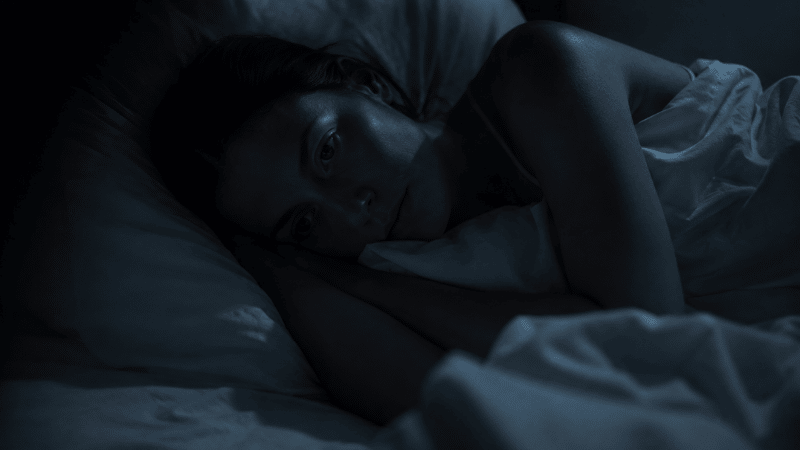
The day is done. You’ve handled everything you had to handle. And now you’re lying in the dark, supposedly resting, except your brain has decided this is the perfect moment to revisit every uncomfortable conversation from the past week, catastrophize about next Thursday, and compile a mental inventory of everything that could still go wrong.
You’re not a worrier by nature — or at least, you don’t think of yourself that way. You function fine during the day. But the moment the lights go off and the house goes quiet, something shifts. The anxiety shows up like it’s been waiting for you.
If this is your pattern, you’re not imagining it, and you’re not broken. There are specific, well-understood reasons why anxiety gets worse at night — biological ones, psychological ones, and environmental ones. And once you understand what’s actually happening, the path forward becomes much clearer than “just try to relax.”
This guide explains all of it.
Key Takeaways
- Nighttime anxiety is not random. It follows predictable patterns rooted in circadian cortisol rhythms, reduced cognitive distraction, and accumulated emotional load from the day.
- Research from UC Berkeley found that sleep deprivation increases amygdala (fear center) reactivity by up to 60% — meaning poor sleep directly creates the neurological conditions for anxiety, which then makes sleep harder the following night.
- The Anxiety and Depression Association of America estimates that anxiety affects roughly 40 million American adults, making it the most common mental health condition in the country — and nighttime anxiety is among its most frequently reported symptoms.
- Most nighttime anxiety responds well to daytime interventions more than bedtime ones. The anxiety that shows up at 11pm was largely built during the day.
- If nighttime anxiety is significantly affecting your sleep or daytime life for more than three months, it’s worth bringing in professional support — not because something is seriously wrong, but because effective help is available.
Why Anxiety Gets Worse at Night: The Four Real Reasons
1. The distractions disappear — and your brain fills the silence

During the day, your nervous system is occupied. There’s work to do, people to talk to, problems to solve, emails to skim. Even passive activities like driving or making dinner require enough low-level attention to interrupt anxious thought spirals before they get going.
At night, that scaffolding disappears. The screens go off. The house goes quiet. And the mind — which has been producing anxious content all day — suddenly has no competition for your attention.
This is why people who describe themselves as “not anxious” during the day can experience significant nighttime anxiety. The anxiety was there the whole time. The daytime structure just kept interrupting it before it could develop.
What happens next is a feedback loop: the quiet amplifies the anxious thoughts, the thoughts activate the nervous system, the physical arousal makes sleep harder, and the awareness of not sleeping adds another layer of anxiety on top. By midnight, you’re anxious about the anxiety.
2. Cortisol is doing something unexpected in the evening
Most people know cortisol as the stress hormone — the one that spikes when you’re scared or overwhelmed. What fewer people know is that cortisol also follows a daily rhythm, independent of stress.
Under normal conditions, cortisol peaks in the early morning (one of the things that helps you wake up) and then gradually declines through the day, reaching its lowest point during the middle of the night. This rhythm is protective: the nighttime cortisol trough is part of what allows the body and nervous system to rest and recover.
But here’s where it gets complicated. Chronic stress — the sustained, low-grade kind that most people are walking around with — disrupts this rhythm. Cortisol stays elevated longer into the evening, or begins its morning rise earlier than it should, or simply doesn’t drop as far. And elevated evening cortisol produces the physiological experience of anxiety: elevated heart rate, tension, alertness, a sense that something needs attention.
From the inside, this doesn’t feel like “my cortisol is high.” It feels like anxiety. It feels like worry. It feels like your brain is trying to tell you something important. But the content — the worries themselves — is partly a story your mind is generating to explain a physiological state that actually originated in your stress system hours earlier.
This is not a comforting fact. But it’s a useful one, because it shifts the focus from “how do I stop these thoughts at 11pm” to “what am I doing at 2pm and 4pm that’s setting the evening cortisol level.”
3. REM sleep debt accumulates — and emotional regulation suffers
REM sleep — the stage in which you dream, and in which your brain processes the emotional content of the day — is concentrated in the second half of the night. During REM, difficult experiences are replayed and their emotional charge is gradually reduced. This is sometimes called “overnight therapy”: the events remain in memory, but their affective sting is diminished.
When you’re chronically short on sleep, or when the second half of your night is frequently disrupted, this processing doesn’t complete. Emotional experiences from the previous day carry their full charge into the next. The emotional baseline gets heavier over time. And what arrives at night is not just today’s anxiety — it’s a backlog of unprocessed emotional material from earlier nights.
This is one of the reasons nighttime anxiety can feel disproportionate to the actual stressors in your life. The content of the worry is real. But the intensity with which it’s felt is partly amplified by accumulated REM debt.
4. The hypervigilance hangover from the day
If your day involves high-stakes decisions, sustained emotional labor, constant context-switching, or simply the relentless cognitive demand of modern work and parenting, your sympathetic nervous system has been running at a low-level elevated state for hours. By the time you get into bed, you’re asking that nervous system to stand down completely — which is not how nervous systems work.
The transition from sustained activation to genuine rest doesn’t happen on command. It happens gradually, through deliberate decompression. If that decompression doesn’t occur — if you go from a demanding evening directly into bed — the body is still physiologically “on duty” when you’re trying to sleep.
Many people describe this as feeling “tired but wired.” The exhaustion is real. The inability to switch off is also real. And the anxiety that surfaces in that state isn’t manufactured — it’s the nervous system doing exactly what it was designed to do when it hasn’t been given a clear signal that the threat period has ended.
Why Night Anxiety Hits Harder for Some People
There’s a pattern worth naming. Nighttime anxiety tends to be more pronounced in people who:
Have high-responsibility roles during the day — parents, caregivers, people in leadership positions, anyone whose job involves sustained vigilance. When you spend your day responsible for others, the nervous system doesn’t get many opportunities to genuinely disengage. By night, the habit of alertness is deeply grooved.
Use activity as their primary anxiety management strategy — staying busy, staying productive, keeping moving. This works reasonably well during the day. At night, when the activity stops, there’s nothing buffering the anxiety anymore.
Have been chronically undersleeping — because sleep deprivation directly impairs the brain’s emotional regulation circuits and amplifies amygdala reactivity. The anxiety you experience at night may be partly neurological in origin, a consequence of the previous night’s sleep loss creating the conditions for tonight’s anxiety.
Experienced a period of intense stress — a difficult life event, a sustained high-pressure period, a loss — that trained the nervous system toward heightened monitoring. The original event may have resolved, but the nervous system stayed in the pattern.
None of these are character flaws. They’re patterns. And patterns can be interrupted.
What Actually Helps Nighttime Anxiety
Here’s something that consistently surprises people: the most effective interventions for nighttime anxiety don’t happen at night.
By the time you’re lying awake at midnight, the cortisol level is already set. The emotional backlog is already built. The nervous system is already in the state it’s in. You can manage the symptoms at that point — and the tools below help with that — but the deeper work is upstream.
During the day: manage the load before it reaches the bedroom
Physical movement in the morning or early afternoon. Exercise is one of the most reliable cortisol regulators available. A 20–30 minute walk in the morning shifts the cortisol curve and improves both sleep quality and baseline anxiety in the evening. It doesn’t have to be intense. It has to happen earlier rather than later — late-evening exercise can raise cortisol at the wrong time for some people.
A genuine workday shutdown ritual. If your work bleeds into the evening — if you’re checking messages at 9pm, if there’s no clear line between the work day and the rest of the day — the nervous system doesn’t get a signal that the high-alert period has ended. Creating a deliberate closing ritual: writing tomorrow’s three priorities, closing the laptop with intention, saying “I’m done” out loud if it helps. The specifics matter less than the consistency of the signal.
Structured worry time in the early evening. This sounds strange but has solid research backing. Set aside 15 minutes between 5 and 7pm to write down your current worries and any possible next steps. When worries surface later at night, you have a genuine response: “I already gave that its time. It’s been written down. It can wait until tomorrow.” The mind’s felt need to keep processing is reduced — not eliminated, but meaningfully reduced.

In the hour before bed: create the descent
The transition from alert to resting doesn’t happen instantly. It requires a deliberate decompression period — what sleep researchers call a wind-down — that sends consistent signals to the nervous system that the day is genuinely over.
Dim the lights. Overhead lighting in the evening delays melatonin production and keeps the nervous system more activated. Switching to lamps or lowering brightness 60–90 minutes before bed is one of the simplest interventions available with meaningful sleep research behind it.
Limit screens — but especially the content. The blue light issue is real but minor compared to the content issue. News, social media, work email, and emotionally activating shows all produce cognitive and emotional arousal that takes time to settle. It’s not that you can’t use screens — it’s that what you consume in the hour before bed significantly affects the emotional state you bring to the bedroom.
Write tomorrow’s to-do list. Research from Baylor University found that spending five minutes writing a specific to-do list for tomorrow — not journaling about today, but writing tomorrow’s tasks — significantly reduced time to sleep onset. The brain can partially release the task-tracking burden when it knows the tasks are externalized.
A warm bath or shower 60–90 minutes before bed. The mechanism is thermal: the warmth causes surface blood vessels to dilate, which accelerates the drop in core body temperature that normally accompanies sleep onset. For people whose anxiety has a physical tension component, this is also one of the most effective relaxation tools available — more reliable than any supplement.
In the moment: when the anxiety arrives at 3am
Even with good daytime habits, nighttime anxiety will sometimes break through. Here’s what helps when it does.
Extended exhale breathing. When the exhale is longer than the inhale, it directly stimulates the vagus nerve and shifts the autonomic nervous system toward parasympathetic dominance. In for 4 counts, hold for 4, out for 6 or 8. Repeat 5–10 cycles. This is not a breathing exercise you do while simultaneously worrying — it requires enough attention to actually displace the thought loop, which is part of why it works.
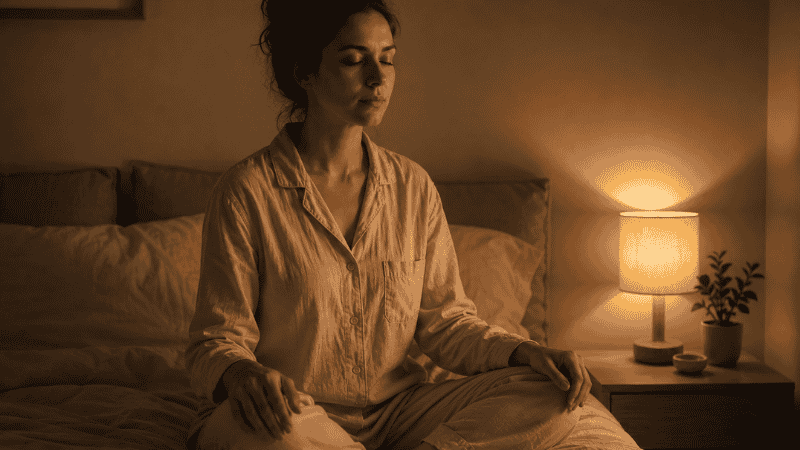
The 4am brain dump. Keep a notepad beside the bed. When thoughts are circling, write them down — not to solve them, just to move them from active working memory to paper. The act of writing externalizes the content and reduces the brain’s felt urgency to keep holding it. You’re not solving anything at 4am. You’re just filing.
Get out of bed if you’re awake for more than 20 minutes. This is uncomfortable advice and it’s correct. Lying awake in bed trains your brain to associate the bed with wakefulness and anxiety. Getting up, going somewhere dim, doing something genuinely low-stimulation, and returning to bed only when drowsy is the behavioral core of stimulus control therapy — the most evidence-supported approach to breaking the conditioned anxiety-bed association.
If You Only Have 10 Minutes Tonight
Before you get into bed, take a notepad and write two things: tomorrow’s top three tasks, and whatever is circling in your mind right now — concerns, worries, anything unresolved. Close the notebook. Dim the lights. Take five slow breaths with a longer exhale than inhale.
That’s it. The writing addresses the cognitive loop. The breathing addresses the physiological activation. The dimming begins the melatonin signal. Ten minutes, no supplements required, no perfect conditions needed.
Do this consistently for two weeks and notice whether the transition to sleep begins to feel different.
When to Get Support
Nighttime anxiety that responds to the approaches above — that improves with consistent practice over 2–3 weeks — is generally within the range of what behavioral self-management can address.
But some presentations warrant direct professional support:
- Anxiety that is significantly present during the day as well as at night — affecting work, relationships, or your ability to function
- Panic attacks at night — sudden, intense physical symptoms (racing heart, chest tightness, a sense of unreality or terror) that feel dramatically different from ordinary anxiety
- Nighttime anxiety that has persisted for more than three months despite genuine consistent effort with behavioral approaches
- Any anxiety accompanied by persistent low mood, hopelessness, or feelings that don’t lift during the day
Cognitive Behavioral Therapy for anxiety (CBT) and CBT-I (the insomnia-specific version) are both highly effective and non-pharmacological. They work. And there’s no version of this problem that is too minor to deserve support — or too severe to respond to it.
Frequently Asked Questions
Why do I get anxious at night but not during the day?
During the day, external demands and activities provide constant low-level distraction that interrupts anxious thought before it develops. At night, that distraction disappears and the mind fills the silence with whatever it’s been carrying. Simultaneously, accumulated cortisol from the day’s stress, incomplete REM emotional processing from previous nights, and a nervous system that hasn’t had a clear “stand down” signal all converge to make anxiety more likely and more intense at night than during daytime hours.
Is nighttime anxiety a sign of an anxiety disorder?
Not necessarily. Occasional nighttime anxiety — particularly during high-stress periods — is normal. It becomes more clinically significant when it occurs most nights, significantly impairs sleep or daytime function, and persists for three months or more despite behavioral management. If you’re uncertain, a brief conversation with a healthcare provider or therapist is always appropriate.
Why does my anxiety get worse when I lie down?
Lying down removes physical activity and most external stimulation simultaneously, which removes the two main daytime buffers against anxious thought. It also shifts physiological awareness inward — you become more aware of your heartbeat, your breathing, physical tension — which can trigger or amplify anxiety for people who are sensitive to internal bodily sensations. The behavioral association between lying down and anxiety can also develop over time, making the bed itself a conditioned trigger.
How do I stop anxious thoughts at night?
The most reliable immediate approach is redirection rather than suppression. Extended-exhale breathing occupies enough attention to interrupt thought loops. Writing thoughts down externally reduces the urgency to keep processing them internally. Getting out of bed when awake for more than 20 minutes prevents the conditioned anxiety-bed association from deepening. None of these eliminate the thoughts — they change your relationship to them and reduce their physiological grip.
Can anxiety at night be caused by something physical?
Yes. Hyperthyroidism causes anxiety-like symptoms including nighttime restlessness. Low blood sugar can trigger a stress hormone response that produces anxiety-like waking. Sleep apnea — which repeatedly disrupts sleep through the night — produces chronic sleep deprivation that impairs emotional regulation. Certain medications cause or worsen nighttime anxiety as a side effect. If nighttime anxiety is new, severe, or accompanied by physical symptoms, a medical evaluation is reasonable.
Does melatonin help with nighttime anxiety?
Melatonin regulates sleep timing — it signals darkness and promotes sleep onset — but it doesn’t directly address anxiety. Some people find that taking melatonin helps them fall asleep faster, which may indirectly reduce the window during which nighttime anxiety can develop. But for anxiety-driven wakefulness, the behavioral and breathing approaches described in this guide address the actual mechanism more directly than melatonin does.
The Part Nobody Usually Says
The anxiety that shows up at night is often carrying things that didn’t get space during the day. Grief that got bypassed. A decision that felt too heavy to sit with. Worry about something you’ve been too busy to look at directly.
The nighttime is uncomfortable, but it’s not without information. Sometimes the question isn’t just “how do I stop this” but “what is this trying to tell me that I haven’t made time for?”
That doesn’t mean lying awake spiraling is productive — it isn’t. But addressing nighttime anxiety fully often involves not just behavioral tools, but also making a little more room during the day for the things the nighttime is trying to surface.
The approaches in this guide help quiet the noise. What remains when the noise quiets is often worth listening to.
For the practical tools that address sleep-anxiety overlap from the sleep side, read our guide on how to sleep with anxiety. And if you’re specifically waking at the same time every night, our guide on why you keep waking up at 3am covers the conditioned arousal pattern that makes that happen.
References
- Yoo, S. S., Gujar, N., Hu, P., Jolesz, F. A., & Walker, M. P. (2007). The human emotional brain without sleep — a prefrontal amygdala disconnect. Current Biology, 17(20), R877–R878.
- Scullin, M. K., Krueger, M. L., Ballard, H. K., Pruett, N., & Bliwise, D. L. (2018). The effects of bedtime writing on difficulty falling asleep: A polysomnographic study comparing to-do lists and completed activity lists. Journal of Experimental Psychology: General, 147(1), 139–146.
- Simon, E. B., Rossi, A., Harvey, A. G., & Walker, M. P. (2020). Overanxious and underslept. Nature Human Behaviour, 4(1), 100–110.
- Anxiety and Depression Association of America. (2023). Facts and statistics about anxiety disorders. https://adaa.org/understanding-anxiety/facts-statistics
- National Institute of Mental Health. (2023). Anxiety disorders. https://www.nimh.nih.gov/health/topics/anxiety-disorders
NourishDAO publishes sleep and wellness content for informational purposes only. This article is not a substitute for professional medical advice, diagnosis, or treatment. If you are experiencing persistent anxiety or sleep difficulty, please consult a qualified healthcare provider.