
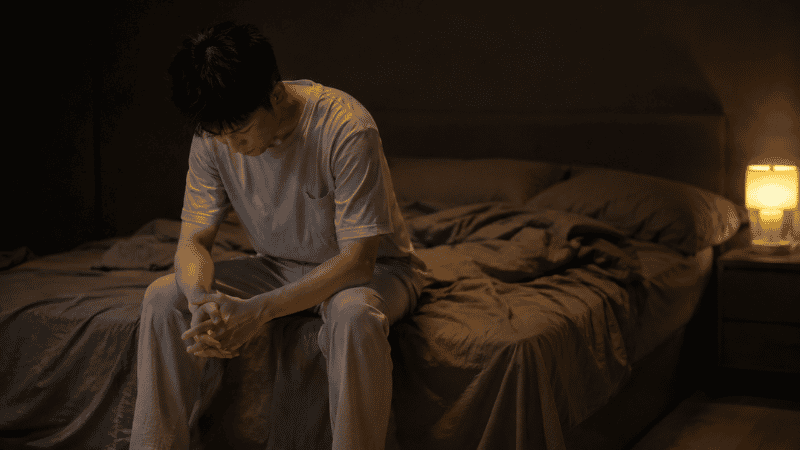
You’ve tried the deep breaths. You’ve done the “think positive thoughts” thing. You’ve told yourself that tomorrow’s meeting is probably fine, that the health thing you Googled is probably nothing, that worrying about it at midnight is genuinely useless. And you’re right — it is useless. Your brain knows this too. It just doesn’t care.
Nighttime anxiety is one of those problems where knowing the solution doesn’t help you execute the solution. “Just relax” is technically correct and almost entirely unhelpful. The anxiety doesn’t respond to logic because it’s not a logical problem — it’s a physiological state that has gotten ahead of your rational mind, and it requires physiological intervention to come back down.
The good news is that those interventions exist, they work, and most of them take less than ten minutes. The less good news is that not all of them work the same way for everyone, and the most effective ones often feel awkward or counterintuitive the first time you try them.
This guide covers the approaches with the best evidence behind them — organized by when and how to use them, with honest notes on what to expect. No supplements required. No perfect conditions needed. Just things you can actually try tonight.
Key Takeaways
- Nighttime anxiety is a physiological state, not just a thought pattern — which means the most effective interventions work on the body first, and let the mind follow.
- Extended-exhale breathing is the fastest available tool for acute nighttime anxiety, producing measurable shifts in heart rate variability within 60–90 seconds by directly stimulating the vagus nerve.
- Research published in the Journal of Experimental Psychology found that writing a to-do list for tomorrow (not journaling about today) significantly reduced time to sleep onset — one of the most practical, evidence-backed sleep interventions available.
- The 20-minute rule — getting out of bed when awake for more than 20 minutes — is counterintuitive and one of the most consistently effective behavioral interventions for anxiety-driven insomnia.
- Most nighttime anxiety is substantially built during the day. Addressing it only at bedtime is like trying to cool a room by opening a window while leaving the oven on.
First: Why Your Current Approach Isn’t Working
Before we get to the tools, it’s worth naming something directly: most of what people try for nighttime anxiety targets the wrong thing.
Trying to control the thoughts — monitoring them, arguing with them, replacing them with better ones — keeps the analytical mind engaged at exactly the moment you need it to stand down. The anxiety feeds on attention. When you focus on stopping the anxious thoughts, you are, paradoxically, giving them more of it.
Similarly, most people try to calm their anxiety at the cognitive level first: “I shouldn’t be thinking about this,” “This is irrational,” “I need to stop.” But the anxiety isn’t primarily cognitive at that point. The nervous system is already activated. The cortisol is already elevated. The heart rate is already up slightly. The body is in a mild stress response, and no amount of reasoning will talk it out of that state. You need to address the physiology first, and then the thoughts become much more manageable.
This is not a minor distinction. It changes the entire approach.
How to Calm Anxiety at Night: The Tools That Actually Work
The Extended Exhale — Start Here
If you only try one thing from this guide, try this one first. It has the fastest onset, requires no equipment, and has solid physiological backing.
The principle: when the exhale is longer than the inhale, it activates the parasympathetic nervous system through vagal stimulation. Heart rate drops. Blood pressure eases slightly. The body gets a signal that the threat period has passed. This response doesn’t require belief — it works whether or not you’re convinced it will.
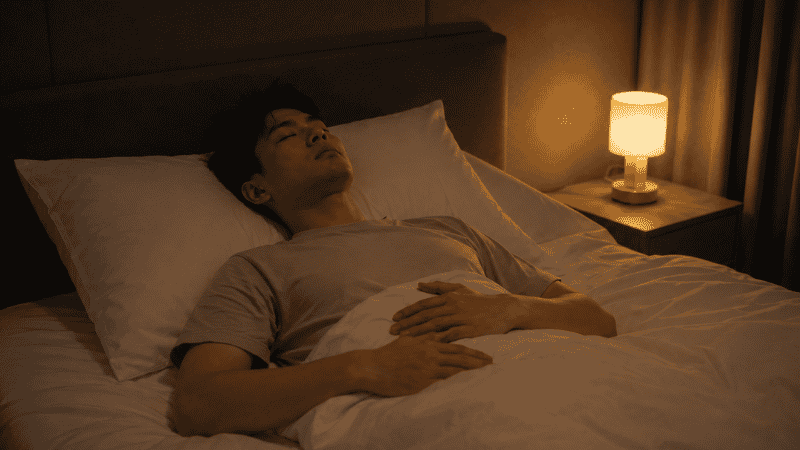
The basic version: Breathe in slowly for 4 counts, out for 6 or 8. That’s it. Repeat for 5–10 cycles. If you’re doing it correctly, you’ll notice a slight heaviness in the body around the third or fourth cycle. That’s the parasympathetic shift happening.
The 4-7-8 version (stronger, slightly more effort): Exhale completely, inhale through the nose for 4 counts, hold for 7, exhale fully through the mouth for 8. The extended hold adds a slight breath-control challenge that occupies just enough cognitive bandwidth to interrupt the thought loop, while the long exhale produces the strongest vagal response.
A note on expectations: the first time you try this in an anxious state, it may feel like it’s not working. Keep going. The effect accumulates across cycles, not within a single breath.
The Brain Dump — For the Looping Thoughts
This one gets recommended constantly and executed poorly. The typical version — journaling about your feelings — is not what works. What works is much more specific.
Research from Baylor University, published in the Journal of Experimental Psychology, compared two groups: one wrote about what they had accomplished that day, one wrote a to-do list of specific tasks for tomorrow. The to-do list group fell asleep significantly faster. The proposed mechanism: writing tomorrow’s tasks offloads them from active working memory. The brain no longer needs to keep rehearsing them to ensure they don’t get lost.
So the version that works:
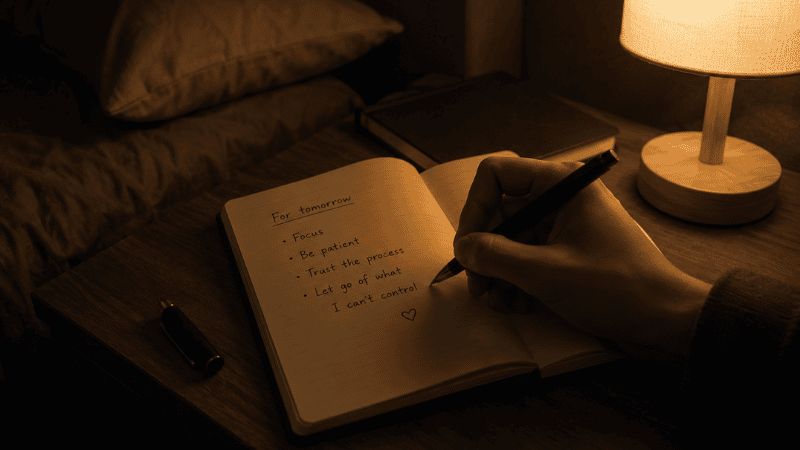
Take a small notepad (not your phone — the screen activation matters). Write tomorrow’s tasks, not today’s feelings. Be specific: “Email Sarah about the report,” not “deal with work stuff.” Include personal tasks alongside professional ones. Write until you feel the mental list exhaust itself, which usually takes 3–5 minutes.
Close the notebook. That’s the important part. The physical closing is a signal. It tells the anxious brain: these things are filed. They will be there tomorrow. You don’t need to hold them anymore.
Progressive Muscle Relaxation — For When the Anxiety Lives in Your Body
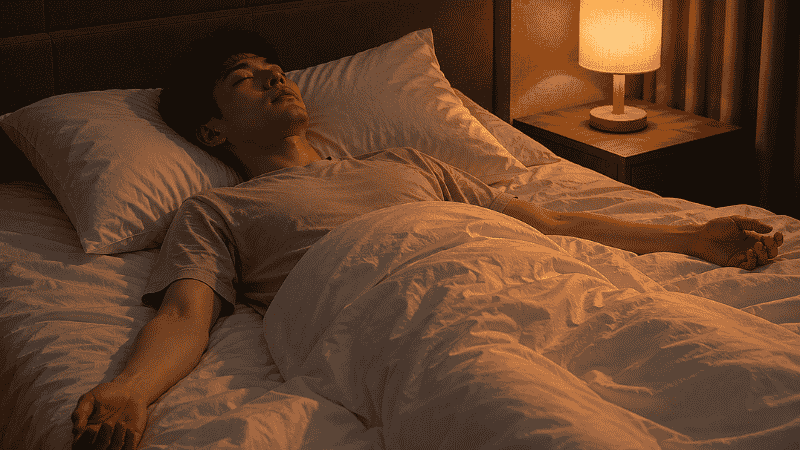
Some people experience nighttime anxiety primarily as a thought problem. Others experience it primarily as a physical one — jaw clenched, shoulders high, chest tight, stomach tense. If you’re in the second group, breathing exercises alone may not be enough. You need to address the physical holding pattern directly.
Progressive muscle relaxation (PMR) works by deliberately tensing and then releasing each muscle group, working from the feet upward. The tension-release contrast produces a relaxation response in the muscles that is deeper than what voluntary relaxation alone can achieve — because most of us have adapted to our chronic baseline tension and can no longer feel it without the contrast.
The sequence: feet (curl toes firmly) → calves → thighs → glutes → stomach → hands (clench) → forearms → upper arms → shoulders (pull up toward ears) → face (scrunch everything). For each area: tense firmly for 5 seconds, then release completely and stay with the release for 20–30 seconds before moving on.
The full sequence takes about 15–20 minutes. A shortened version focusing on the three areas where most people hold the most tension — jaw, shoulders, stomach — takes 5–7 minutes and is often enough for a meaningful shift.
One thing most guides don’t say: the release phase is where the work happens. Don’t rush through it to get to the next muscle group. Stay with the release. Let the warmth and weight settle in.
The Cognitive Defusion Technique — For When Thoughts Won’t Let Go
This comes from Acceptance and Commitment Therapy (ACT) and it’s different from anything else in this guide because it doesn’t try to stop the thoughts or change them. It changes your relationship to them instead.
When an anxious thought arrives — “What if I don’t sleep tonight,” “What if that symptom is something serious,” “What if I can’t handle tomorrow” — instead of engaging with it, trying to solve it, or suppressing it, you observe it as an object.
Literally: “I’m having the thought that I won’t sleep tonight.” Not “I won’t sleep tonight” — “I’m having the thought that I won’t sleep tonight.” The slight distance this creates between you and the content of the thought is genuinely meaningful. The thought loses some of its urgency. It becomes something your mind produced, rather than something that’s necessarily true or urgent.
You can take this further: imagine the thought written on a piece of paper, floating downstream. Or on a sign being carried past by someone walking by. The visual isn’t the point — the point is the detachment. You’re watching thoughts, not inhabiting them.
This feels strange the first time. Most people who find it useful say the same. Give it a genuine try across 2–3 nights before deciding it’s not for you.
The Physical Reset — When Everything Else Fails
Sometimes the anxiety is high enough that none of the above is making a dent. The body is in a stress response that isn’t going to be talked down or breathed down. In that case: get up.
Cold water on the face and wrists activates the dive reflex — a parasympathetic response that slows the heart rate. It’s abrupt, a little shocking, and often more effective than 20 minutes of deep breathing for acute anxiety spikes. Splash your face, run cold water over the inside of your wrists, dry off.
Then: sit somewhere dim and quiet. Not in bed. Make a warm non-caffeinated drink if it helps — the act of making it is itself a small behavioral anchor, something concrete to do while the nervous system settles. Read something genuinely unengaging. Return to bed when you feel genuinely drowsy, not just when you think you should.
This feels like the wrong thing to do when you’re exhausted and desperately want to sleep. It is also frequently the most effective thing available in that moment.
What to Do Before Bed to Prevent the Anxiety Arriving at All
The interventions above address anxiety that’s already arrived. These address the setup — reducing how often and how intensely it shows up in the first place.
The shutdown ritual. If there’s no clear signal to your nervous system that the workday has ended, it doesn’t end. Emails at 9pm, problem-solving conversations at 10pm, planning and worrying carried right up to lights-out — all of these keep the sympathetic system active past the point where it needs to be. A deliberate closing sequence — writing tomorrow’s tasks, closing devices with intention, a brief transition activity — sends a consistent signal that the high-alert period is over.
Structured worry time earlier in the evening. Set 15 minutes between 5pm and 7pm to write down whatever you’re currently worried about and any possible next steps. This is not a solution to the worries. It’s a containment strategy: when anxiety surfaces at midnight, you have a genuine response available — “I already gave that its time.” Many people find this dramatically reduces the urgency of nighttime worry content.
Dimming the environment. Bright overhead lighting in the hour before bed delays melatonin production and keeps the nervous system more activated than it needs to be. Switching to lamps, reducing screen brightness, avoiding news and emotionally activating content — these create a gradual environmental descent that makes the physiological shift to rest easier.
The warm bath. This one comes up in sleep guides constantly and deserves its reputation. A warm bath (around 40–42°C / 104–108°F) taken 60–90 minutes before bed accelerates core temperature drop, which is one of the physiological triggers for sleep onset. For people whose anxiety has a physical tension component, it’s also one of the most effective muscle relaxants available without a prescription.
If You Only Have 10 Minutes Tonight
Here’s the sequence: dim your room, take your notepad, write tomorrow’s tasks until the list feels empty, close the notebook. Then get into bed and do 10 cycles of 4-in, 6-out breathing before you try to sleep.
That covers the cognitive loop (the writing), the environmental signal (the dimming), and the physiological activation (the breathing). Ten minutes, no equipment, no preparation. Do this every night for two weeks and pay attention to whether the transition to sleep feels different.
When the Anxiety at Night Isn’t Responding
If you’ve genuinely practiced the approaches above consistently for 3–4 weeks and nighttime anxiety remains significantly disruptive, there are a few things worth considering.
First: the daytime load may be too heavy for any bedtime intervention to fully address. Anxiety that is present during the day as well as at night, anxiety that significantly affects your ability to function, anxiety that comes with low mood, hopelessness, or physical symptoms — this warrants direct support, not more sleep hygiene adjustments.
Second: the anxiety may be sustaining a conditioned arousal pattern around the bed — where the act of getting into bed itself triggers anxiety because the bed has become associated with lying awake. This is psychophysiological insomnia, and CBT-I (Cognitive Behavioral Therapy for Insomnia) is specifically designed for it. It works. It’s more effective than sleep medication in long-term outcomes, and it’s available through therapists and validated digital programs.
Consider speaking with a healthcare provider or therapist if:
- Nighttime anxiety is significantly present during the day as well
- It has persisted for more than three months despite genuine effort
- It comes with panic attacks — sudden, intense physical symptoms including chest tightness, racing heart, a sense of unreality or danger
- It’s accompanied by persistent low mood that doesn’t lift
Frequently Asked Questions
How do I calm severe anxiety at night?
For acute high anxiety: cold water on the face and wrists (the dive reflex), followed by getting out of bed, sitting somewhere dim and quiet, and doing extended-exhale breathing (in for 4, out for 8) until the physiological peak passes. Staying in bed during a spike of severe anxiety tends to deepen the bed-anxiety association and makes the next night harder. Getting up, managing the spike outside of bed, and returning when drowsy is both physiologically and behaviorally the better approach.
What is the fastest way to calm anxiety at night?
Extended-exhale breathing is the fastest intervention with the most consistent evidence — effects begin within 60–90 seconds because the vagal stimulation directly slows heart rate. The 4-7-8 method (inhale 4, hold 7, exhale 8) produces a stronger response than simple slow breathing for most people. Cold water on the face produces an even more abrupt reset but is harder to do in bed.
Why does my anxiety get worse when I try to sleep?
Because lying down removes the external stimulation and activity that interrupts anxious thought during the day. The silence creates space for the anxiety that’s been building all day. Additionally, if you’ve had enough nights of lying awake with anxiety, the bed itself may have become a conditioned trigger — your nervous system anticipates anxiety when you get into bed because that’s the pattern it’s learned. This conditioned response is real and is one of the primary targets of CBT-I.
Does melatonin help with nighttime anxiety?
Melatonin regulates sleep timing — it signals darkness and promotes sleep onset — but it doesn’t address anxiety directly. For some people, taking melatonin helps them fall asleep faster, which reduces the window during which nighttime anxiety can develop. But for anxiety that’s already active, melatonin won’t calm it. The approaches in this guide address the anxiety itself; melatonin addresses a different mechanism.
Is it normal to have anxiety every night?
Occasional nighttime anxiety, particularly during high-stress periods, is common and expected. Anxiety most nights that significantly disrupts sleep or causes distress is worth taking seriously — not because it signals something wrong with you, but because effective help is available and it doesn’t have to stay this way.
How long does it take for these techniques to work?
The breathing and cold water approaches can produce noticeable effects within minutes on the first try. The brain dump and PMR typically take 3–5 nights of practice before they feel natural and produce reliable results. The overall pattern of nighttime anxiety usually begins to shift meaningfully within 2–3 weeks of consistent practice — not because any single night was dramatically different, but because the nervous system is gradually recalibrating.
One More Thing
If you’ve been living with nighttime anxiety for a while, there may be a part of you that has started to dread bedtime. That dread is its own layer of the problem — the anticipatory anxiety about the anxiety — and it’s worth naming directly.
You’re not failing at sleep. You’re dealing with a nervous system that has gotten into a pattern, for understandable reasons, and that can be helped out of it. The approaches in this guide work for most people most of the time, when applied consistently and with realistic expectations.
Tonight doesn’t have to be perfect. It just has to be slightly different from the approach that hasn’t been working.
For a deeper understanding of why nighttime anxiety happens in the first place, read our guide on why you get anxious at night. And if the broader sleep-anxiety connection is what you’re navigating, our guide on how to sleep with anxiety covers the full behavioral framework.
References
- Scullin, M. K., Krueger, M. L., Ballard, H. K., Pruett, N., & Bliwise, D. L. (2018). The effects of bedtime writing on difficulty falling asleep: A polysomnographic study comparing to-do lists and completed activity lists. Journal of Experimental Psychology: General, 147(1), 139–146.
- Haghayegh, S., Khoshnevis, S., Smolensky, M. H., Diller, K. R., & Castriotta, R. J. (2019). Before-bedtime passive body heating by warm shower or bath to improve sleep: A systematic review and meta-analysis. Sleep Medicine Reviews, 46, 124–135.
- Toussaint, L., Nguyen, Q. A., Roettger, C., et al. (2021). Effectiveness of progressive muscle relaxation, deep breathing, and guided imagery in promoting psychological and physiological states of relaxation. Evidence-Based Complementary and Alternative Medicine, 2021, 5924040.
- Hayes, S. C., Strosahl, K. D., & Wilson, K. G. (2011). Acceptance and Commitment Therapy: The Process and Practice of Mindful Change (2nd ed.). Guilford Press.
- National Institute of Mental Health. (2023). Anxiety disorders. https://www.nimh.nih.gov/health/topics/anxiety-disorders
NourishDAO publishes sleep and wellness content for informational purposes only. This article is not a substitute for professional medical advice, diagnosis, or treatment. If you are experiencing persistent anxiety or sleep difficulty, please consult a qualified healthcare provider.