

The day was fine. Not great, not terrible — fine. You got through it. And now you’re lying in bed, which should be the easy part, except your brain has apparently been saving things up all day and is ready to present them now, in the dark, at 10:47pm.
It’s not always dramatic anxiety. Sometimes it’s just the low hum of things you didn’t finish, conversations you’re replaying, a vague sense that something needs attention that you can’t quite identify. Other times it’s more acute — a specific worry that keeps circling back, or that particular flavor of dread where you’re anxious about being anxious, watching yourself not sleep, knowing tomorrow is coming.
Anxiety before bed is extraordinarily common. According to the Anxiety and Depression Association of America, nearly 40 million American adults live with anxiety disorders — and disrupted sleep is among the most frequently reported symptoms. But even beyond clinical anxiety, millions more experience the milder version: the ordinary, modern phenomenon of a mind that doesn’t know how to stop when the day does.
The good news is that this pattern, however entrenched it feels, is largely behavioral. And behavioral patterns can be changed.
Key Takeaways
- Pre-sleep anxiety typically isn’t caused by bedtime itself — it’s the accumulated emotional and cognitive load of the day finally finding space to surface when external demands disappear.
- The 30-30-3 rule is a useful clinical benchmark: if it takes 30+ minutes to fall asleep, or you’re awake 30+ minutes in the night, 3+ nights per week, the pattern warrants attention.
- Stimulus control — getting out of bed when you can’t sleep — is counterintuitive and one of the most evidence-backed behavioral interventions available for anxiety-driven insomnia.
- Research from Baylor University published in the Journal of Experimental Psychology found that writing a specific to-do list for tomorrow significantly reduced time to sleep onset compared to journaling about the day.
- Trying to force sleep makes it harder. The pressure activates the fight-or-flight response, which is the physiological opposite of what sleep requires.
Why Anxiety Before Bed Feels So Much Worse Than Daytime Anxiety
During the day, you’re occupied. Tasks, conversations, decisions, movement — all of this provides constant low-level distraction that interrupts anxious thought before it can develop into a full spiral. The busyness isn’t just productivity. It’s also, inadvertently, a form of emotional management.
When the day ends and the structure falls away, the emotional content that’s been buffered all day suddenly has nowhere to go except into your awareness. The worry that got interrupted seventeen times during the day by emails and meetings now has your full, undivided attention. In a dark, quiet room with nothing else demanding your focus, the mind fills the silence with whatever it’s been carrying.
This is why people who describe themselves as “not particularly anxious” during the day can experience significant pre-sleep anxiety. The anxiety wasn’t absent — it was just being outcompeted by external demands. Take those away, and here it is.
There’s also a physiological dimension that’s easy to miss. Your nervous system has been in a state of sustained activation throughout the day — low-level stress responses, decision-making load, social demands. By the time you get into bed, you’re asking that system to stand down immediately and completely. That’s not how nervous systems work. The transition from sustained activation to genuine rest requires a deliberate decompression period that most people skip entirely.
The Anxiety-Insomnia Cycle: How It Gets Entrenched
Occasional anxiety before bed is uncomfortable but manageable. What turns it into a persistent problem is what happens next.
After enough nights of lying awake with pre-sleep anxiety, your nervous system begins to anticipate it. The bed — which should be associated with rest — becomes associated with wakefulness, worry, and frustration. Eventually, getting into bed itself becomes a trigger for anxiety. You’re not just anxious before bed because of what happened during the day; you’re anxious because you’ve learned, through repeated experience, that this is where anxiety lives.
This conditioned arousal pattern is one of the primary targets of CBT-I (Cognitive Behavioral Therapy for Insomnia). It’s not a character flaw or a weakness. It’s a learned association — and learned associations can be unlearned with the right approach, consistently applied.
The other layer that develops is anticipatory anxiety: dreading bedtime because you’re expecting the anxiety. You spend the evening half-consciously bracing for it. By the time you actually get into bed, you’re already activated — which confirms the expectation and deepens the association.
Recognizing this cycle is important because it explains why trying harder to sleep never helps. The effort itself is activation. The monitoring of whether you’re falling asleep is activation. You cannot think your way out of a physiological state. You need to address the physiology.
What Actually Helps: Building a Buffer Between Day and Bed
The most effective interventions for anxiety before bed don’t start at bedtime. They start an hour or two earlier — in the space between the end of the day’s demands and the attempt to sleep.

Create a genuine transition — not just a wind-down
There’s a difference between “I stopped working and watched TV for an hour” and a real decompression. Television, particularly anything with news, drama, or stimulating content, maintains cognitive activation even while the body is resting. The nervous system is still processing — it’s just processing someone else’s conflict and urgency instead of your own.
A genuine transition involves activities that are not just passive but actually calming: gentle movement (slow yoga, a short walk), something with your hands (simple cooking, tidying), music without lyrics, a warm bath or shower. The specific activity matters less than what it’s not — not stimulating, not demanding, not involving a screen that’s pulling for your attention.
The warm bath deserves particular mention. Research published in Sleep Medicine Reviews found that a warm bath taken 60–90 minutes before bed significantly improved both subjective and objective sleep quality. The mechanism is thermal: the warmth dilates surface blood vessels, accelerating the core temperature drop that is one of the body’s natural sleep-onset signals. For people whose anxiety has a physical component — tension held in the body — it’s also one of the most effective muscle relaxants available without a prescription.
Write tomorrow’s tasks, not today’s feelings
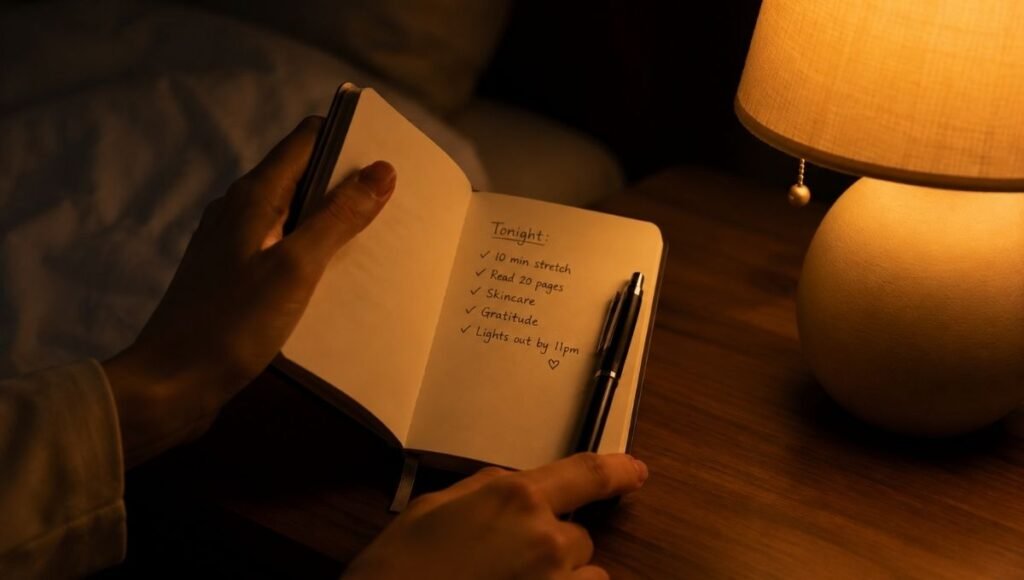
This recommendation comes with research backing that surprises most people. A study from Baylor University, published in the Journal of Experimental Psychology, compared people who spent five minutes before bed journaling about what they’d accomplished that day versus people who wrote a specific to-do list of tomorrow’s tasks. The to-do list group fell asleep significantly faster.
The reasoning: when you write tomorrow’s tasks down in specific, concrete terms, you offload them from active working memory. The brain no longer needs to keep rehearsing them to ensure they won’t be forgotten. You’re telling the nervous system: these are filed. They will be there in the morning.
The version that works is specific: “Email Marcus the revised draft,” “Call the insurance company before noon,” “Pick up prescription.” Not vague: “deal with work,” “sort out health thing.” The brain trusts the concrete. It doesn’t trust the general.
Close the notebook when you’re done. The physical act of closing it matters — it’s a signal, and signals are what the nervous system responds to.
Give your worries their time — before bed
Structured worry time is one of the more counterintuitive techniques in this space, and one of the most consistently useful. The idea: set aside 15 minutes in the early evening — between 5pm and 7pm is ideal — to write down your current worries and any possible next steps. Then close the notebook.
When worries surface later at night, you have a genuine and honest response available: “I already gave that its time today. It’s written down. It can wait until morning.”
This isn’t suppression. You’re not telling yourself not to worry. You’re telling yourself you already did, and you’ll do it again tomorrow. The mind’s felt urgency to process the worry is reduced — not eliminated, but meaningfully reduced — because the content has been acknowledged and externalized.
At Bedtime: What to Do When the Anxiety Arrives Anyway
Even with a good transition routine, anxiety before bed will sometimes break through. Here’s what to do when it does.
Don’t try to force sleep
This is genuinely difficult advice because the impulse to try harder when something isn’t working is deeply human. But sleep is one of the few things where effort actively works against the goal. Trying to make sleep happen activates the sympathetic nervous system — the fight-or-flight response — which is the physiological opposite of what sleep requires.
The reframe that helps: your goal right now is not to fall asleep. Your goal is to create the conditions in which sleep can happen. Rest without sleep is still rest. Your body benefits from lying quietly even when the brain isn’t fully offline. Removing the demand for sleep removes the activation that the demand creates.
Use extended-exhale breathing
When the exhale is longer than the inhale, it activates the vagus nerve and shifts the autonomic nervous system toward parasympathetic dominance — the rest-and-digest state. Heart rate slows. Blood pressure eases. The body gets a physiological signal that the threat period has ended.
In for 4 counts, out for 6 or 8. Repeat 8–10 cycles. The effect accumulates across cycles, not within a single breath — so give it time before judging whether it’s working.
Turn the clock away
Looking at the clock when you can’t sleep activates an immediate calculation: how much time has passed, how much sleep remains, how impaired you’ll be tomorrow. This is pure activation, reliably counterproductive. Turn the clock to face the wall. Put your phone in another room, or face-down and out of reach. The time genuinely is not useful information at 11pm when your goal is to sleep.
Get out of bed at 20 minutes
If you’ve been awake and anxious for more than 20 minutes, get out of bed. Go somewhere dim and quiet. Do something genuinely low-stimulation — read something unengaging, sit with a warm drink, practice slow breathing. Return to bed only when you feel genuinely drowsy.
This is the behavioral core of stimulus control therapy, and it addresses the conditioned arousal pattern directly. Every time you lie awake in bed for an extended period, you deepen the association between bed and wakefulness. Every time you get up, do something calm, and return when drowsy, you rebuild the association between bed and sleep.
It feels wrong. You’re exhausted and you want to sleep, not wander around your house at midnight. Do it anyway. Consistently, over 2–3 weeks, it changes the pattern.
If You Only Have 10 Minutes Before Bed Tonight

Dim your lights. Take a notepad and write tomorrow’s specific tasks until the list feels empty — 3 to 5 minutes. Close the notebook. Get into bed and do 10 cycles of slow extended-exhale breathing before you try to sleep.
That’s it. The task list addresses the cognitive loop. The dimming begins the melatonin signal. The breathing addresses the physiological activation. None of it requires perfect conditions or elaborate preparation. Do this consistently for two weeks and pay attention to whether the pre-sleep period begins to feel different.
When Pre-Sleep Anxiety Needs More Than Self-Help
Behavioral self-management works for most people with mild-to-moderate pre-sleep anxiety. But there’s a threshold at which professional support is not just helpful but genuinely necessary.
The 30-30-3 rule is a useful clinical marker: if it takes you 30 or more minutes to fall asleep, or you’re awake for 30 or more minutes in the middle of the night, on 3 or more nights per week — that pattern meets the threshold for clinical attention.
Consider speaking with a healthcare provider or therapist if:
- Pre-sleep anxiety has persisted for more than three months despite consistent behavioral effort
- Anxiety is significantly present during the day — affecting work, relationships, daily function
- You experience panic attacks, either at night or during the day
- The anxiety comes with persistent low mood or hopelessness that doesn’t lift
CBT-I is the most evidence-based non-drug treatment for anxiety-driven insomnia and is more effective than sleep medication in long-term outcomes. It’s available through therapists trained in sleep medicine and increasingly through validated digital programs. If this pattern has been running for months, it’s worth knowing that effective help exists and works.
Frequently Asked Questions

Why do I get anxiety before bed every night?
Pre-sleep anxiety typically follows a predictable pattern: the external demands and distractions of the day have been managing emotional content that surfaces when those demands disappear. When the environment goes quiet and there’s nothing left competing for attention, whatever you’ve been carrying — worries, unresolved stress, things left undone — fills the space. It’s not that bedtime creates the anxiety; it’s that bedtime is the first moment it has room to fully emerge.
How do I stop anxiety before bed?
The most effective approach addresses both the transition (what happens in the hour before bed) and the bedtime moment itself. Building a genuine decompression buffer — warm bath, task list written, structured worry time earlier in the evening — reduces how much anxiety arrives at bedtime. For anxiety that arrives anyway: extended-exhale breathing, no clock-watching, and the willingness to get out of bed rather than lying awake.
Why is my anxiety worse at night than during the day?
Because daytime structure provides constant interruption for anxious thought. Tasks, conversations, and demands break up the thought spirals before they develop. At night, those interruptions are gone. Simultaneously, the nervous system hasn’t had a clear signal that the high-demand period has ended — which keeps arousal elevated past the point where sleep can occur easily.
Does anxiety before bed mean I have an anxiety disorder?
Not necessarily. Anxiety before bed exists on a spectrum from the entirely normal (occasional pre-sleep worry during high-stress periods) to the clinically significant (persistent disruption affecting daily function). The 30-30-3 benchmark is a reasonable guide: if the pattern is occurring most nights for an extended period and significantly affecting your sleep or next-day functioning, it’s worth raising with a healthcare provider or therapist.
What is the best thing to do when you can’t sleep due to anxiety?
Get out of bed after 20 minutes. Go somewhere dim. Do something genuinely low-stimulation. Use extended-exhale breathing to bring the physiological activation down. Return to bed when you feel genuinely drowsy — not when you think you should, but when you actually feel it. This is less satisfying than lying still and hoping sleep arrives, and it works considerably better.
Can anxiety before bed go away on its own?
Sometimes, when the underlying stressor resolves. But when pre-sleep anxiety has been running for weeks or months, it often develops its own self-sustaining logic — conditioned arousal, anticipatory anxiety, the bed-wakefulness association — that persists even after the original trigger has passed. At that point, behavioral intervention (specifically the approaches in this guide, or structured CBT-I) is more effective than waiting.
The Thing About Bedtime
Bedtime has a strange quality: it’s when you’ve finally done everything you needed to do, and your reward is lying in the dark with your thoughts. For people with pre-sleep anxiety, that reward starts to feel like a punishment.
It doesn’t have to stay that way. The bed-anxiety association isn’t permanent. The habit of dreading sleep isn’t a fixed feature of who you are. These patterns developed over time through repeated experience, and they can be changed through different repeated experiences — the same mechanism, working in the other direction.
Give the approaches in this guide a genuine trial across two to three weeks. Not a perfect trial — a consistent one. That’s what moves the needle.
For the complete toolkit of in-the-moment techniques for calming anxiety at night, read our guide on how to calm anxiety at night. And if you’ve ever wondered why the anxiety is so much worse at night specifically, our guide on why you get anxious at night explains the neuroscience behind the pattern.
References
- Scullin, M. K., Krueger, M. L., Ballard, H. K., Pruett, N., & Bliwise, D. L. (2018). The effects of bedtime writing on difficulty falling asleep: A polysomnographic study comparing to-do lists and completed activity lists. Journal of Experimental Psychology: General, 147(1), 139–146.
- Haghayegh, S., Khoshnevis, S., Smolensky, M. H., Diller, K. R., & Castriotta, R. J. (2019). Before-bedtime passive body heating by warm shower or bath to improve sleep: A systematic review and meta-analysis. Sleep Medicine Reviews, 46, 124–135.
- Anxiety and Depression Association of America. (2023). Facts and statistics about anxiety disorders. https://adaa.org/understanding-anxiety/facts-statistics
- Morin, C. M., & Benca, R. (2012). Chronic insomnia. The Lancet, 379(9821), 1129–1141.
- Harvey, A. G. (2002). A cognitive model of insomnia. Behaviour Research and Therapy, 40(8), 869–893.
NourishDAO publishes sleep and wellness content for informational purposes only. This article is not a substitute for professional medical advice, diagnosis, or treatment. If you are experiencing persistent anxiety or sleep difficulty, please consult a qualified healthcare provider.