
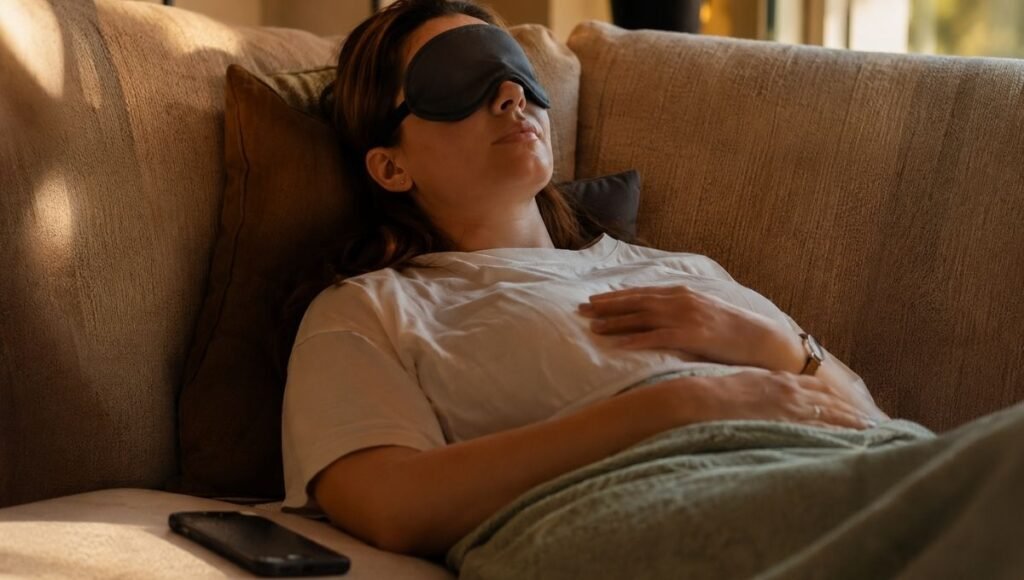
There’s a particular kind of afternoon that most people know well. It’s around 2pm. You’ve eaten lunch. Your screen is blurring slightly at the edges. The words you’re reading are landing but not quite sticking. You’re not unwell — you’re just done, in a way that coffee hasn’t been fixing reliably since 11am.
And somewhere in your brain, you know that a nap would help. But you also know, or think you know, that if you lie down now you’ll either wake up in three hours feeling worse than before, or you’ll be staring at the ceiling at midnight wondering why you can’t sleep.
So you make another coffee, scroll something you won’t remember, and white-knuckle your way through the afternoon.
Here’s what the research actually says: done correctly, a short nap won’t ruin your night — and for people carrying any sleep debt, it may be the most effective non-pharmaceutical tool available for afternoon cognitive performance. The operative phrase is “done correctly.” The length, timing, and a handful of other variables determine whether a power nap leaves you refreshed or groggy. Get them right, and it works reliably. Get them wrong, and you’ll confirm every bad story you’ve ever told yourself about napping.
This guide covers exactly how to get them right.
Key Takeaways
- The optimal power nap length for most adults is 10–20 minutes — long enough to access N2 sleep (restorative light sleep) but short enough to avoid slow-wave deep sleep, which produces grogginess on waking.
- A NASA study on military pilots found that a 26-minute nap improved cognitive performance by 34% and alertness by 100% — making it one of the most cited pieces of nap research in sleep medicine.
- The best window for a power nap is early-to-mid afternoon (12pm–2pm), aligned with the natural post-lunch dip in the circadian rhythm — not as a compensatory response to a bad night, but as a scheduled maintenance window.
- The coffee nap — drinking a cup of coffee immediately before a 20-minute nap — has research support for producing greater alertness than either coffee or a nap alone, because caffeine’s peak effect arrives exactly when you wake up.
- People with chronic insomnia should approach napping differently — daytime napping reduces sleep pressure and can worsen nighttime sleep difficulty; the guidance for this group is specific and covered below.
Why Power Naps Work: The Sleep Science

Understanding the mechanism changes how you use the tool.
Sleep is not binary — it doesn’t switch from “awake” to “asleep” like a light. It progresses through stages, each with different neurological functions and different effects on how you feel when you emerge from them.
The stages relevant to napping:
N1 (Stage 1): The transition into sleep. Lasts 1–5 minutes. You may still be partially aware of your surroundings. Emerging from N1 produces no grogginess but also limited restorative benefit.
N2 (Stage 2): Consolidated light sleep. Typically begins 5–10 minutes after sleep onset. Heart rate slows, body temperature drops, and the brain begins producing sleep spindles — bursts of neural activity associated with memory consolidation. This is the target stage for a power nap: restorative, and you emerge from it feeling genuinely refreshed rather than sluggish.
N3 (Slow-wave / deep sleep): Begins approximately 20–30 minutes after sleep onset in most adults. This is the most physically restorative stage — growth hormone release, immune function, tissue repair — but waking from it produces significant sleep inertia (the groggy, disoriented, “where am I” feeling that can last 15–30 minutes and makes the nap feel like a net negative).
The goal of a power nap is to stay in N2 and wake before entering N3. That’s why the timing matters so much. A 10–20 minute nap with an alarm means you spend almost entirely in N2. A 30-minute nap without an alarm can easily slide into N3 — and that’s where the grogginess comes from that puts people off napping entirely.
How Long Should a Power Nap Be?
Different durations produce meaningfully different effects:
10–20 minutes — The Classic Power Nap
Best for: Alertness, mood, cognitive performance, afternoon energy What happens: You reach N2 sleep and spend the majority of the nap in it. You wake in the lightest phase, feeling genuinely refreshed within a few minutes. Sleep inertia risk: Very low. This is the right choice for most people, most of the time.
20–30 minutes — The Extended Recovery Nap
Best for: People with significant sleep debt from the previous night What happens: More time in N2, possible brief entry into early N3. Benefits are greater, but so is the risk of waking mid-cycle with grogginess. Sleep inertia risk: Low-to-moderate. Set an alarm without question.
90 minutes — The Full Sleep Cycle Nap
Best for: People who need physical recovery (illness, heavy training, extreme sleep debt) What happens: One complete sleep cycle — N1, N2, N3, REM — followed by a natural light-sleep phase that makes waking easier. You emerge refreshed rather than groggy because you’ve surfaced at the end of the cycle rather than the middle of it. Sleep inertia risk: Low if the 90 minutes completes cleanly, high if the alarm interrupts mid-cycle. The catch: 90 minutes is long enough to meaningfully reduce sleep pressure for the night ahead. Not appropriate as a regular practice unless you’re dealing with significant sleep debt or illness.
Over 30 minutes but under 90 minutes — The Problem Zone
This is where most of the bad nap experiences come from. Long enough to enter deep sleep, not long enough to complete a cycle. High sleep inertia risk, significant sleep pressure reduction. If you’re going to nap longer than 20 minutes, either stop at 20 or commit to 90.
When to Take a Power Nap: The Timing Window
The ideal nap window is aligned with the natural dip in your circadian rhythm — a physiological slowing that occurs approximately 6–8 hours after your wake time, independent of what you ate for lunch (the “post-lunch dip” is real, but it would happen even if you hadn’t eaten).
For someone who wakes at 6:30am, this window is approximately 12:30–2pm. For someone who wakes at 7:30am, it shifts to 1:30–3pm.
Napping after 3pm (for standard schedules) risks meaningful interference with nighttime sleep — not because it directly causes insomnia, but because it reduces the sleep pressure (adenosine accumulation) that makes falling asleep at your target bedtime feel natural. The later the nap, the less sleep pressure remains by bedtime.
The exception: Night shift workers, people with significantly delayed sleep phases, and those dealing with acute sleep deprivation may nap at different times that serve their specific schedules. The principle remains the same — nap earlier relative to your main sleep period rather than closer to it.
How to Take a Power Nap: The Step-by-Step Protocol

Step 1: Pick your window (not too late)
For standard schedules: somewhere between noon and 2:30pm. Earlier is generally safer for nighttime sleep. If you’re uncertain, earlier.
Step 2: Set an alarm — always
This is non-negotiable. Set it for 20 minutes from now, not from when you fall asleep. Most people take 5–10 minutes to fall asleep, which means the alarm goes off around the 10–15 minute mark of actual sleep — comfortably in N2, well before N3.
If you’re an unusually quick sleep-onset person, set it for 15 minutes. If you regularly take 15–20 minutes to fall asleep, set it for 30 minutes total (20 minutes of actual sleep plus your typical onset time).
Step 3: Consider the coffee nap
Drink a cup of coffee or a shot of espresso immediately before lying down. This sounds counterintuitive because caffeine keeps you awake — but caffeine’s mechanism (blocking adenosine receptors) requires 20–30 minutes to take full effect. By the time you wake from your nap, the caffeine is just beginning to work, stacking on top of the alertness the nap itself has produced.
Research on the coffee nap — including a study published in Psychophysiology — found that it produced greater alertness and better performance on cognitive tests than either coffee or a nap alone. The effect is real and the protocol is simple: drink, lie down, set alarm, sleep.
Note: this only works with caffeinated coffee or tea. Decaf does not produce the timing effect.
Step 4: Reduce light and noise — but don’t wait for perfect conditions
Darkness and quiet are helpful but not required. An eye mask helps if you can’t darken the space. Earplugs or ambient noise help if the environment is unpredictably loud. White noise through earphones is one of the most effective tools for falling asleep in a less-than-ideal environment.
If perfect conditions aren’t available, don’t let that stop you from napping. Research on napping in imperfect environments (airplane seats, office chairs, car passenger seats) shows meaningful benefits even without full sleep onset — passive rest, even without unconsciousness, reduces physiological fatigue.
Step 5: Give yourself 5–10 minutes after waking before demanding full performance
Even from a well-timed 20-minute nap, there’s a brief period of mild sleep inertia — a minute or two of slight haziness that resolves quickly. If you have something immediately demanding (a presentation, a call you need to be fully sharp for), factor in 5–10 minutes of transition time. Step outside briefly if possible, splash cool water on your face, get moving. The residual haziness clears faster with mild physical activity.
The Coffee Nap in Practice
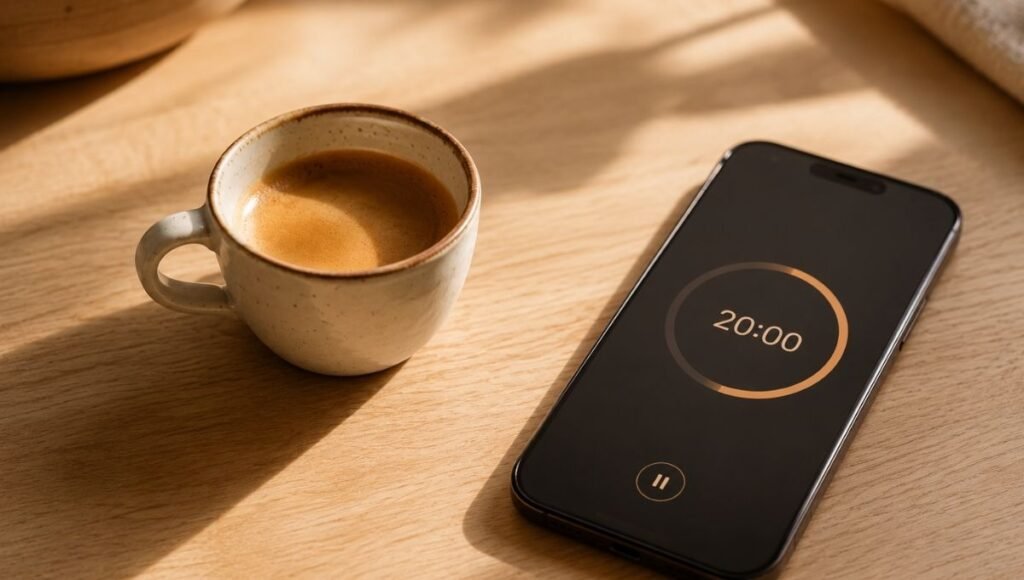
This is worth expanding because it’s underused and works reliably:
- Make your coffee (or have it ready)
- Drink it in the five minutes before you lie down — one standard cup, 80–100mg caffeine
- Set your alarm for 20 minutes
- Lie down, close your eyes, relax
- When the alarm goes off, caffeine is peaking — stand up, move, go
The nap part produces the restoration; the caffeine part provides the additional alertness boost at exactly the right moment. It’s not a hack — it’s a genuine physiological stack that has been studied and validated.
Power Napping and Insomnia: The Important Exception
Everything above applies to people who sleep reasonably well at night and want to optimize their afternoon performance or manage occasional sleep debt.
If you have chronic insomnia — difficulty falling asleep or staying asleep most nights for more than three months — the guidance is different, and it’s worth stating clearly:
Daytime napping can worsen chronic insomnia. Here’s why: sleep pressure (the accumulating drive to sleep, driven by adenosine) is your most reliable natural ally for falling asleep at night. Every minute you sleep during the day reduces that pressure. For someone whose nighttime sleep is already fragile, reducing sleep pressure by napping during the day can be enough to tip the balance — making it genuinely harder to fall asleep or stay asleep at night, and deepening the insomnia cycle.
The clinical guidance for chronic insomnia sufferers:
- Avoid napping during active treatment with CBT-I (Cognitive Behavioral Therapy for Insomnia) — the sleep restriction protocol specifically requires accumulating sleep pressure
- If you feel you must nap for safety reasons (driving, dangerous work), limit it to 10 minutes maximum and before 1pm
- If napping is not making your nights worse, a very brief early nap may be acceptable — but track the effect carefully
This exception is important because the people who most desperately want to nap (the chronically overtired) are sometimes the people for whom napping will make the underlying problem worse. Understanding this changes the recommendation.
When Power Naps Help Most
Shift workers: People working nights or irregular schedules who cannot get consolidated nighttime sleep benefit substantially from strategic napping. A planned nap before a night shift is specifically recommended by occupational health guidelines for reducing alertness-related accidents.
People with acute sleep debt: One or two bad nights followed by a strategic 20-minute nap the following afternoon helps restore cognitive function for the rest of the day without significantly impacting the subsequent night’s sleep.
High-performance contexts: Athletes, surgeons, pilots, anyone whose work requires sustained concentration and fast reaction times — the research on napping in professional performance contexts is consistently supportive. A 2021 systematic review in International Journal of Environmental Research and Public Health found significant improvements in cognitive performance after short daytime naps across multiple study designs.
The afternoon energy slump: Even without sleep debt, the circadian dip at 1–3pm produces a measurable reduction in alertness and performance for most adults. A 20-minute nap at this point isn’t compensating for failure — it’s working with the biology.
If You Only Have 10 Minutes to Try This Today
Set an alarm for 20 minutes from now. Drink whatever caffeinated drink is nearest. Sit or lie somewhere dim with your eyes closed. Don’t try to sleep — just rest. Let whatever happens happen.
If you fall asleep: you needed it, and you’ll wake in N2 feeling clearer. If you don’t fall asleep: you’ve still had 20 minutes of passive rest that reduces physiological fatigue, and the caffeine is arriving right now.
Either way, you’ll be in better shape for the rest of the afternoon than if you’d spent those 20 minutes scrolling.
Frequently Asked Questions
How long should a power nap be?
10–20 minutes is optimal for most adults. This keeps you in N2 (restorative light sleep) and prevents entering N3 (deep sleep), which produces grogginess when interrupted. Set an alarm without exception — most people’s sense of “I’ll just rest for a minute” expands considerably once they’re actually comfortable with their eyes closed.
Does napping ruin nighttime sleep?
A well-timed nap (10–20 minutes, before 3pm) is unlikely to meaningfully interfere with nighttime sleep for most adults. A late, long nap (after 3pm, over 30 minutes) reduces sleep pressure and can make falling asleep at night harder. The key variables are duration and timing — both of which you control.
What is sleep inertia and how do I avoid it?
Sleep inertia is the grogginess you feel when you wake from deep sleep (N3). It occurs because the brain is not designed to return to full alertness instantly from deep sleep — it needs time to transition. You avoid it by keeping naps under 20 minutes (so you don’t enter N3) or extending them to a full 90-minute sleep cycle (so you emerge naturally from the lighter end of the cycle). Naps between 30 and 89 minutes are in the high-risk zone.
Can I nap if I have insomnia?
With caution. Napping during the day reduces the sleep pressure that helps people with insomnia fall asleep at night. If you’re following a CBT-I protocol, daytime napping is typically contraindicated during the treatment period. If your insomnia is not currently being treated and a brief early nap doesn’t appear to affect your nights, a very short (10-minute maximum) early-afternoon nap may be acceptable — but monitor the effect carefully.
What is a coffee nap?
A coffee nap is the practice of drinking a cup of coffee immediately before a 20-minute nap. Because caffeine takes 20–30 minutes to block adenosine receptors and produce its alerting effect, you wake up at exactly the point when the caffeine is beginning to work — stacking the nap’s restoration on top of caffeine’s alerting effect. Research suggests this combination produces greater alertness than either alone.
Is napping a sign that I’m not sleeping enough at night?
Sometimes, but not always. A daytime circadian dip that makes a brief nap feel natural is normal physiology — it happens regardless of how much you slept. Feeling genuinely exhausted and unable to function without a nap most days, or falling asleep involuntarily during passive activities, suggests more significant sleep debt that deserves attention in your nighttime sleep first.
The Honest Summary

A power nap is not a workaround for inadequate nighttime sleep. It’s a complement to it — a tool for managing the natural afternoon energy dip, handling occasional sleep debt, or maintaining performance in high-demand circumstances.
Used correctly (10–20 minutes, before 3pm, with an alarm, ideally after a coffee), it reliably delivers what it promises: a modest but real restoration of alertness and mood for the rest of the afternoon. Used incorrectly (too long, too late, without an alarm), it delivers the opposite.
The science on this has been settled for long enough that NASA incorporated napping protocols for its pilots in the 1990s. If it’s good enough for people flying spacecraft, a quiet 20 minutes on your lunch break is probably fine.
For the foundational understanding of how sleep cycles work and why timing matters, read our guide on how much deep sleep do you need. And if you’re dealing with persistent nighttime sleep difficulty that makes daytime fatigue a regular occurrence, our guide on how to sleep through the night covers every fixable cause.
References
- Rosekind, M. R., Smith, R. M., Miller, D. L., et al. (1995). Alertness management: Strategic naps in operational settings. Journal of Sleep Research, 4(S2), 62–66. [NASA nap study]
- Hayashi, M., Masuda, A., & Hori, T. (2003). The alerting effects of caffeine, bright light and face washing after a short daytime nap. Clinical Neurophysiology, 114(12), 2268–2278. [Coffee nap research]
- Dutheil, F., Danini, B., Bagheri, R., et al. (2021). Effects of a short daytime nap on the cognitive performance: A systematic review and meta-analysis. International Journal of Environmental Research and Public Health, 18(19), 10212.
- Lovato, N., & Lack, L. (2010). The effects of napping on cognitive functioning. Progress in Brain Research, 185, 155–166.
- Centers for Disease Control and Prevention. (2024). Sleep and sleep disorders. https://www.cdc.gov/sleep
NourishDAO publishes sleep and wellness content for informational purposes only. This article is not a substitute for professional medical advice, diagnosis, or treatment. If you have persistent sleep difficulties, please consult a qualified healthcare provider.