
Seeing “mild sleep apnea” on a sleep study report often raises more questions than answers. Does “mild” mean it’s nothing to worry about? Could it explain why you’re still waking up tired, even after a full night’s sleep? And do you actually need treatment, or are lifestyle changes enough?
Many people receive a mild diagnosis and aren’t sure whether it’s something to worry about, whether they need a CPAP machine, or whether lifestyle changes alone might be enough. This matters because sleep apnea, even in its mildest form, can quietly affect your energy, focus, mood, and long-term health if left unaddressed.
This guide walks through what mild sleep apnea really means, the symptoms worth paying attention to, and a practical, evidence-informed set of natural strategies that can genuinely help — along with an honest look at when medical treatment is still the right call.
Overview: The Quick Answer
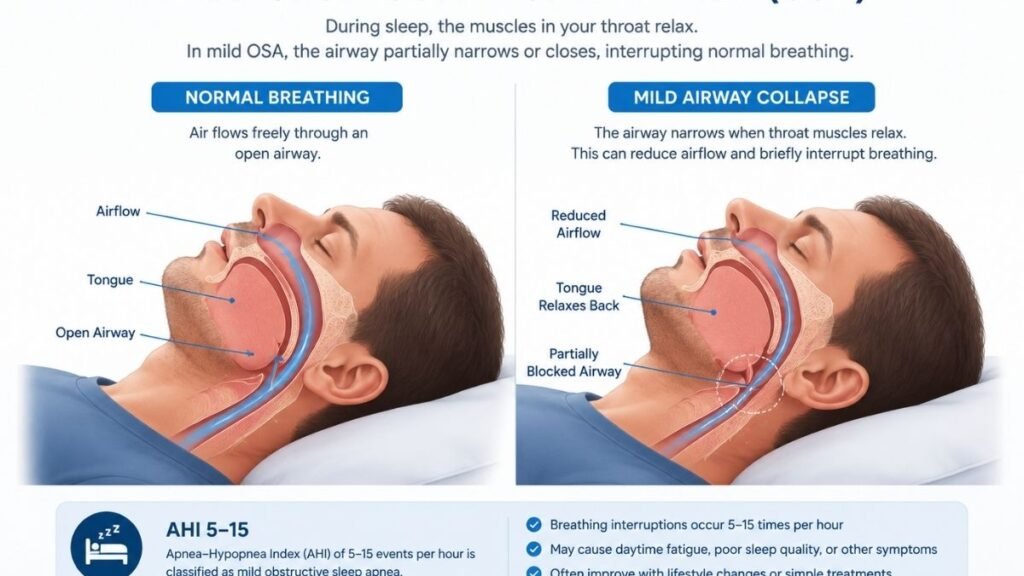
Mild obstructive sleep apnea typically means your Apnea-Hypopnea Index (AHI) falls between 5 and 15 events per hour. That number reflects how often your breathing partially or fully stops during sleep — but it doesn’t capture the full picture of how you actually feel.
A few things worth knowing right away:
- “Mild” is a measurement of frequency, not a guarantee that your symptoms are mild too.
- Some people with a mild diagnosis feel completely fine, while others struggle with real fatigue and brain fog.
- CPAP helps some people, but positional therapy, weight management, oral appliances, airway exercises, and better sleep habits can meaningfully help others.
- The right approach depends on your symptoms, oxygen levels, overall health, and personal preferences — not on the AHI number alone.
Think of this article as a decision-making framework, not a one-size-fits-all prescription. The goal is to help you understand your options clearly enough to have a productive conversation with your doctor, and to start making changes tonight if you’re ready.
What Is Mild Sleep Apnea? Understanding the AHI 5–15 Range
Obstructive sleep apnea (OSA) happens when the muscles in your throat relax during sleep enough to partially or completely block your airway. Each blockage briefly interrupts your breathing, often followed by a small awakening you don’t even remember, as your body works to reopen the airway.
What does AHI actually measure?
AHI stands for Apnea-Hypopnea Index. It’s the average number of breathing interruptions — full stops (apneas) and partial reductions (hypopneas) — you experience per hour of sleep. Sleep specialists use this number to classify severity:
| AHI Range | Classification | What It Generally Means |
|---|---|---|
| Under 5 | Normal | Minimal to no breathing disruption |
| 5–15 | Mild | Occasional airway blockages, usually manageable |
| 15–30 | Moderate | More frequent disruptions, often needing active treatment |
| Over 30 | Severe | Frequent, significant disruptions requiring prompt treatment |
Why a “mild” diagnosis doesn’t always feel mild
AHI only counts how often your breathing is interrupted — it doesn’t fully account for how long each event lasts, how far your oxygen levels drop, or how fragmented your sleep architecture becomes as a result. It’s surprisingly common for two people with an identical AHI of 8 to report completely different daytime experiences: one feels perfectly rested, while the other struggles with persistent grogginess and difficulty concentrating.
That’s because factors like the depth of oxygen desaturation, how much deep and REM sleep gets disrupted, and individual sensitivity to sleep fragmentation all shape how a “mild” case actually feels day to day. If your symptoms feel disproportionate to your AHI number, that’s a legitimate observation worth bringing up with your doctor, not something to dismiss.
How Mild Sleep Apnea Can Affect You
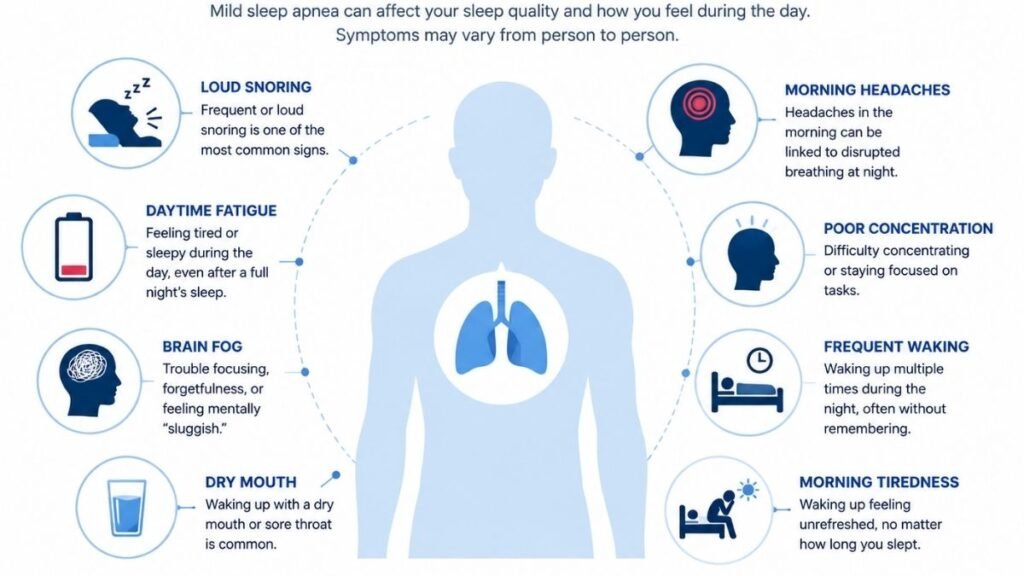
Mild sleep apnea doesn’t affect everyone in the same way. While some people mainly snore at night, others notice the biggest changes during the day—such as waking up tired, struggling to focus, or feeling sleepy even after a full night’s sleep. Knowing the most common symptoms can help you decide whether it’s time to speak with a healthcare provider or consider treatment.
Nighttime symptoms
- Loud, frequent snoring (often noticed by a bed partner before the person experiencing it)
- Waking up briefly and repeatedly, sometimes without remembering it
- Dry mouth or sore throat upon waking
- Gasping or choking sensations during sleep
- Needing to urinate more than once overnight
Daytime symptoms
- Morning headaches
- Excessive sleepiness despite a full night in bed
- Brain fog or trouble concentrating
- Irritability or mood changes
- A general sense that sleep isn’t restorative, even after 7–8 hours
When symptoms seem worse than your AHI
A recurring theme among people newly diagnosed with mild sleep apnea is the frustration of being told their case is “mild” while they feel anything but rested. This disconnect is real, and it’s one of the more common misconceptions worth correcting: a mild AHI classification does not automatically mean mild impact on your life. If daytime fatigue and brain fog are significantly affecting your work, relationships, or safety (for example, drowsy driving), that’s worth escalating regardless of what the number says.
Related reading: How to Tell If You Have Sleep Apnea
Can Mild Sleep Apnea Improve Without Treatment?
Yes. Mild sleep apnea can improve when the underlying cause is addressed, such as losing excess weight, changing sleep position, or treating chronic nasal congestion. However, it rarely disappears on its own without any changes, and some people still need ongoing treatment or regular follow-up.
When improvement is possible
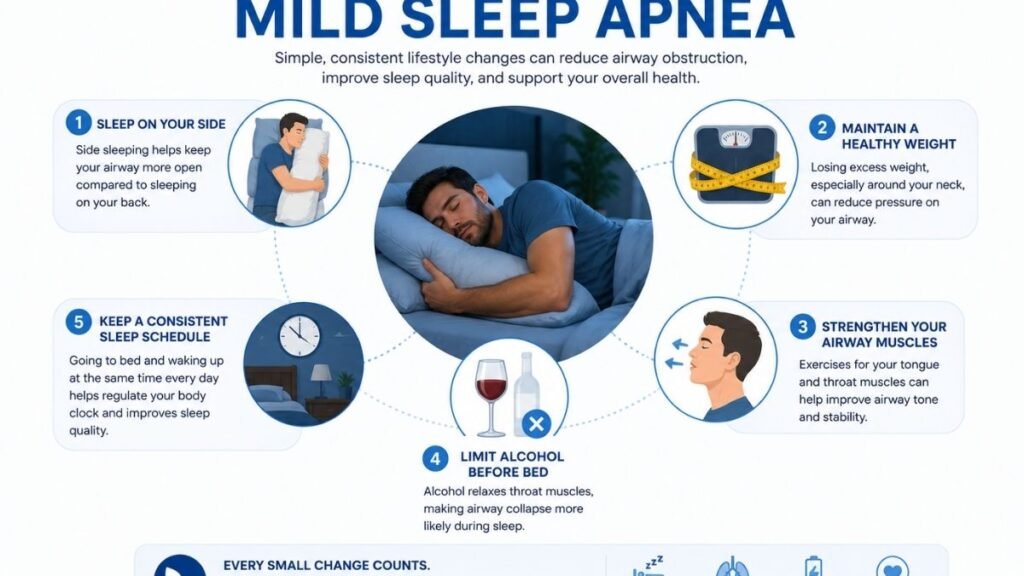
- Losing excess weight, particularly around the neck and upper airway
- Reducing or eliminating alcohol in the hours before bed
- Treating chronic nasal congestion or allergies
- Correcting a habit of sleeping on your back
- Quitting smoking, which reduces airway inflammation over time
When treatment is still recommended
- Symptoms are moderate to severe despite a mild AHI
- You have high blood pressure, heart disease, or other cardiovascular risk factors
- Your airway anatomy (such as a naturally narrow airway or enlarged tonsils) is a primary contributor
- Age-related loss of muscle tone in the throat is a factor, since this tends to progress rather than reverse on its own
| Factor | Can Improve Mild Sleep Apnea | Can Worsen Mild Sleep Apnea |
|---|---|---|
| Weight loss | ✔ | — |
| Weight gain | — | ✔ |
| Alcohol before bed | — | ✔ |
| Side sleeping | ✔ | — |
| Back sleeping | — | ✔ |
| Nasal congestion treatment | ✔ | — |
| Smoking | — | ✔ |
| Natural aging | — | ✔ (gradually) |
One of the more persistent misconceptions is that a mild diagnosis means it’s safe to ignore indefinitely. In reality, untreated mild sleep apnea can gradually worsen, particularly if weight, alcohol use, or airway anatomy are working against you. Ongoing monitoring — even if you choose a lifestyle-first approach — is part of managing it responsibly.
Do You Really Need CPAP?
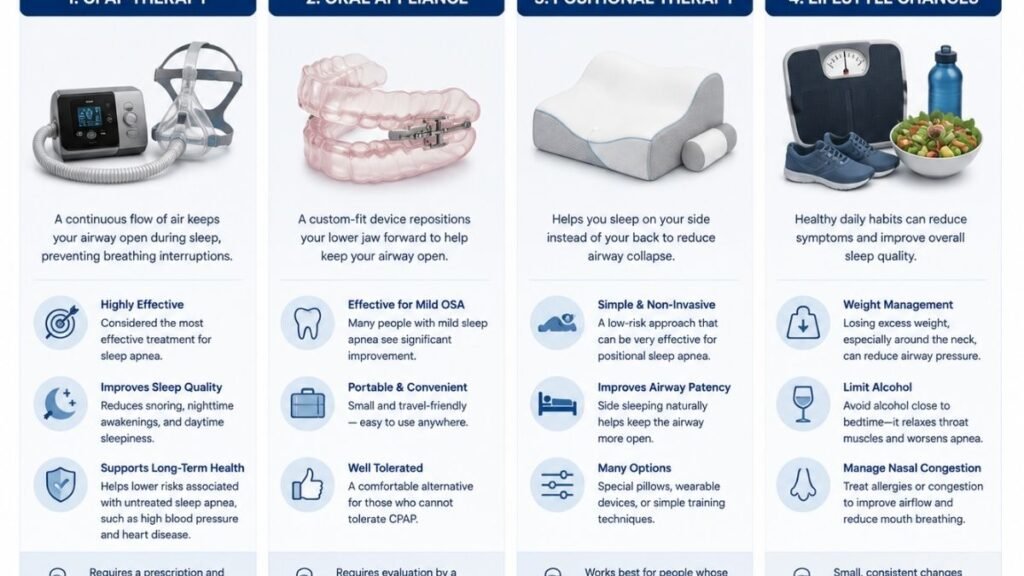
CPAP (continuous positive airway pressure) is highly effective, but for mild sleep apnea specifically, it’s one option among several rather than a universal first step.
When CPAP is recommended
- Daytime sleepiness is significant despite a mild AHI
- Oxygen levels drop meaningfully during sleep events
- You have cardiovascular risk factors that make even mild apnea worth treating aggressively
- Other approaches (positional therapy, weight loss, oral appliances) haven’t sufficiently improved symptoms
When alternatives may be considered
- Symptoms are minimal or absent
- Apnea events are strongly linked to back-sleeping and resolve with positional therapy
- You’ve had difficulty tolerating CPAP in the past
- A sleep specialist agrees that a trial of lifestyle-based interventions is reasonable given your overall health profile
| Scenario | Typical Recommendation |
|---|---|
| Mild AHI, minimal symptoms, no cardiovascular risk | Lifestyle changes ± positional therapy, with monitoring |
| Mild AHI, significant daytime sleepiness | CPAP often recommended, sometimes alongside lifestyle changes |
| Mild AHI, back-sleeping dependent | Positional therapy trial before CPAP escalation |
| Mild AHI with heart disease or hypertension | CPAP more strongly recommended regardless of symptom severity |
A common source of anxiety after a first diagnosis is the assumption that CPAP means a lifelong, non-negotiable commitment starting immediately. In practice, this decision is almost always a shared one between you and a sleep specialist, and it’s reasonable to revisit it over time as your weight, symptoms, or health status change. Many people who start with lifestyle interventions and later need CPAP find the transition far less daunting than they expected, especially with a properly fitted mask and some adjustment time.
Related reading: CPAP Beginner Guide
Five Natural Strategies That Can Improve Mild Sleep Apnea
People who see the biggest improvements usually don’t rely on a single change. Instead, they combine several small habits—such as sleeping on their side, managing weight, and treating nasal congestion—over several weeks.
1. Positional therapy
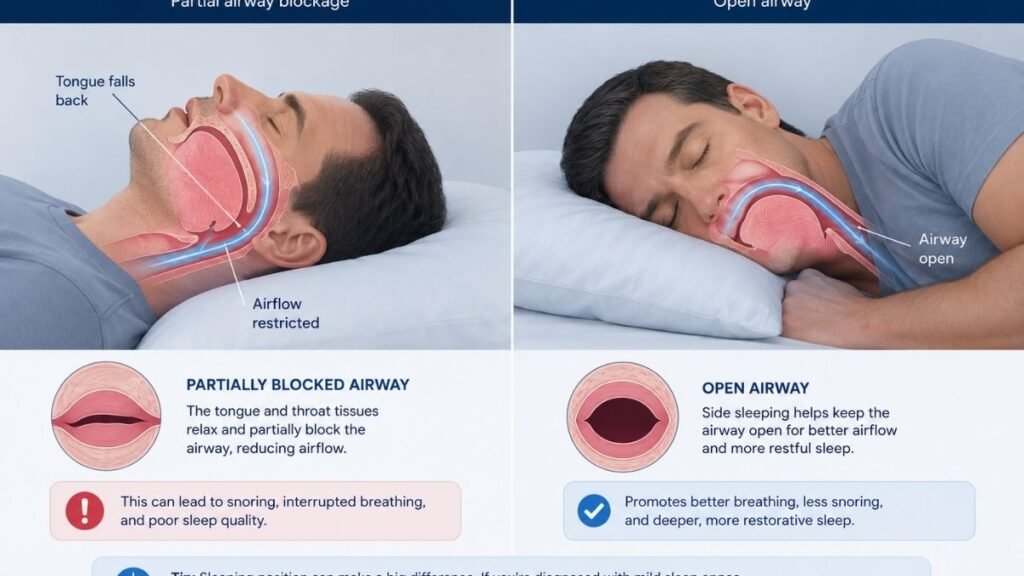
Many people with mild sleep apnea have events that are heavily concentrated during back-sleeping, when gravity allows the tongue and soft tissue to fall backward into the airway. Training yourself to stay on your side can meaningfully reduce event frequency.
Practical ways to do this include:
- Sewing a tennis ball into the back of a sleep shirt (a low-cost, old-school trick that still works for many people)
- Using a positional therapy device or wedge pillow designed to discourage back-sleeping
- Choosing a supportive side-sleeping pillow that keeps your neck aligned
2. Airway muscle exercises
Oropharyngeal, or myofunctional, exercises strengthen the muscles of the tongue, soft palate, and throat. Over time, stronger airway muscles are less likely to collapse during sleep. These typically involve simple daily repetitions — tongue presses, swallowing exercises, and specific vowel sounds — done consistently over several weeks.
3. Weight management
Excess weight around the neck and upper airway is one of the most modifiable contributors to sleep apnea severity. Even a moderate reduction in body weight — often cited in clinical literature as somewhere in the 5–10% range — can meaningfully reduce AHI for many people, though results vary based on where weight is carried and individual airway anatomy.
4. Better sleep hygiene
Consistent sleep and wake times, a cool and dark bedroom, and limiting screens before bed all support deeper, less fragmented sleep. While sleep hygiene alone won’t eliminate airway obstruction, it reduces the compounding effect of poor sleep quality on top of apnea-related fragmentation.
5. Reducing airway inflammation
Treating nasal congestion (through allergy management, a humidifier, or nasal strips), reducing evening alcohol intake, and quitting smoking all help keep the airway more open and less prone to collapse.
30-Day Mild Sleep Apnea Improvement Checklist
- Identify your primary sleep position and note whether back-sleeping is common
- Try a positional therapy method (device, pillow, or shirt trick) for at least two weeks
- Begin a simple daily airway exercise routine
- Set a consistent bedtime and wake time, even on weekends
- Cut off alcohol at least 3–4 hours before bed
- Address nasal congestion with saline rinses, allergy treatment, or a humidifier
- Track how you feel each morning to spot patterns
A realistic expectation worth setting from the start: meaningful improvement rarely comes from one single change. People who see the best results tend to combine two or three of these strategies consistently rather than relying on a single trick and expecting it to solve everything on its own.
Related reading: Best Sleeping Position for Better Breathing · Drug-Free Sleep Improvement Habits
Why Mild Sleep Apnea Can Disrupt Your Sleep All Night
In some cases, sleep apnea isn’t the only reason. Insomnia and mild sleep apnea often occur together, making it harder to stay asleep and wake up feeling refreshed.
What is COMISA?
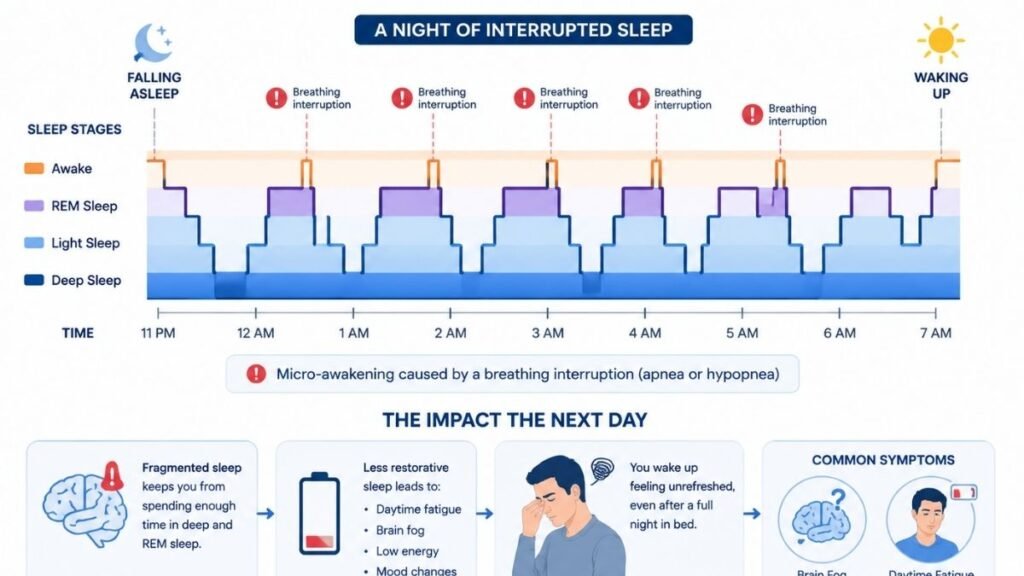
COMISA (Comorbid Insomnia and Sleep Apnea) describes the common overlap between insomnia and obstructive sleep apnea. The two conditions can reinforce each other: apnea-related micro-arousals fragment sleep, and that fragmentation can trigger the kind of hyperarousal that makes falling back asleep difficult — which is the hallmark of insomnia.
Micro-arousals are brief awakenings, often just a few seconds long, that occur as your body responds to a partially blocked airway. You typically don’t remember them, but they interrupt your sleep cycles enough to prevent you from reaching or staying in deep, restorative sleep stages.
Improving both breathing and sleep quality
It’s a common and understandable experience for people to feel like they “don’t sleep deeply anymore,” even when they’re spending enough hours in bed. This is often the result of fragmentation rather than insufficient total sleep time — the sleep is happening, but it’s being interrupted before it can do its job.
Addressing the breathing component (through positional therapy, weight management, or CPAP) is important, but it may not fully resolve the insomnia piece on its own. Behavioral sleep strategies — such as maintaining a consistent wind-down routine, limiting time spent awake in bed, and managing pre-sleep anxiety about not sleeping — often need to be addressed alongside the physical breathing issue for the best results.
Related reading: How to Stay Asleep All Night
Best Treatment Options for Mild Sleep Apnea
“What’s the best treatment for me?” The answer depends on more than your AHI score. Your symptoms, overall health, sleep position, and personal preferences all play a role in choosing a treatment that you’ll actually use consistently.
| Option | Effectiveness | Comfort | Cost | Portability | Maintenance | Best For |
|---|---|---|---|---|---|---|
| CPAP | High | Moderate (adjustment period) | Higher upfront cost | Low | Regular cleaning, mask replacement | Significant symptoms, cardiovascular risk |
| Oral appliance (MAD) | Moderate–High | Generally good once fitted | Moderate–high (custom) | High | Occasional dental check-ins | Positional or mild-moderate cases, CPAP-intolerant users |
| Positional therapy | Moderate | High | Low | High | Minimal | Back-sleeping-dependent mild cases |
| Lifestyle changes alone | Variable | High | Low | High | Ongoing habit consistency | Mild cases with modifiable risk factors |
A few honest trade-offs worth understanding: CPAP tends to offer the most reliable reduction in AHI but requires the most adjustment and nightly commitment. Oral appliances are often more comfortable and portable but can be less effective for higher AHI ranges and typically require a custom fitting from a dentist trained in sleep medicine for the best results. Positional therapy is low-cost and easy to try, but only helps if your apnea is genuinely position-dependent. Lifestyle changes are the gentlest starting point but require sustained consistency to produce results.
If you’re considering an oral appliance, a professionally fitted version from a qualified dentist is generally more effective and comfortable than an over-the-counter “boil and bite” mouthpiece, though it comes at a higher cost. Sleep tracking wearables can also be useful for spotting patterns in your sleep position, duration, and perceived quality over time — though it’s worth noting that consumer wearables estimate rather than diagnose sleep apnea, so they’re best used as a monitoring tool alongside, not instead of, professional follow-up.
Related reading: Oral Appliance vs CPAP
When Should You See a Sleep Specialist?
Lifestyle changes are often the first step in managing mild sleep apnea, but they don’t replace ongoing medical care when symptoms continue or worsen. Knowing when to schedule a follow-up can help ensure your treatment still matches your current symptoms and overall health.

Signs You Should Schedule Follow-Up Care
- Daytime sleepiness hasn’t improved after 4–6 weeks of consistent lifestyle changes
- Symptoms are getting worse rather than better
- You notice new or worsening high blood pressure
- You have a diagnosed heart condition and haven’t discussed your apnea with a cardiologist or sleep specialist
- Your bed partner reports gasping, choking, or long pauses in breathing
- You’ve gained significant weight since your last sleep study
- It’s been over a year since your last evaluation and your symptoms have changed
Reassessment is a completely normal part of managing mild sleep apnea, not a sign that your initial approach failed. A repeat sleep study can confirm whether lifestyle changes have genuinely reduced your AHI, or whether it’s time to consider CPAP or an oral appliance more seriously. Many people go through more than one round of evaluation as their weight, health, and symptoms evolve over the years.
Frequently Asked Questions
Is CPAP really necessary for mild sleep apnea, or can it be managed without a machine?
Not always. Many people with mild sleep apnea and minimal symptoms manage effectively with positional therapy, weight management, and better sleep habits. CPAP becomes more strongly recommended when symptoms are significant or cardiovascular risk factors are present. The decision should be made with a sleep specialist based on your specific situation.
What non-CPAP treatments actually work best for mild obstructive sleep apnea?
Positional therapy tends to be the most effective single strategy for people whose apnea is concentrated during back-sleeping. Weight management, oral appliances, and airway exercises also show meaningful benefit, especially when combined rather than used alone.
Can mild sleep apnea cause severe daytime fatigue and brain fog?
Yes. AHI reflects event frequency, not the full impact on sleep quality or oxygen levels. Some people with a mild AHI experience significant fragmentation and oxygen drops that produce noticeable daytime fatigue and difficulty concentrating.
Are custom oral appliances effective for treating mild sleep apnea?
Custom-fitted oral appliances from a qualified dentist are generally effective for mild to moderate cases, particularly for people who can’t tolerate CPAP. They work by repositioning the jaw to keep the airway more open during sleep.
How does positional therapy help prevent airway blockage during sleep?
Sleeping on your back allows gravity to pull the tongue and soft tissue backward, narrowing the airway. Positional therapy keeps you on your side, reducing this effect and often lowering the frequency of breathing interruptions for people whose apnea is position-dependent.
Does mouth taping actually help with mild sleep apnea symptoms?
Mouth taping is intended to encourage nasal breathing, but it isn’t a treatment for the underlying airway collapse that causes sleep apnea and can be uncomfortable or unsafe for people with nasal congestion. It’s not a substitute for evaluated treatments like positional therapy, oral appliances, or CPAP.
Can losing weight completely cure mild obstructive sleep apnea?
For some people, meaningful weight loss significantly reduces or resolves mild sleep apnea, especially when excess weight around the neck was a primary contributing factor. For others, particularly those with anatomical airway narrowing, weight loss helps but doesn’t fully eliminate the condition. Results vary by individual.
How long does it take to notice improvements after starting treatment for mild sleep apnea?
Positional therapy and lifestyle changes often show initial improvement within a few weeks of consistent effort, though full benefits from weight loss or airway exercises can take a couple of months. CPAP and oral appliances often produce noticeable improvement within the first one to two weeks of correct, consistent use.
Final Thoughts
A diagnosis of mild sleep apnea doesn’t automatically mean your symptoms are mild, and it doesn’t automatically mean you’ll need CPAP either. The AHI score is only one part of the picture. How you sleep, how you feel during the day, and any underlying health conditions are just as important when deciding on the right approach.
Consistent lifestyle changes—such as sleeping on their side, maintaining a healthy weight, improving sleep habits, and addressing nasal congestion—can lead to meaningful improvements over time. Others may benefit more from a custom oral appliance or CPAP, especially if symptoms persist or other health risks are present. The goal isn’t to find the “perfect” treatment, but to find one that fits your life and that you can stick with consistently.
If there’s one takeaway from this guide, it’s that mild sleep apnea is worth paying attention to, but it’s also highly manageable for many people. Start with the changes you can make today, monitor how your symptoms evolve, and don’t hesitate to follow up with a sleep specialist if you’re not seeing the improvement you expected. Small, consistent steps often lead to better sleep—and better days—in the long run.
🏠 Behind This Guide
Getting a diagnosis of mild sleep apnea often creates more uncertainty than reassurance. Many people aren’t sure whether they actually need treatment, whether CPAP is their only option, or whether simple lifestyle changes could be enough to improve their sleep.
That’s why this guide focuses on practical steps you can realistically take, while also explaining when professional treatment may be the better choice.
This guide is built around three essentials:
- 😴 Understanding Your Diagnosis — What a mild AHI really means, why symptoms vary, and why “mild” doesn’t always feel mild.
- 🌿 Natural Ways to Improve Sleep — Lifestyle changes, positional therapy, airway exercises, and habits that may help reduce symptoms.
- 🩺 Choosing the Right Treatment — When CPAP, oral appliances, or follow-up with a sleep specialist may be appropriate.
Because the goal isn’t simply to lower an AHI number.
It’s to help you sleep better, feel more rested, and make confident decisions about your care.
🌙 Continue Building Better Sleep Habits
Better sleep rarely comes from solving just one problem. These guides can help you improve different parts of your sleep routine and build healthier, more restorative sleep over time.
- Sleep Through the Night — Learn practical ways to reduce nighttime awakenings and enjoy more continuous, uninterrupted sleep.
- Create a Better Sleep Environment — Discover simple bedroom changes that can help you fall asleep faster and sleep more comfortably.
- Why Deep Sleep Matters — Understand how deep sleep supports recovery, brain function, and feeling refreshed the next day.
- Sleep and Blood Pressure — Explore how healthy sleep habits can support heart health and help maintain healthy blood pressure.
❤️ A Final Note
Better sleep doesn’t happen overnight—it grows from small, consistent changes that become part of your everyday routine.
At NourishDao, we believe better sleep should be practical, sustainable, and accessible to everyone. That’s why we create evidence-informed, drug-free resources that help people improve sleep quality, support overnight recovery, and build healthier sleep habits with confidence.
Our goal is simple: helping you build better sleep, naturally, one night at a time.