
There’s a reason every sleep guide mentions breathing. Not because it’s trendy, or because it’s simple enough to pad out a list, but because slow, deliberate breathing is one of the few things you can do right now — in bed, in the dark, without any equipment — that produces a measurable physiological change within minutes.
The frustrating part is that most breathing advice skips over the mechanism entirely. You’re told to breathe in for four counts and out for eight, as if the counting itself is the magic. It isn’t. The counting is just a way to slow the exhale — and it’s the slow exhale that’s actually doing something specific and useful to your nervous system.
Understanding why deep breathing works changes how you use it. It explains which techniques work for which situations, why some people find them helpful immediately and others need a few weeks, and — most importantly — why they stop working when you approach them as a performance rather than a practice.
This guide covers the complete picture: the physiology, the techniques that have the best evidence for sleep specifically, and how to build a practice that works at 11pm on a Tuesday when your mind has decided this is the perfect moment to process everything.
Key Takeaways
- Deep breathing works through a specific physiological mechanism: a long exhale stimulates the vagus nerve, which sends a calming signal to the heart, lungs, and brain — shifting the autonomic nervous system from sympathetic (fight-or-flight) to parasympathetic (rest-and-digest) dominance.
- This shift can produce measurable changes in heart rate variability within 60–90 seconds — faster than any supplement or medication.
- Research published in Psychophysiology found that slow breathing at 6 breaths per minute significantly increased heart rate variability and reduced anxiety in participants — roughly what you achieve with a 5-second inhale and 5-second exhale pattern.
- The 4-7-8 method (developed by Dr. Andrew Weil) produces a stronger parasympathetic response than simple slow breathing due to the extended hold and dramatically lengthened exhale, but requires more practice to use comfortably.
- Breathing techniques are more effective as a consistent nightly practice than as an emergency intervention — your nervous system learns the response over time, and the techniques become more potent with repetition.
Why Deep Breathing Actually Works: The Mechanism
Most breathing guides skip this entirely, which is a mistake — because understanding the mechanism helps you use the technique correctly and gives you realistic expectations about what it will and won’t do.
Your autonomic nervous system has two divisions that are relevant here:
Sympathetic nervous system: Governs the fight-or-flight response. When active, it raises heart rate, elevates cortisol, tenses muscles, sharpens attention toward threats, and keeps the brain generating content. This is the state you’re in when you’re lying awake with racing thoughts.
Parasympathetic nervous system: Governs rest and recovery. When active, it slows heart rate, relaxes muscles, reduces cortisol, and creates the physiological conditions in which sleep can happen. This is the state you need to be in.
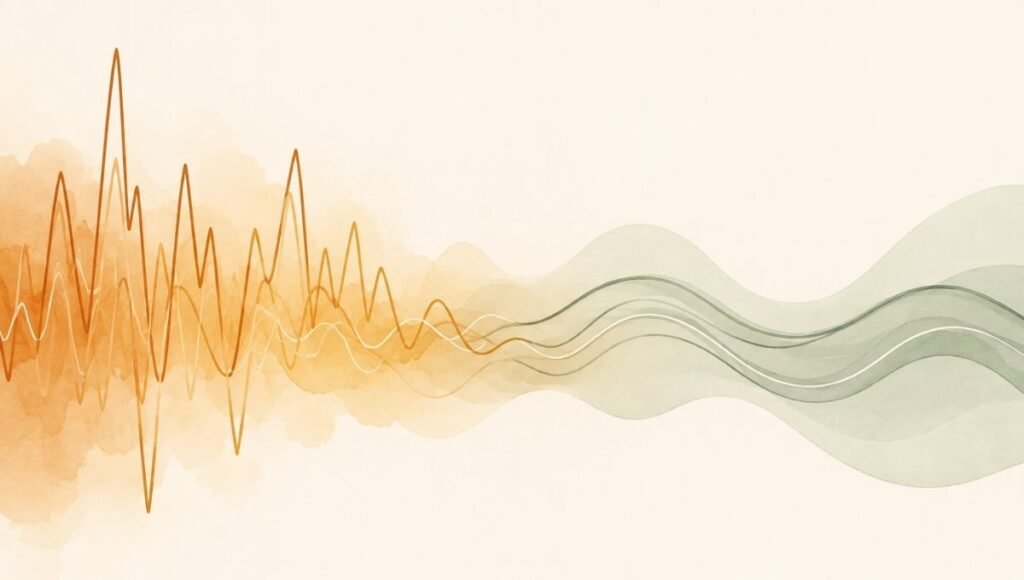
These two systems are not simply “on” and “off.” They exist on a continuum, and slow, deliberate breathing is one of the most direct tools available for shifting the balance from sympathetic toward parasympathetic.
Here’s the specific mechanism: your heart rate naturally increases slightly with each inhale (as the lungs expand and the vagus nerve temporarily releases its calming grip) and decreases with each exhale (as the vagus nerve re-engages). The longer and slower your exhale, the more vagal stimulation you produce — and the more your heart rate drops, blood pressure eases, and nervous system settles.
This is why the exhale matters more than the inhale. A slow, extended exhale is doing the specific thing that shifts your physiological state. The inhale is just the setup.
The Most Effective Deep Breathing Techniques for Sleep
1. Extended Exhale Breathing — Start Here
Best for: Immediate calming when anxiety or racing thoughts make other techniques feel too complex; anyone new to breathing practices
The principle: Make the exhale meaningfully longer than the inhale. That’s it. Everything else is detail.
The simplest version:
- Inhale slowly through the nose for 4 counts
- Exhale slowly through the nose or mouth for 6–8 counts
- Repeat without trying to control what happens — just keep the exhale longer
If counting itself feels activating (some people find it creates its own micro-anxiety), try this instead: breathe in until your lungs feel comfortably full, then exhale until they feel comfortably empty, making the exhale roughly twice as long as the inhale by feel rather than count.
What to expect: Most people notice a subtle heaviness in the body — a slight relaxing of the shoulders, a slowing of thoughts — within 3–5 cycles. This is the parasympathetic shift. It’s not dramatic. If you’re expecting to feel profoundly different, you’ll miss the actual experience, which is more like a quiet settling.
2. The 4-7-8 Method — For Deeper Relaxation
Best for: People who have practiced extended exhale breathing for at least a week and want something more potent; anxiety that doesn’t settle with simpler techniques
The rationale: The 4-7-8 ratio was developed by Dr. Andrew Weil, drawing on pranayama breath retention traditions. The extended breath hold after the inhale is the key differentiator — it allows CO2 to accumulate slightly, which produces a strong parasympathetic response when the exhale finally occurs. Combined with the dramatically lengthened exhale (8 counts), this technique produces one of the most consistent physiological relaxation responses available without medication.
The technique:
- Rest the tip of your tongue lightly on the roof of your mouth, just behind your front teeth — hold it there throughout
- Exhale completely through your mouth
- Close your mouth and inhale quietly through your nose for 4 counts
- Hold your breath for 7 counts
- Exhale completely through your mouth for 8 counts
- That’s one cycle. Repeat 4–8 cycles
Important notes:
- The ratio (4:7:8) matters more than the speed. Start slowly.
- If holding for 7 counts feels genuinely uncomfortable, reduce proportionally: try 3:5:6 and work toward the full ratio over a few weeks
- Do not practice this technique more than 8 cycles at first — some people experience light-headedness, which is normal but disorienting in the dark
- This technique gains effectiveness with consistent practice. The first week may produce modest results. After two to four weeks of nightly use, most people find it substantially more reliable
3. Diaphragmatic (Belly) Breathing — For Physical Tension
Best for: People who carry tension in the chest, shoulders, and jaw; those who tend to breathe shallowly; useful as a foundation before the 4-7-8 method
The mechanism: Most adults under chronic stress breathe predominantly from the chest — short, shallow breaths that use secondary breathing muscles in the neck and shoulders. This breathing pattern maintains a low-level sympathetic activation because shallow breathing is physiologically associated with the threat response. Diaphragmatic breathing engages the primary breathing muscle (the diaphragm) and produces a slower, deeper breath that directly supports parasympathetic activation.
The technique:
- Lie on your back with one hand on your chest and one on your lower belly
- Inhale slowly through your nose — the hand on your belly should rise, the hand on your chest should stay relatively still
- Exhale slowly — the belly falls
- Repeat for 5–10 minutes
The goal is to redirect the breath from the chest to the belly. This may feel awkward at first if chest breathing is your default — the correct pattern usually comes within a few sessions.
A useful cue: Imagine your belly as a balloon that inflates with the inhale and deflates with the exhale. Keep the chest as still as possible. This shifts the breathing locus downward automatically.
4. Box Breathing — For Racing Thoughts
Best for: Cognitive hyperactivation — the thought loops that won’t stop; situations where counting provides a useful focus point that displaces anxious content
The technique:
- Inhale for 4 counts
- Hold for 4 counts
- Exhale for 4 counts
- Hold for 4 counts
- Repeat
Why equal counts? Box breathing’s symmetry is less about physiological optimization and more about cognitive occupation. The equal-count pattern requires just enough sustained attention to make it difficult to simultaneously generate anxious thought content. It’s a focus technique as much as a breathing technique.
The honest caveat: Box breathing produces a somewhat less potent parasympathetic response than the 4-7-8 method because the exhale is no longer than the inhale. Its primary value is the cognitive occupation it creates. For purely physical anxiety, extended exhale breathing or 4-7-8 is more effective. For anxiety that’s primarily manifesting as racing thoughts you can’t interrupt, box breathing’s equal-count structure may be more useful precisely because it requires more active attention.
5. Alternate Nostril Breathing — For Mental Clarity Before Sleep
Best for: People who feel mentally cluttered and overstimulated rather than acutely anxious; wind-down practice 30–60 minutes before bed
The technique:
- Sit comfortably (this one is easier sitting than lying down initially)
- Rest your right hand on your knee; bring your left hand to your nose
- Close your right nostril with your right thumb and inhale through the left nostril
- Close both nostrils and hold briefly
- Release the right nostril and exhale through it
- Inhale through the right nostril
- Close both, hold briefly
- Release the left nostril and exhale
- That’s one complete cycle. Repeat 5–10 times
Research on alternate nostril breathing (nadi shodhana in Sanskrit) has found effects on heart rate variability and subjective relaxation comparable to other slow breathing techniques. Some people find it produces a particular quality of mental quietness — less like being sedated and more like the mind becoming orderly — that makes it useful specifically for transitioning from a busy day into a wind-down state.
The Common Mistakes That Make Breathing Not Work
Trying too hard. Approaching breathing exercises with an agenda — “I need to fall asleep; this needs to work” — activates the monitoring function of the anxious mind and undermines the practice. The paradox: the more important falling asleep feels, the harder it is to relax. Breathing techniques work by releasing effort, not by applying it. The goal of any breathing session is simply to breathe in the specified pattern. Sleep may or may not follow. Releasing the expectation that it will removes the secondary anxiety that prevents it.
Using them only on bad nights. Breathing techniques as emergency interventions work less reliably than breathing techniques as consistent nightly practice. Your nervous system learns the relaxation response over repetition — each time you complete a session, the subsequent response is slightly faster and slightly more potent. People who practice briefly every night, even on nights when they’re not anxious, find they work considerably better when they actually need them.
Too short a session. The physiological shift from sympathetic to parasympathetic doesn’t happen in one breath. It accumulates across cycles. Three cycles of 4-7-8 breathing produces a modest response. Eight cycles produces a more consistent one. Give any technique at least five minutes before judging its effect.
Giving up too quickly. The research on breathing for sleep is consistent that effects increase with practice over weeks, not sessions. If you’ve tried a technique twice and it hasn’t helped, that’s not evidence it doesn’t work — it’s evidence your nervous system hasn’t yet learned the response. Most people who benefit from breathing practices report a tipping point somewhere in the second or third week where they notice the effect becoming reliable.
Building a Breathing Practice That Actually Sticks
The most effective approach is a brief, consistent sequence before sleep every night — not just on difficult nights, not just when you remember.
A minimal starting practice (5 minutes):
- Get into bed and lie on your back
- Place one hand on your belly
- Take 10 diaphragmatic breaths — belly rises on the inhale, falls on the exhale
- Move to 5 cycles of 4-7-8 (or extended exhale if 4-7-8 is too new)
- Roll to your preferred sleeping position
That’s it. Five minutes. Done consistently for two weeks, the sequence becomes a conditioned signal — your nervous system begins to associate the pattern with sleep onset, and the transition becomes progressively easier.
Once this feels natural, you can extend the session, add a body scan after the breathing, or experiment with other techniques. But starting simple and doing it every night is more valuable than starting elaborate and doing it sporadically.
Deep Breathing and Stretching Before Bed
Slow breathing pairs particularly well with gentle stretching because both work through overlapping mechanisms — reducing physical tension, lowering heart rate, shifting toward parasympathetic dominance.
A brief sequence that works well:
- Child’s pose (1–2 minutes): Forward fold with arms extended, breathing slowly into the back and sides of the body
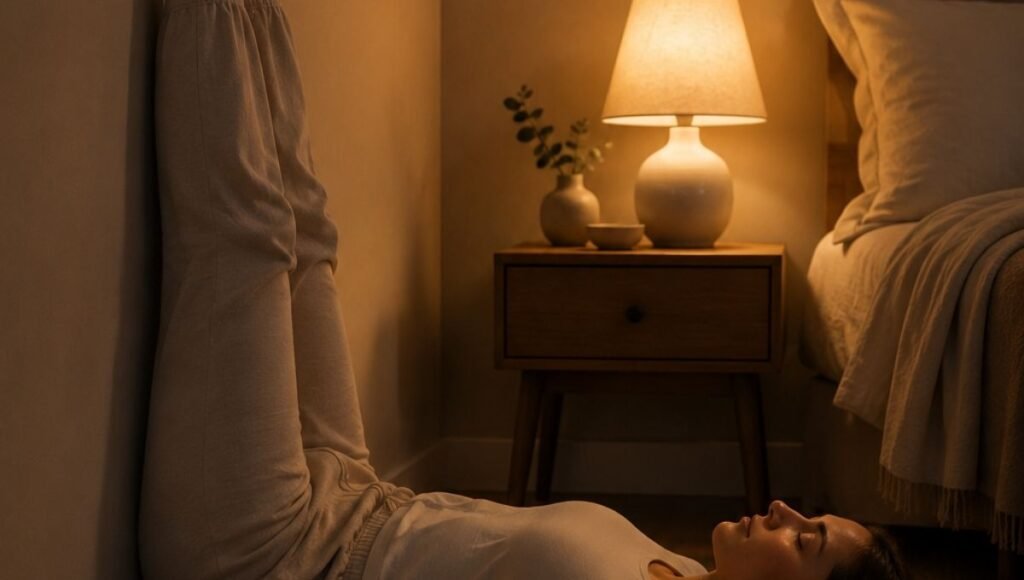
- Legs up the wall (3–5 minutes): Lie on your back with legs resting vertically against the wall; breathe with extended exhale; this position uses gravity to support venous return and produces a noticeably calming effect
- Supine spinal twist (1 minute each side): Lying on your back, knees fall to one side; breathe into any areas of tension
Move directly from this sequence into bed and begin your breathing practice. The physical relaxation from the stretches and the nervous system calming from the breathing compound each other.
If You Only Have 5 Minutes Tonight
Before you turn the light off: ten slow diaphragmatic breaths, belly rising on the inhale. Then five cycles of in for four counts, out for six or eight.
That’s it. No apps required, no perfect conditions needed. The technique doesn’t care what your room looks like or how your day went. It works because of physiology, not because of circumstance.
Do this again tomorrow night, and the night after. The third week is usually when it stops feeling like something you’re doing and starts feeling like something that simply works.
Frequently Asked Questions
Does deep breathing help you fall asleep?
Yes, through a direct physiological mechanism. Slow, extended exhale breathing stimulates the vagus nerve, which slows heart rate and shifts the autonomic nervous system toward parasympathetic (rest-and-digest) dominance — directly counteracting the cortisol-driven sympathetic activation that prevents sleep onset. Research consistently shows reduced anxiety and improved sleep quality with slow breathing practices, though effects build over weeks of consistent practice rather than producing dramatic results on the first night.
What is the best breathing technique for sleep?
For most people, the extended exhale method (4 counts in, 6–8 counts out) is the best starting point — it’s simple, physiologically effective, and doesn’t require the breath holding that can feel uncomfortable in the 4-7-8 method. Once extended exhale breathing feels natural, the 4-7-8 method produces a stronger parasympathetic response and is worth learning. Box breathing is most useful when the primary issue is racing thoughts rather than physical anxiety.
How long does deep breathing take to work for sleep?
The immediate physiological effect (slowing heart rate, beginning to shift the nervous system) starts within 60–90 seconds of a slow extended exhale. The subjective experience of relaxation typically develops over 5–10 minutes of consistent breathing. As a long-term practice, effects become meaningfully stronger after 2–3 weeks of nightly use, as the nervous system learns to associate the breathing pattern with sleep onset.
Why does deep breathing make me feel worse sometimes?
This happens most commonly with techniques that involve breath holding (like 4-7-8) when the body isn’t accustomed to it. Some people also experience heightened awareness of physical sensations during slow breathing, which can feel anxiety-provoking for those with health anxiety or panic disorder. If breathing exercises consistently increase your anxiety, start with the simplest version (just making the exhale longer than the inhale, without counting or holding) and build gradually. If the problem persists, it’s worth mentioning to a healthcare provider.
Can I use deep breathing if I have a respiratory condition?
Generally yes, but it depends on the condition. Diaphragmatic breathing is specifically recommended for people with COPD and asthma as a way to improve respiratory efficiency. Breath holding techniques (like 4-7-8) are less appropriate for people with significant respiratory conditions. Consult with your healthcare provider about which approach is appropriate for your specific situation.
The Honest Summary
Deep breathing for sleep isn’t a miracle cure. It won’t override significant insomnia, resolve sleep apnea, or eliminate the stress that’s producing the anxiety in the first place. What it will do — consistently, and without side effects — is shift your nervous system toward the physiological state that sleep requires, faster than almost anything else available without a prescription.
The exhale is the key. Make it longer than the inhale. Be patient with the process. Practice on the ordinary nights so it works on the hard ones.
That’s the whole thing.
For a broader set of physical and cognitive relaxation techniques that pair well with breathing practice, read our guide on relaxation techniques for sleep. And if anxiety is the primary driver of your sleep difficulty, our guide on how to sleep with anxiety covers the complete behavioral approach.
References
- Jerath, R., Edry, J. W., Barnes, V. A., & Jerath, V. (2006). Physiology of long pranayamic breathing: Neural respiratory elements may provide a mechanism that explains how slow deep breathing shifts the autonomic nervous system. Medical Hypotheses, 67(3), 566–571.
- Lehrer, P. M., & Gevirtz, R. (2014). Heart rate variability biofeedback: How and why does it work? Frontiers in Psychology, 5, 756.
- Zaccaro, A., Piarulli, A., Laurino, M., et al. (2018). How breath-control can change your life: A systematic review on psycho-physiological correlates of slow breathing. Frontiers in Human Neuroscience, 12, 353.
- Vierra, J., Boonla, O., & Prasertsri, P. (2022). Effects of sleep deprivation and 4-7-8 breathing control on heart rate variability, blood pressure, blood glucose, and endothelial function in healthy young adults. Physiological Reports, 10(13), e15389.
- National Center for Complementary and Integrative Health. (2021). Relaxation techniques: What you need to know. https://www.nccih.nih.gov/health/relaxation-techniques-what-you-need-to-know
NourishDAO publishes sleep and wellness content for informational purposes only. This article is not a substitute for professional medical advice, diagnosis, or treatment. If you have persistent sleep difficulties or a respiratory condition, please consult a qualified healthcare provider.