
You’ve been lying here for forty minutes. You’re not on your phone. You’re not thinking about anything particularly dramatic. But your brain refuses to settle — it’s producing a low-level hum of thoughts that aren’t urgent or distressing, just relentlessly present. Your body feels simultaneously tired and alert, and sleep keeps hovering just out of reach.
This is where relaxation techniques come in — not as a wellness trend, but as a physiological intervention. Your nervous system is stuck in a mode that’s incompatible with sleep initiation, and specific practices can shift it. Not by tricking your brain, and not by forcing relaxation, but by activating a biological process your body already knows how to do.
The research is solid. Practices like progressive muscle relaxation, extended-exhale breathing, and body scan meditation have been shown in multiple clinical trials to reduce sleep onset time, decrease nighttime waking, and improve subjective sleep quality — specifically in people with anxiety-driven insomnia. They’re not a replacement for good sleep habits, but for many people, they’re the missing piece.
This guide explains how each technique works, which situation each one is best suited for, and exactly how to use them — including what to do when they don’t seem to be working.
Key Takeaways
- Relaxation techniques work by activating the parasympathetic nervous system (the “rest and digest” system), which directly counteracts the cortisol-driven arousal that prevents sleep initiation.
- A 2021 study published in Evidence-Based Complementary and Alternative Medicine found that progressive muscle relaxation, deep breathing, and guided imagery all significantly promoted psychological and physiological relaxation states in participants.
- The extended exhale is the single most powerful component of breathing-based relaxation: when the exhale is longer than the inhale, it directly stimulates the vagus nerve and lowers heart rate — often within 90 seconds.
- Relaxation techniques are most effective when practiced consistently — not just on difficult nights. The nervous system learns the response over time, and the techniques become more effective with repetition.
- These techniques are evidence-supported for anxiety-driven insomnia specifically — if sleep difficulty has structural causes (sleep apnea, restless legs, pain), relaxation practices help but are unlikely to resolve the underlying issue.
Why Your Nervous System Prevents Sleep (And How Relaxation Fixes It)
Understanding the mechanism makes these techniques far easier to use correctly — and makes their results less surprising.
Your body operates two overlapping nervous system modes. The sympathetic nervous system governs the fight-or-flight response — it produces alertness, raises heart rate, tightens muscles, and sharpens attention. The parasympathetic nervous system governs rest and recovery — it slows heart rate, relaxes muscles, reduces cortisol, and creates the physiological conditions for sleep.
These two systems are not simply “on” and “off.” They exist on a continuum, and modern life — with its constant stimulation, cognitive demands, and low-level anxiety — tends to keep most adults biased toward sympathetic activation even when they’re trying to rest. You get into bed with a nervous system that’s still processing the day, and no amount of willpower can override that.
Relaxation techniques work by directly activating the parasympathetic response. Slow, extended breathing stimulates the vagus nerve, which carries the calming signal from the brainstem through the major organs. Progressive muscle relaxation uses the paradox of deliberate tension — by consciously tensing and releasing muscle groups, you interrupt the chronic holding pattern that stress produces and signal the brain that threat has passed. Body scan meditation redirects attention from anxious thought to neutral physical sensation, interrupting the cognitive loop that keeps the sympathetic system engaged.
None of these practices create sleep. They create the conditions in which sleep can happen — which is exactly what’s needed.
The 5 Most Evidence-Supported Relaxation Techniques for Sleep
1. Extended-Exhale Breathing: The Fastest Route to Calm
Best for: People who are lying awake with physical tension or mild anxiety; anyone who wants a technique that works within 1–2 minutes.
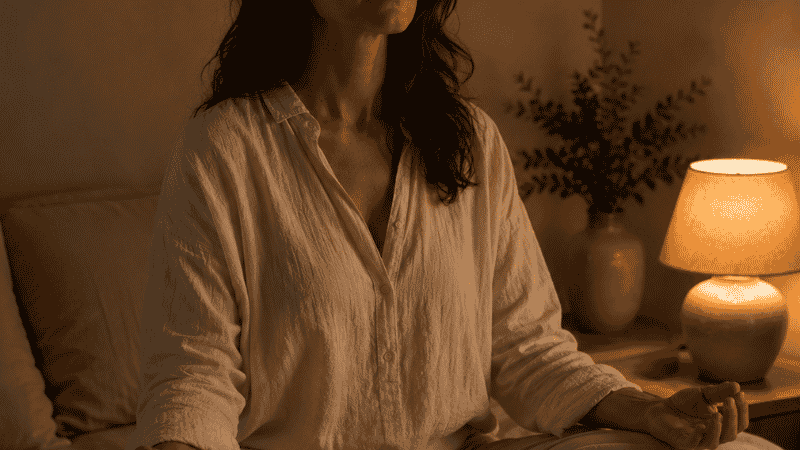
The single most important principle in sleep-oriented breathing is this: the exhale is more powerful than the inhale. When you exhale slowly, your heart rate slows — a phenomenon called respiratory sinus arrhythmia. When your exhale is significantly longer than your inhale, you directly stimulate the vagus nerve and shift the nervous system toward parasympathetic dominance.
You don’t need a specific technique to use this principle. Simply breathing in for four counts and out for six or eight counts — repeatedly, with your eyes closed — will produce a measurable physiological response within a few minutes.
The 4-7-8 Method (The Most Studied Version)
This specific ratio was developed by Dr. Andrew Weil and is one of the most frequently studied breathing techniques for sleep and anxiety:
- Place the tip of your tongue gently on the roof of your mouth, just behind your front teeth — keep it there throughout
- Exhale completely through your mouth, making a quiet whooshing sound
- Close your mouth and inhale through your nose for 4 counts
- Hold your breath for 7 counts
- Exhale completely through your mouth for 8 counts
- Repeat 3–4 cycles to start; increase to 8 cycles with practice
The ratio is what matters — 4:7:8. The extended hold and extended exhale together produce a significantly stronger parasympathetic response than a simple slow breath. If holding for 7 counts feels uncomfortable initially, reduce the ratio proportionally (try 4:5:6) and work toward the full ratio over several weeks.
Important note: this technique gains power with practice. The first few sessions may produce only mild effects. After two to four weeks of daily practice — not just on difficult nights — most people find it substantially more effective.
Simple Extended Exhale (For Beginners)
If the 4-7-8 ratio feels too complex when you’re lying awake at midnight:
- Inhale slowly through the nose for 4 counts
- Exhale slowly through the nose or mouth for 6–8 counts
- Repeat without counting if counting itself feels activating — just ensure the exhale is longer
This simpler version is less precisely studied but uses the same underlying mechanism and is easier to maintain when cognitive resources are low.
2. Progressive Muscle Relaxation (PMR): Releasing What You Can’t Feel
Best for: People who carry physical tension (tight jaw, tense shoulders, clenched stomach) without fully realizing it; people whose anxiety manifests physically rather than as intrusive thoughts.
Progressive muscle relaxation is based on a core insight: chronic stress produces chronic muscle tension, and most people have adapted to this tension to the point where they no longer consciously feel it. By deliberately tensing each muscle group — more than it’s already held — and then releasing, you produce a contrast effect that allows the muscles to release more fully than they would through voluntary relaxation alone.
The sequence also has a secondary effect: it redirects attention away from anxious thought and anchors it in physical sensation, interrupting the cognitive loop that sustains anxiety.
How to practice PMR for sleep:
Start at the feet and work upward. For each muscle group:
- Inhale and tense the muscle firmly (not painfully) for 5 seconds
- Exhale and release completely for 20–30 seconds
- Notice the contrast between tension and release before moving to the next group
Sequence: feet → calves → thighs → glutes → stomach → hands and forearms → upper arms and shoulders → face (jaw, eyes, forehead)
The full sequence takes 15–20 minutes. A shortened version — focusing on the three areas that hold the most tension for most people (jaw, shoulders, stomach) — takes 5–7 minutes and is effective for nights when time or patience is limited.
A key note: don’t skip the release time. The 20–30 seconds of relaxed awareness after each release is where the parasympathetic response is actually produced. Rushing through the sequence reduces its effectiveness significantly.
3. Diaphragmatic (Belly) Breathing: Correcting How Most People Breathe
Best for: People who regularly breathe shallowly from the chest (which is most people under chronic stress); helpful as a starting point before 4-7-8 or PMR.
Most adults under stress habitually breathe from the chest — short, shallow breaths that use the secondary breathing muscles of the neck and shoulders. This breathing pattern maintains a low-level sympathetic activation because shallow breathing is physiologically associated with threat response.
Diaphragmatic breathing — breathing fully into the belly, allowing the lower abdomen to rise on the inhale — engages the primary breathing muscle (the diaphragm) and produces a slower, deeper breath that supports parasympathetic activation.
How to practice:
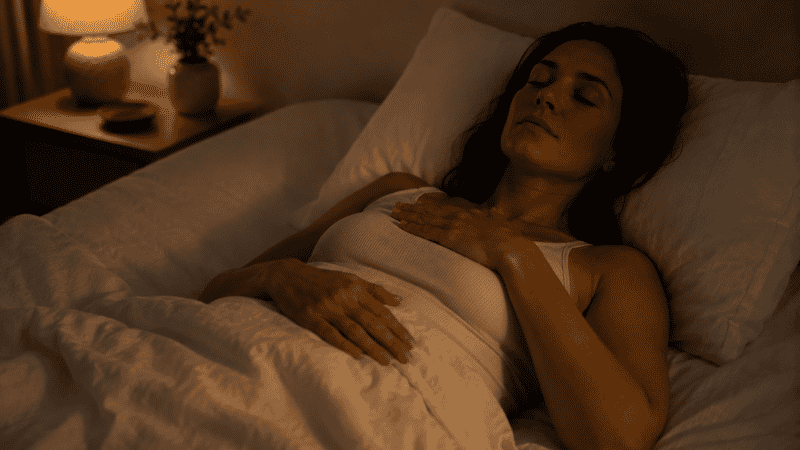
- Lie on your back with one hand on your chest and one hand on your lower belly
- Inhale slowly through your nose — the hand on your belly should rise, the hand on your chest should stay relatively still
- Exhale slowly — the hand on your belly falls
- Continue for 5–10 minutes, focusing on keeping the chest hand still
This takes practice if shallow chest breathing is your default. Don’t be discouraged if you struggle initially — the correct pattern usually comes within a few sessions.
4. Body Scan Meditation: Redirecting a Racing Mind
Best for: People whose insomnia is primarily cognitive — the racing mind, the endless thought loop — rather than physical tension; people who have tried breathing techniques and find that thoughts immediately return.
Body scan meditation works differently from breathing techniques. Rather than directly activating the parasympathetic system through physiological means, it works by redirecting attention. When attention is anchored to neutral physical sensation — the weight of the legs, the temperature of the feet, the sensation of breathing in the chest — it has less bandwidth available for anxious thought generation.
This is not suppression. You’re not fighting thoughts. You’re simply placing your attention somewhere else with gentle repetition, and letting thoughts arise and pass without following them.
How to practice:
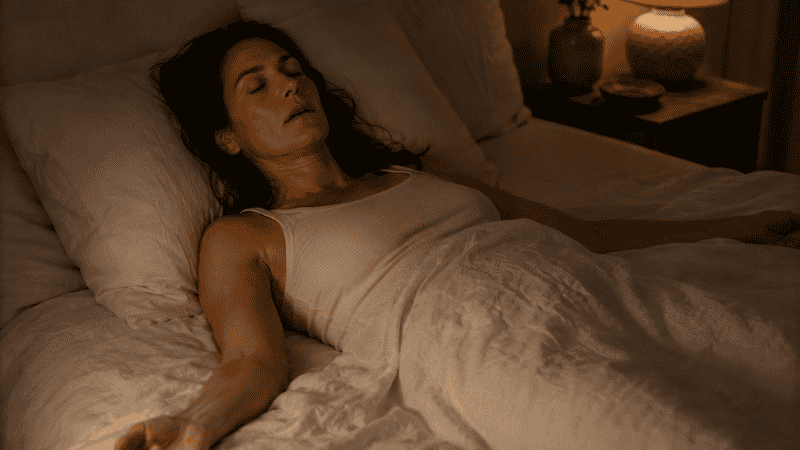
- Lie comfortably on your back
- Take three slow breaths to settle
- Bring your attention to the soles of your feet — notice any sensation: temperature, pressure, tingling, or nothing at all
- Hold your attention there for 20–30 seconds
- Slowly move attention up: feet → ankles → calves → knees → thighs → hips → lower back → stomach → chest → hands → forearms → upper arms → shoulders → neck → face → scalp
- At each region, simply notice without judgment — tension, warmth, neutrality, anything
- If thoughts arise, notice them briefly and return to wherever you were in the scan
The scan takes 15–20 minutes done fully. A shortened version — just scanning from feet to chest — takes 8–10 minutes and is effective as a starting practice.
5. Guided Imagery: For Minds That Need Direction
Best for: People who struggle to self-direct their attention; those who find breathing and body scan meditation too internally focused; people who respond well to narrative or visual content.
Guided imagery uses mental visualization to create a sense of safety and calm. By imagining a peaceful, specific scene in sensory detail — the sound of water, the warmth of sunlight, the smell of a forest — you activate the neural circuitry associated with those experiences, producing genuine physiological calming rather than mere distraction.
The key to effective guided imagery is sensory specificity. Vague instructions to “imagine somewhere peaceful” produce weak effects. The more specific and multi-sensory the image, the stronger the response.
How to practice:
- After a few slow breaths, close your eyes and begin to visualize a specific place that feels genuinely safe and calm to you — this is personal, not prescribed
- Build the image detail by detail: What is the light like? What sounds are present? What can you feel against your skin — a breeze, warmth, the texture of a surface? Is there a scent?
- Stay in the scene, adding detail and allowing it to develop, as if you’re walking through it slowly
- If thoughts intrude, acknowledge them briefly (“just a thought”) and return to the scene
Guided imagery is also available in audio form — apps and YouTube resources offer guided versions that are particularly helpful if self-directing attention feels difficult.
Which Technique Should You Start With?
| Your main problem | Start with |
|---|---|
| Physical tension you can feel (jaw, shoulders, neck) | Progressive Muscle Relaxation |
| Anxious mind that won’t stop generating thoughts | Body Scan or Guided Imagery |
| General difficulty settling, mild anxiety | 4-7-8 Breathing or Extended Exhale |
| Breath awareness feels activating rather than calming | Body Scan or Guided Imagery first |
| You want the fastest possible effect | Extended Exhale Breathing |
| You’re new to all of these | Diaphragmatic breathing → then 4-7-8 |
When Relaxation Techniques Aren’t Working
This is the most important section for the many people who have tried breathing or body scan techniques and found them ineffective. Here’s what’s usually happening.
You’re trying to force relaxation. Paradoxically, approaching these techniques with an agenda — “I need to fall asleep, this needs to work” — activates the monitoring function of the anxious mind and undermines the practice. The goal is to redirect attention and allow the parasympathetic response to develop, not to achieve sleep directly. Releasing the outcome agenda is itself part of the practice.
You’ve only tried once or twice. The nervous system learns through repetition. The first session of 4-7-8 breathing produces a modest response. The fifteenth session, practiced consistently over three weeks, produces a significantly stronger one. These techniques build in effectiveness — which means they’re often most needed in the moments when they’re least practiced.
You’re using them as a last resort. Relaxation techniques work better as a regular before-bed practice than as an emergency intervention after 45 minutes of lying awake. If you begin the extended-exhale breathing while you’re still relatively calm — before the frustration sets in — the response develops more reliably.
The underlying anxiety needs more than breathwork. For moderate-to-severe anxiety that’s present throughout the day, breathing and relaxation techniques are helpful tools but not complete solutions. Cognitive Behavioral Therapy for Insomnia (CBT-I) addresses the thought patterns that sustain anxiety-driven insomnia at a deeper level. If your sleep difficulty is severe or persistent, CBT-I is worth exploring.
A Simple 10-Minute Routine for Tonight
If you want to start tonight without reading everything above:
- Get into bed and lie on your back
- Take one slow breath — in for four counts, out for six — and notice the exhale
- Do the shortened PMR: tense your feet firmly for five seconds, release for twenty. Move to your calves, thighs, stomach, shoulders, jaw — same pattern
- Finish with five slow extended-exhale breaths
- Roll to your preferred sleeping position and close your eyes
That’s it. Ten minutes. No app required, no audio needed. Repeat the same sequence before sleep for the next two weeks and notice whether your transition to sleep feels smoother.
When to Seek Professional Help
Relaxation techniques for sleep are safe, accessible, and appropriate for most adults with anxiety-driven or stress-related sleep difficulty. But there are situations where professional support is warranted.
Consider speaking with a healthcare provider if:
- Sleep difficulty has persisted for more than three months despite consistent effort
- You suspect sleep apnea — loud snoring, gasping, morning headaches, or excessive daytime sleepiness despite adequate time in bed
- Anxiety is significantly present during the day and not just at bedtime — this often responds better to therapy than to self-directed relaxation practices alone
- Mood changes accompany sleep difficulty — depression and sleep problems are bidirectionally linked and often need treatment together
- You’ve practiced these techniques consistently for four weeks with no improvement
CBT-I is the first-line evidence-based treatment for chronic insomnia and is more effective than sleep medication in long-term outcomes. It incorporates and builds on relaxation techniques while also addressing the cognitive and behavioral patterns that sustain insomnia.
Frequently Asked Questions

What is the best relaxation technique to fall asleep fast?
For the fastest physiological response, extended-exhale breathing — particularly the 4-7-8 ratio — is the most studied and most consistently effective for rapid nervous system calming. It can lower heart rate by 10–15 bpm within two minutes and produces noticeable effects on the first try. That said, “fast” is relative: the technique works more reliably with several weeks of regular practice. For immediate relief on a difficult night, combining three minutes of extended-exhale breathing with a shortened body scan (just feet to chest) tends to work better than either alone.
How do I stop my mind from racing at night?
Racing thoughts at night are usually a cognitive activation problem — the mind has no assigned task and fills the space with worry or planning. The most effective counter is redirection rather than suppression. Body scan meditation is particularly effective because it gives the mind a specific, neutral task (noticing physical sensation) that requires enough attention to crowd out anxious thought generation without being stimulating. A written brain dump before bed — writing down whatever is circling in your mind, without trying to solve it — also reduces the brain’s felt need to keep processing during sleep.
Does progressive muscle relaxation actually help with sleep?
Yes, and it’s one of the most studied relaxation techniques for insomnia specifically. The 2021 study in Evidence-Based Complementary and Alternative Medicine found significant improvements in relaxation states from PMR, and multiple clinical trials have demonstrated reduced sleep onset time and improved sleep quality with regular practice. It’s most effective for people whose insomnia has a significant physical tension component — jaw clenching, shoulder tension, stomach tightness — which is common in people under chronic stress.
Can breathing exercises help with anxiety-related sleep problems?
Yes, directly. Anxiety-driven sleep difficulty involves a cortisol-mediated arousal state that breathing techniques specifically counteract. The extended exhale activates the vagus nerve, which sends the calming signal to the heart, lungs, and brain. Research on 4-7-8 breathing and diaphragmatic breathing both show significant reductions in subjective anxiety and physiological stress markers. For anxiety that is present throughout the day — not only at bedtime — breathing techniques are most effective as part of a broader anxiety management approach.
How long should I practice relaxation techniques before bed?
Even five to ten minutes produces measurable effects. Most protocols recommend 15–20 minutes for full progressive muscle relaxation or body scan, but shortened versions done consistently are more effective than complete versions done sporadically. The consistency of daily practice matters more than the duration of any individual session. Begin with the technique that feels most accessible and do it every night — including nights when you sleep well — for the first two weeks to establish the response.
What if relaxation techniques make me more anxious?
This is uncommon but real, particularly with breathing techniques for people who have panic disorder, trauma history, or high interoceptive sensitivity (heightened awareness of internal bodily sensations). If focused breathing increases anxiety rather than reducing it, switch to body scan meditation (which is less physiologically focused) or guided imagery (which redirects attention outward rather than inward). Starting with shorter sessions — two to three minutes rather than ten — can also help the nervous system adapt gradually.
The Simplest Possible Summary
Your nervous system doesn’t shut down on command. But it can be guided — gently, deliberately, with specific physiological inputs that signal safety and calm.
The extended exhale tells your vagus nerve to stand down. Progressive relaxation tells your muscles the tension is no longer needed. The body scan gives your mind somewhere neutral to rest while the physiological shift happens underneath.
None of these are difficult. None cost anything. All of them are available right now, in whatever bed or chair you’re in. The only requirement is consistency — practiced before you need them, so they work when you do.
Start with one. Do it tonight. Do it again tomorrow.
For the complete evening approach that pairs these techniques with the right environment and timing, read our guide on building a night routine for better sleep. And if anxiety is the primary driver of your sleep difficulty, our guide on why you keep waking up at 3am addresses the cortisol and nervous system patterns that relaxation techniques most directly support.
References
- Toussaint, L., Nguyen, Q. A., Roettger, C., Dixon, K., Offenbächer, M., Kohls, N., Hirsch, J., & Sirois, F. (2021). Effectiveness of progressive muscle relaxation, deep breathing, and guided imagery in promoting psychological and physiological states of relaxation. Evidence-Based Complementary and Alternative Medicine, 2021, 5924040.
- Vierra, J., Boonla, O., & Prasertsri, P. (2022). Effects of sleep deprivation and 4-7-8 breathing control on heart rate variability, blood pressure, blood glucose, and endothelial function in healthy young adults. Physiological Reports, 10(13), e15389.
- Naik, G. S., Gaur, G. S., & Pal, G. K. (2018). Effect of modified slow breathing exercise on perceived stress and basal cardiovascular parameters. International Journal of Yoga, 11(1), 53–58.
- National Center for Complementary and Integrative Health. (2021). Relaxation techniques: What you need to know. https://www.nccih.nih.gov/health/relaxation-techniques-what-you-need-to-know
- Morin, C. M., & Benca, R. (2012). Chronic insomnia. The Lancet, 379(9821), 1129–1141.
NourishDAO publishes sleep and wellness content for informational purposes only. This article is not a substitute for professional medical advice, diagnosis, or treatment. If you have persistent sleep difficulties, please consult a qualified healthcare provider.