
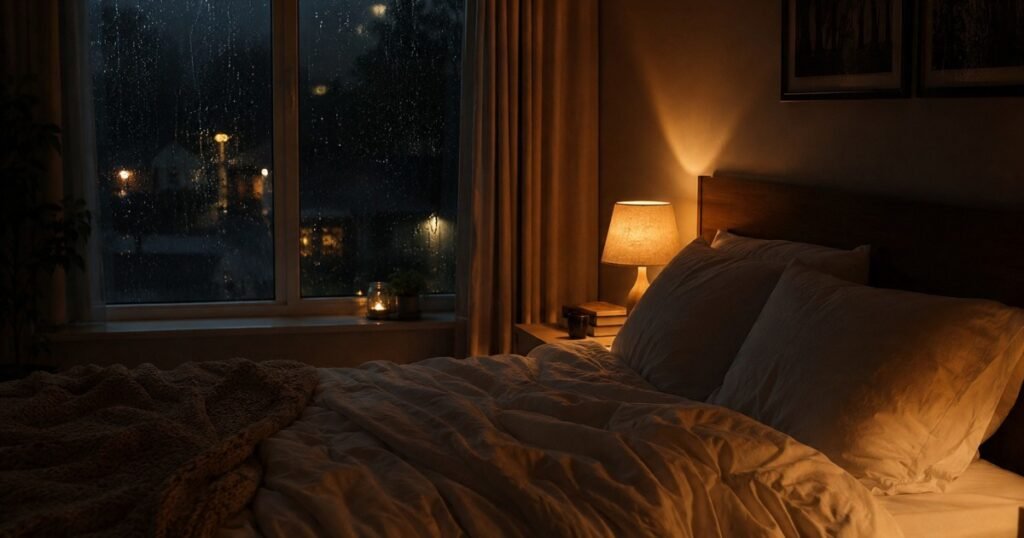
I still remember the first time I really couldn’t sleep. It wasn’t dramatic — no crisis, no emergency. I was just lying there at 1:14am, staring at the ceiling while my brain catalogued every mildly awkward interaction I’d had in the previous three weeks. The apartment above mine had a creaky walker. A car alarm went off twice. My partner was breathing at a perfectly normal volume that somehow felt unreasonably loud.
I opened YouTube, typed “rain sounds,” hit play on the first result, and — I’d be lying if I said I was immediately cured. But something shifted. The racing thoughts slowed. The ambient noise of the building blurred into the background. I fell asleep within about twenty minutes, and I genuinely don’t know if I would have otherwise.
Here’s what I’ve learned since then: rain sounds aren’t magic. They don’t sedate you, they don’t cure insomnia, and they won’t fix whatever structural issues are disrupting your sleep. What they do — and what they do remarkably well when used correctly — is create a specific kind of acoustic and psychological environment that makes it easier for a wound-up brain to let go.
This article isn’t going to tell you to just play rain sounds and hope for the best. I’m going to walk you through the actual science of why they work, the specific ways they quiet racing thoughts, how to choose the right type for your situation, and — this part most guides skip — the mistakes that make them less effective or create a dependency you didn’t sign up for.
What You’ll Learn
In this guide, you’ll learn:
- Why rain sounds help calm the brain and make it easier to fall asleep.
- How rain sounds compare with white noise and brown noise for different sleep challenges.
- How to choose the best type of rain sound based on your sleep environment and personal preferences.
- Common mistakes that can reduce the benefits of sleep sounds, including playing them too loudly or all night.
- How to use the 30-Minute Sleep Bridge Method to support healthy sleep without relying on continuous audio.
- How to combine rain sounds with light, temperature, and bedtime habits for a more effective natural sleep routine.
Why Rain Sounds Help You Fall Asleep Faster
Before rain sounds can help you sleep, it’s worth understanding why your brain responds to them differently from music, television, or everyday background noise. The answer lies in how the nervous system interprets predictable natural sounds as signals of safety.

Why rain feels safe to the human brain
There’s a reason rain sounds have been used for relaxation across cultures for centuries, long before anyone studied the neuroscience of it. The explanation isn’t complicated once you understand it: for most of human history, rain meant your tribe wasn’t moving, hunting wasn’t happening, and external threats were reduced. Rain was, evolutionarily speaking, a signal that you could stop being vigilant.
Your brain still carries that association. Rain activates what researchers call a “safety signal” — it’s a sound pattern that tells the nervous system, at a very deep level, that nothing dangerous is happening. This isn’t metaphorical. Neuroimaging studies on nature sounds show reduced activity in the amygdala (the brain’s threat-detection center) and increased activity in the prefrontal cortex during exposure to natural sounds like rain. Your brain literally relaxes its guard.
This is distinct from what happens with, say, instrumental music or ambient electronic tracks. Those can also be calming, but they don’t carry the same evolutionary weight as sounds the brain has been processing as “safe” for thousands of years.
Rain sounds are a form of pink noise
Acoustically, rain is what researchers classify as pink noise — a sound spectrum where energy decreases at higher frequencies in a mathematically consistent way. Unlike white noise, which distributes energy equally across all frequencies (and sounds harsh to many people), pink noise emphasizes lower frequencies and produces a warmer, more natural tone.
A study published in Frontiers in Human Neuroscience found that pink noise synchronized with slow brain oscillations significantly enhanced deep sleep and memory consolidation in participants. The effect was measurable in polysomnography data — participants showed stronger slow-wave sleep activity when exposed to pink noise timed appropriately.
Rain sounds produce a pink noise spectrum naturally, which is one reason they tend to be more soothing and sleep-compatible than pure white noise for many people. The spectrum matches what the brain finds acoustically comfortable rather than stimulating.
How predictable sounds calm the nervous system
The key word in how rain sounds work is predictable. Individual raindrops are random, but the overall pattern of rainfall — the continuous, slightly variable, non-threatening soundscape — is deeply predictable at the level your nervous system processes. There are no sudden changes in pitch, no voice, no tonal variation that demands interpretation.
This predictability is neurologically significant. Your auditory cortex is constantly evaluating incoming sounds for novelty and potential threat. A sudden noise requires attention; a predictable background sound can be safely deprioritized. When the acoustic environment is predictable and non-threatening, the brain’s monitoring load drops — which creates the physiological conditions for sleep to begin.
How Rain Sounds Help Quiet Racing Thoughts
Most articles about rain sounds treat them as ambient background. They’re missing the more interesting and more useful part of the story — the specific mechanism by which rain sounds interact with the thought patterns that keep people awake.
Interrupting internal mental chatter
Racing thoughts — the replay loop of conversations, the planning spiral, the anxiety catalog that activates the moment you lie down — are a form of internal attention. Your brain is directing its processing resources toward mental content rather than toward the sensory environment.
Rain sounds work partly by giving the auditory cortex something to gently process that is engaging enough to pull partial attention away from internal chatter, but not engaging enough to prevent sleep. This is sometimes called “cognitive distraction through non-demanding stimulation” — and it’s precisely what makes rain effective where silence fails.
In silence, internal thought has no acoustic competition. Rain sounds provide a gentle interference pattern that makes the thought loop harder to sustain at full volume. You don’t stop thinking — you just lose grip on the thoughts long enough for sleep to arrive.
Reducing anxiety before bedtime
Anxiety at bedtime is a physiological state, not just a cognitive one. Cortisol is elevated, heart rate is slightly higher than ideal, and the body’s threat-monitoring systems are running in the background. Rain sounds address this partly through the safety signal described above, and partly through their effect on the autonomic nervous system.
Research on nature sounds — including rain — has found reduced skin conductance (a measure of physiological arousal), lower heart rate, and increased heart rate variability (a marker of parasympathetic nervous system activity) during exposure. These are the same physiological markers that relaxation techniques like slow breathing target. Rain sounds produce a similar, if milder, effect — without requiring any deliberate effort.
For people with bedtime anxiety, this combination of cognitive distraction and autonomic calming is genuinely useful. It’s not a treatment for anxiety disorder, but it removes some of the friction between an activated state and a sleep-ready one.
Helping your brain transition into sleep mode
Sleep onset isn’t instantaneous — it’s a transition that requires the brain to progressively disengage from environmental monitoring and internal processing. This transition is easier when the environment provides consistent, low-demand sensory input rather than silence (which the hypervigilant brain can fill with internal content) or variable noise (which demands monitoring).
Rain sounds create what I’d call an optimal transition environment: consistent enough that the brain stops monitoring it, present enough that internal thought doesn’t flood in unchecked. The result is a more reliable passage from wakefulness to sleep, particularly for people whose transition is typically disrupted by a busy mind.
The Acoustic Shield: How Rain Sounds Block Disruptive Noise
Even if you fall asleep easily, an unexpected car horn, hallway conversation, or slamming door can pull your brain back into alert mode. Rain sounds act like an acoustic shield, reducing the contrast between background noise and sudden sounds so your sleep is less likely to be interrupted.
Understanding sound masking
Sound masking isn’t about being louder than the sounds you’re blocking. It’s about reducing the contrast between background sound level and disruptive sounds — the ratio that determines whether your brain registers something as a “noise event” worth waking for.
In a quiet room, a door closing three apartments away might be audible enough to pull you out of light sleep. In a room with continuous rain sounds at a consistent volume, that same door closing is partially absorbed into the acoustic background. The absolute sound level hasn’t changed, but the contrast ratio has — and it’s contrast that wakes you up, not absolute volume.
This is the core mechanism of sound masking, and it’s why rain sounds (like all consistent background sounds) are particularly effective in environments with unpredictable noise events.
Blocking sudden nighttime noises
The sleep stages most vulnerable to noise disruption are N1 (the transition into sleep) and N2 (light sleep), which occur repeatedly throughout the night. Deep slow-wave sleep (N3) has higher arousal thresholds and is harder to disrupt. REM sleep is more variable.
Rain sounds are most protective during the light sleep stages — which is where noise-sensitive people most commonly experience sleep fragmentation. A car backfiring, a neighbor’s TV, a hallway conversation — these are the sounds most likely to produce partial arousal or full waking in a quiet room. Continuous rain sounds narrow that window by raising the ambient acoustic floor.
When rain sounds work better than white noise
For many people, rain sounds are more effective sleep aids than traditional white noise. The reasons are practical:
Tonal quality: White noise at sufficient masking volume can sound harsh or abrasive. Rain at equivalent volume sounds natural and doesn’t fatigue the auditory system the same way.
Psychological association: White noise is associated with machinery and electronics. Rain is associated with rest, shelter, and safety. The psychological loading is different, and it matters.
Volume ceiling: Because rain is perceptually easier to tolerate, you can run it at a masking-effective volume without it becoming intrusive. Some people find white noise at masking volume actually disrupts sleep rather than supporting it.
That said, this is individual. Some people find white noise more effective, particularly for very loud environments where rain’s softer texture doesn’t provide adequate masking. The right choice is the one that works for your specific acoustic environment and sensitivity.
Rain Sounds vs. White Noise vs. Brown Noise: Which One Is Best for Sleep?
| Feature | 🌧 Rain Sounds | ⚪ White Noise | 🟤 Brown Noise |
|---|---|---|---|
| Sound Type | Natural pink-noise-like sound | Equal energy across all frequencies | Deeper, bass-heavy sound |
| Best For | Anxiety, racing thoughts, light sleepers | Blocking loud or unpredictable noise | Deep relaxation and low-frequency masking |
| How It Feels | Calm, natural, soothing | Constant, steady, neutral | Deep, rich, immersive |
| Noise Masking | ★★★★☆ | ★★★★★ | ★★★★☆ |
| Relaxation | ★★★★★ | ★★★☆☆ | ★★★★★ |
| May Feel Too Harsh? | Rarely | Sometimes | Rarely |
| Ideal Environment | Quiet bedrooms, bedtime routines | Apartments, city noise, snoring | Low-frequency traffic or HVAC noise |
| Potential Drawback | Less effective for extremely noisy spaces | Can sound artificial or tiring | May feel too deep or “boomy” for some people |
| Recommended For | ⭐ Most people looking to fall asleep naturally | People needing maximum noise masking | People who enjoy deeper, softer soundscapes |
Quick Recommendation
If you’re not sure where to start, rain sounds are the best choice for most people because they combine the gentle characteristics of pink noise with the calming effect of natural soundscapes. White noise is often better for extremely noisy environments, while brown noise may appeal to people who prefer deeper, bass-rich sounds.
Choosing the Right Rain Sound for Your Sleep Style
I spent about three months casually experimenting with different rain sounds before I landed on what consistently works for me. I tried thunderstorm tracks that I found initially dramatic and exciting — which turned out to be the opposite of what I needed. I tried forest rain that felt pleasant but somehow too lush. I eventually settled on steady moderate rainfall with no thunder, no birds, no music — just rain on what sounds like leaves and earth.
What works varies significantly by person. Here’s a practical framework:
Gentle rainfall
A soft, light rain without wind or thunder produces minimal masking but maximum psychological safety signaling. This is most effective for:
- Light sleepers who find heavier sounds stimulating or overwhelming
- People with anxiety whose primary issue is nervous system activation rather than environmental noise
- People who sleep in relatively quiet environments and need help with the mental transition rather than noise masking
If you find yourself tensing up at louder rain sounds rather than relaxing, start here.
Steady forest rain
Moderate rainfall with a natural environment texture — the sound of rain on leaves, soft ground, gentle water movement. This is the most versatile option and works well for:
- Everyday sleep support across most situations
- People who want something present enough to be useful but not so prominent it becomes the focus
- Those who find pure rain too sparse but thunderstorms too stimulating
This is the category most people end up in after some experimentation.
Heavy rain
Intense rainfall with significant acoustic presence — effective masking capability, prominent enough to override significant background noise. Most useful for:
- People in genuinely noisy environments (city apartments, thin walls, street noise)
- Those who find lighter sounds inadequate for blocking intrusive noise
- People who find heavy rain psychologically comforting rather than alarming
Not suitable for everyone — some people find heavy rain activating rather than calming, particularly if it’s associated with stressful memories or severe weather anxiety.
Rain with thunder
Thunder adds periodic, lower-frequency acoustic events to the rain baseline. Many people find this deeply relaxing — the predictable rumble of distant thunder has its own safety signal quality for those who grew up associating storms with staying inside and being warm.
However: thunder is not ideal for everyone. For people with storm anxiety, or for those whose sleep is disrupted by sudden acoustic changes, the thunder component can produce arousal rather than relaxation. Test this during the day before using it as a sleep aid at night.
A note across all categories: none of these is universally best. The most important thing is that the sound you choose doesn’t demand your attention. If you’re listening to the rain rather than dissolving into it, it’s not working as a sleep aid — it’s working as entertainment. Adjust the type or volume until it becomes background rather than content.
The Biggest Mistakes People Make With Rain Sounds
If you’ve tried rain sounds but still wake up feeling tired, the problem may not be the sound itself—it may be how you’re using it. A few common habits can quietly reduce the benefits, even when the audio seems relaxing at first.
Playing it too loudly
This is the most common and most consequential mistake. The right volume for sleep isn’t the volume that sounds pleasant — it’s the minimum volume that achieves the masking or calming effect you need.
Current sleep sound guidelines suggest keeping audio below 65 decibels and ideally in the 50–60 dB range. At higher volumes, continuous sound can disrupt sleep architecture rather than support it, and prolonged exposure at excessive volumes carries real hearing risk over time.
A practical test: if you can comfortably hold a conversation at normal speaking volume while the rain plays, the volume is probably appropriate for sleep. If you need to raise your voice, it’s too loud.
Listening all night
I made this mistake for months. I set rain sounds to play continuously, assumed they were helping, and woke up seven or eight hours later having experienced what felt like normal sleep. But when I started using a timer — cutting off the sound after 30 to 45 minutes — my sleep felt subjectively better the following morning, consistently.
There’s a real explanation for this, which I’ll cover in the Sleep Bridge section. The short version: continuous sound throughout the night may interfere with the natural acoustic environment that deeper sleep stages benefit from, and for some people, the brain partially continues monitoring the audio rather than fully disengaging.
Using phone speakers beside the pillow
Phone speakers are, acoustically, bad. The frequency response is narrow, the volume tops out lower than you might want for masking, and — more importantly — the phone itself becomes an object beside your head with screen light, notification potential, and all the psychological associations that prevent sleep.
Playing rain sounds through your phone speaker while the phone sits on your nightstand facing up, with notifications enabled, is working against yourself.
Wearing earbuds throughout the night
This feels counterintuitive — earbuds seem like a more controlled way to hear the rain. But sleeping with earbuds creates real problems: physical discomfort (most earbuds aren’t designed to be worn horizontally for hours), ear canal hygiene issues with extended overnight use, and — most significantly — the risk that the earbud cord becomes tangled or the pressure creates ear discomfort that disrupts sleep.
Sleep-specific headphones (flat, pillow-embedded, or bone conduction designs) are a genuinely different category and worth considering if you want personal audio. Standard earbuds worn overnight are not.
The 30-Minute Sleep Bridge Method
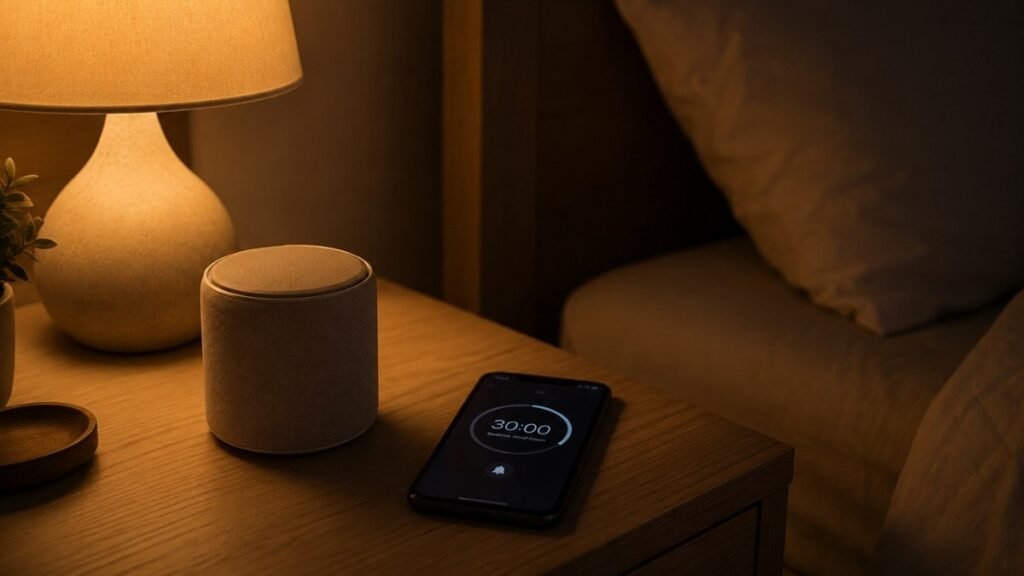
After experimenting with different approaches over about a year, I landed on what I think of as the Sleep Bridge — and it’s the approach I now consistently recommend.
The problem with continuous rain sounds all night is that you’re training your brain to need them. The goal should be to use rain sounds as a bridge to sleep, not as a permanent feature of your sleep environment.
Here’s how the method works:
Minutes 0–10: Begin your wind-down with rain sounds playing at a comfortable volume. This is the decompression phase — you’re lowering cortisol, quieting the nervous system, and beginning the transition from the day’s demands.
Minutes 10–30: Continue rain sounds through the critical transition period. This is when racing thoughts are most likely to interfere and when environmental noises are most likely to prevent sleep onset. The rain sounds are doing their most important work here.
Timer: Set a timer for 30 minutes (some people do 45, depending on how long their typical sleep onset takes). The audio stops automatically.
Natural silence: Sleep continues in your room’s natural acoustic environment. You’re already in a sleep state by this point, and the brain’s arousal threshold is higher. The silence doesn’t wake you — it simply allows the natural sleep architecture to proceed without the sound becoming a permanent dependency.
Why this matters for REM sleep: REM sleep is the stage most sensitive to disruption and also the stage that processes emotional memory and supports cognitive function. Some research suggests that continuous acoustic stimulation throughout the night may affect REM architecture for certain individuals. By allowing natural silence during the deeper portions of the night, you’re protecting the sleep stages that matter most for restoration.
The adjustment to the timer takes a few nights. You may wake briefly when the sound stops for the first week. This is normal and typically resolves within 5–7 days as the brain learns that silence at that point means sleep continues, not that something requires attention.
Build a Better Sleep Environment Around Rain Sounds
Rain sounds work better when they’re part of a coherent sleep environment rather than the only change you’ve made. Here’s what pairs well:
Dim the lights
Light suppresses melatonin production — the circadian signal that tells your brain sleep is approaching. Dimming lights 60–90 minutes before bed, switching to warm-spectrum lamps, and avoiding overhead lighting in the evening creates the low-light environment in which rain sounds are most effective. The two together — darkness and calming sound — produce a stronger sleep onset signal than either alone.
Cool your bedroom
The optimal sleep temperature range is 65–68°F (18–20°C). Your core body temperature needs to drop slightly to initiate and sustain sleep, and a warm bedroom actively counteracts this. Rain sounds won’t compensate for a room that’s too warm. Cool the environment first, then add the sound.
Reduce evening screen exposure
Screen content activates the exact cognitive and emotional processing that rain sounds are trying to quiet. News, social media, work email, and emotionally stimulating video content in the 30–60 minutes before bed maintain the arousal state that rain sounds need to overcome. Reduce the screen load before starting the rain sounds, and they’ll work considerably faster.
Pair rain sounds with breathing exercises
Slow extended-exhale breathing (in for 4 counts, out for 6–8) combined with rain sounds targets the nervous system’s calming response from two directions simultaneously. The breathing directly stimulates the vagus nerve; the rain sounds reduce environmental monitoring and cognitive interference. Together, they produce a faster and more reliable transition to sleep than either alone.
Create a consistent bedtime routine
My actual evening sequence, on the nights I sleep best: warm shower around 9:30, lights dimmed, phone in another room, rain sounds started on a Bluetooth speaker across the room, ten minutes of reading something genuinely unengaging, then sleep. The sequence itself has become a signal — my nervous system now begins downshifting when I step into the shower, before the rain sounds even start, because the pattern has been repeated enough to become conditioned.
Consistency is the force multiplier for all of this. Rain sounds used sporadically on bad nights produce moderate benefit. Rain sounds as part of a consistent nightly ritual produce compounding benefit over weeks.
Best Devices for Playing Rain Sounds
The quality of your sleep doesn’t depend on rain sounds alone—it also depends on how you play them. The right device can create a more natural, balanced soundscape, while the wrong one may introduce distortion, discomfort, or unnecessary distractions.
Bluetooth speakers
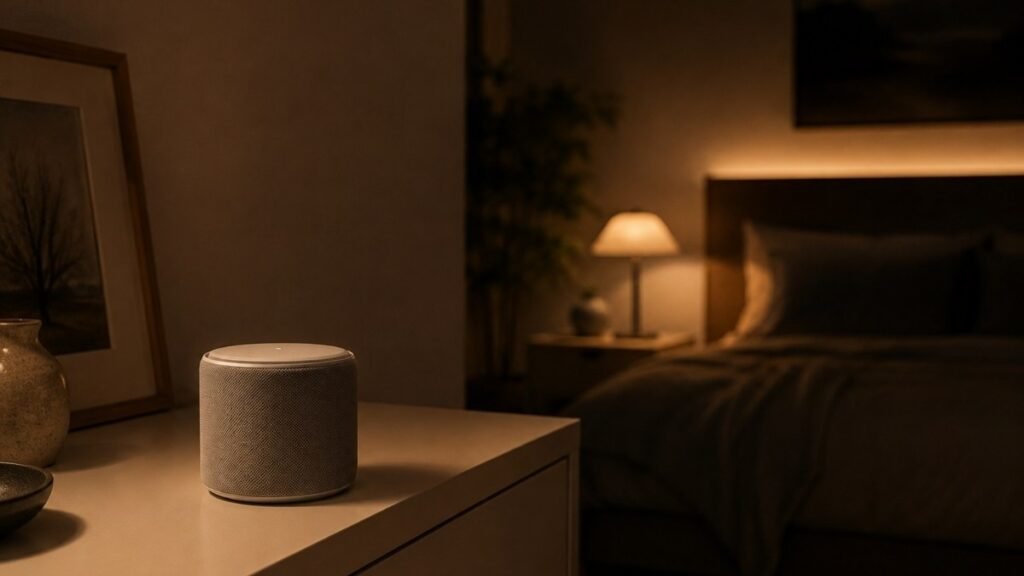
A quality Bluetooth speaker placed across the room — not beside the pillow — is the best general option for rain sounds. The acoustic quality is significantly better than phone speakers, the volume can be set appropriately for masking without distortion, and the physical distance from your head means you’re not hearing compressed, narrow-spectrum audio all night.
Look for speakers with: at least 90dB SPL capacity (so you’re not pushing the speaker to its limit at your target volume), a frequency response that includes low frequencies (for the warm texture of rain), and battery life sufficient to run through a timer without cutting out prematurely.
Sleep sound machines
Dedicated white noise and sleep sound machines have improved significantly. Models from LectroFan, Marpac, and similar manufacturers offer specifically tuned acoustic profiles, mechanical volume controls (no screen required at 2am), and stable power that doesn’t run down a battery. If you use rain sounds consistently every night, a dedicated machine is a better long-term investment than a phone or Bluetooth speaker.
The limitation: app-based variety. Dedicated machines have limited sound options compared to streaming services or apps. If sound variety matters to you, a Bluetooth speaker with your preferred streaming source offers more flexibility.
Sleep headphones
For people who share a bed with a light-sleeping partner, or who need particularly effective masking without disturbing others, purpose-built sleep headphones are worth exploring. These fall into a few categories:
Pillow speakers: Thin speakers embedded in or placed inside a pillow, so sound is directed toward your ears while remaining inaudible to a partner at normal volume. The acoustic quality is modest but functional for rain sounds, which don’t require high fidelity.
Flat headband headphones: Soft fabric headbands with embedded speakers — more comfortable for side sleeping than standard headphones. Audio quality varies significantly by product.
Bone conduction headphones: Transmit sound through vibration against the cheekbones rather than through the ear canal. Comfortable for extended wear, effective at keeping audio personal, and becoming more accessible in price.
Why your phone speaker isn’t ideal
I used my phone speaker for the first eight months of trying rain sounds for sleep. The experience was fine — the sounds played, I fell asleep. But when I switched to a quality Bluetooth speaker, the difference was immediately apparent.
Phone speakers produce a compressed, treble-heavy version of rain sounds. They’re engineered for voice calls and music listening at a distance, not for sustained low-frequency acoustic environments. The bass frequencies that give rain its characteristic warmth and soothing quality are significantly reduced. You’re essentially hearing a diminished version of what the track actually sounds like — and for something you’re using to help your nervous system settle, audio quality actually matters.
Who Benefits Most From Rain Sounds?
The benefits of rain sounds depend on both your sleep environment and the reasons you’re struggling to sleep. For people dealing with anxiety, light sleep, or environmental noise, they can provide meaningful support—but they’re not a universal solutio
People with anxiety
The combination of safety signaling, cognitive distraction, and autonomic calming makes rain sounds particularly well-suited for anxiety-driven sleep difficulty. For people whose primary barrier to sleep is a nervous system that won’t stand down, rain provides a specific kind of acoustic environment that reduces the monitoring load and gives the mind something gentle to rest against.
Light sleepers
Light sleepers — people who wake at minor sounds throughout the night — benefit significantly from the masking function of rain sounds. By raising the ambient acoustic floor, rain reduces the contrast between background and disruptive sounds, narrowing the window during which minor noises produce arousal.
Shift workers
People working irregular or night schedules often need to sleep during daylight hours or in acoustically active environments. Rain sounds provide both the masking needed to sleep through daytime noise and the circadian-neutral acoustic environment that doesn’t confuse the sleep timing system the way light or activity-based sounds might.
Students under stress
Academic stress produces exactly the kind of evening cortisol elevation and racing-thought pattern that rain sounds are most effective at interrupting. For students studying until late and then struggling to turn off the mental processing, rain sounds provide a consistent transition signal that the study period is over.
People living in noisy neighborhoods
City noise — traffic, neighbors, HVAC systems, nightlife — is one of the clearest use cases for rain sounds as acoustic masking. For people whose sleep is routinely disrupted by environmental noise they can’t control, consistent masking sound is a practical and effective intervention.
When Rain Sounds May Not Be the Right Solution
Rain sounds are a useful tool, not a universal one. There are situations where they’re the wrong intervention:
Untreated sleep apnea. If your sleep is fragmented because of repeated breathing interruptions during the night, acoustic masking won’t address the underlying problem. Signs of sleep apnea include loud snoring, waking with headaches, gasping during sleep (reported by a partner), and excessive daytime sleepiness despite adequate time in bed. Rain sounds may mask the snoring from a partner’s awareness without addressing the apnea itself. If these signs apply to you, a sleep study should precede any sound-based intervention.
Chronic insomnia. For primary chronic insomnia — the persistent inability to fall or stay asleep over months — rain sounds may help at the margins but won’t address the conditioned arousal, sleep anxiety, and behavioral patterns that maintain the condition. CBT-I (Cognitive Behavioral Therapy for Insomnia) is the evidence-based first-line treatment; rain sounds can be a useful complement, not a replacement.
Hearing sensitivity or tinnitus. People with tinnitus sometimes find rain sounds helpful (the masking can reduce the perceived prominence of tinnitus), but others find that constant sound stimulation worsens their symptoms. Anyone with significant hearing sensitivity should start at very low volumes and assess the effect carefully before using rain sounds regularly.
Severe anxiety disorders. For people with clinical anxiety disorders — particularly those involving hypervigilance or trauma responses — rain sounds may be insufficient or, in some cases, counterproductive. A therapist or psychiatrist familiar with sleep-anxiety interactions is more appropriate than self-directed sound therapy.
When to see a doctor: If you’ve had significant sleep difficulty for more than three months, if sleep problems are substantially impairing your daytime function, or if you have symptoms suggesting an underlying medical cause (as above), sound-based interventions should follow professional evaluation rather than replace it.
FAQ
Is it bad to sleep with rain sounds all night?
Not necessarily harmful, but not optimal for most people. Continuous rain sounds throughout the night can create dependency — over time, your brain may struggle to initiate or maintain sleep without them. There’s also emerging evidence that some individuals experience altered sleep architecture with continuous auditory stimulation throughout all sleep stages. The Sleep Bridge method (30–45 minute timer) avoids both issues while capturing the primary benefits.
What volume is safest for rain sounds during sleep?
Sleep researchers generally recommend keeping sleep audio at 50–65 decibels — roughly the level of a normal conversation or light background noise. At this volume, you achieve acoustic masking without risking hearing damage or disrupting sleep architecture. If you’re regularly pushing volume higher to achieve masking, the solution is a better speaker or a higher-quality recording, not more volume.
Are rain sounds better than white noise?
For most people, yes — though this is individual. Rain’s pink noise spectrum is gentler on the auditory system than pure white noise, its natural quality is psychologically more compatible with rest and safety associations, and it tends to be tolerable at masking-effective volumes without becoming irritating. White noise has a slight edge in pure masking power for extremely loud environments. If you find white noise harsh or uncomfortable, rain sounds are the better option.
Can rain sounds help with anxiety before bed?
Yes, through specific mechanisms: the safety signal associated with natural rain sounds reduces amygdala activity, the predictable acoustic pattern reduces the nervous system’s monitoring load, and the cognitive distraction effect interrupts racing thought patterns. For mild-to-moderate bedtime anxiety, rain sounds are a genuinely useful tool. For clinical anxiety, they’re a complement to — not a replacement for — appropriate treatment.
Should I use headphones or a speaker while sleeping?
A speaker positioned across the room is generally preferable to headphones. Speakers allow natural sound distribution, don’t create physical discomfort during position changes, and don’t raise ear canal hygiene concerns with extended use. If you share a bed and personal audio is necessary, purpose-built sleep headphones (flat headband designs, pillow speakers, or bone conduction devices) are better than standard earbuds, which aren’t designed for overnight use.
Can babies safely sleep with rain sounds?
Low-volume rain sounds are used extensively in infant sleep environments and are generally considered safe. The critical parameter is volume — the American Academy of Pediatrics advises keeping sound machines for infants at or below 50 decibels and at least 7 feet from the sleep space. The concern isn’t the sound type but the volume and proximity. Parents should check the output of their specific device rather than assuming it’s within safe limits.
Why do rain sounds stop working after a while?
This is called habituation — the brain’s natural process of adapting to repeated, non-threatening stimuli. Over time, the novelty and contrast that made rain sounds effective can diminish. The nervous system learns to treat the sound as part of the expected environment rather than as a signal worth processing. The solution isn’t to find more exotic sounds; it’s to vary the specific rain sounds occasionally (different recordings, different types), ensure you’re using them as part of a broader sleep routine rather than relying on them alone, and potentially take brief breaks. Habituation tends to be faster with continuous all-night use than with the timer-limited approach.
Can rain sounds improve deep sleep and REM sleep?
This requires a careful answer. Rain sounds don’t directly increase deep sleep (N3) or REM sleep duration in the way that, say, resolving sleep apnea might. What they do — through their masking function — is reduce nighttime arousals that would otherwise fragment sleep and reduce time in these stages. By creating a more acoustically stable environment, they allow the sleep architecture that’s already there to proceed without interruption.
The distinction matters: rain sounds help you get the deep sleep and REM sleep your biology is capable of by removing obstacles to it. They don’t add stages your body wouldn’t otherwise produce. If your deep sleep is limited by physiological causes — sleep apnea, hormonal changes, age-related changes in sleep architecture — rain sounds won’t compensate for those underlying factors.
Final Thoughts
Rain sounds aren’t a cure for poor sleep — they’re a tool.
The real goal isn’t to fill your bedroom with noise. It’s to create the right conditions for your brain to let go of alertness and naturally transition into sleep. Used thoughtfully, rain sounds can become a gentle bridge between a busy mind and a restful night, especially when paired with healthy evening habits.
What I’ve found, after years of experimenting with this, is that the nights I sleep best aren’t the nights I’ve optimized any single variable. They’re the nights when everything works together — the room is cool, the lights went down early, the phone is in another room, the rain sounds played for thirty minutes and then stopped, and I had no urgent reason to monitor anything. Rain sounds are one part of that. A useful part. But one part.
🌙 NourishDAO Sleep Notes: Why Rain Sounds Work Best as Part of a Bigger Sleep Routine
Better sleep rarely comes from one single habit.
Rain sounds can help quiet a busy mind, but they work best when they’re part of a healthier nighttime routine—not a replacement for one.
Research consistently shows that sleep quality is shaped by multiple factors, including light exposure, bedroom temperature, daily stress, and consistent sleep timing. Sound is one important piece of that puzzle, but it’s most effective when combined with habits that support your body’s natural circadian rhythm.
This guide is based on research covering:
🌧 Natural Sound & Sleep Quality
Studies exploring pink noise, sound masking, and how natural soundscapes support sleep.
🧠 Stress, Anxiety & Nervous System Regulation
Evidence on how predictable sounds may reduce pre-sleep arousal and help calm racing thoughts.
🌙 Healthy Sleep Habits
Research from sleep organizations on building sustainable bedtime routines rather than relying on a single sleep aid.
Our goal isn’t simply to help you fall asleep faster.
It’s to help you build sleep habits that continue working—even when the rain stops.
Continue Building Your Sleep Routine
Sleep is influenced by far more than sound alone. These evidence-based guides can help you create a healthier nighttime routine.
For the full picture on building an environment that supports sleep, read our guide on best temperature for sleep. If racing thoughts are the primary barrier to sleep for you, our guide on how to stop overthinking at night covers the specific techniques that interrupt that pattern.
🌙 A Final Note
Better sleep is rarely about finding one perfect solution.
It’s about creating the right conditions for your body to unwind, your mind to slow down, and healthy sleep to happen naturally.
At NourishDAO, every guide is built on evidence, practical habits, and long-term thinking—not trends, myths, or quick fixes.
Our mission is simple: helping you build healthier sleep habits, one restful night at a time.
NourishDAO publishes sleep and wellness content for informational purposes only. This article is not a substitute for professional medical advice, diagnosis, or treatment. If you have persistent sleep difficulties, please consult a qualified healthcare provider.