
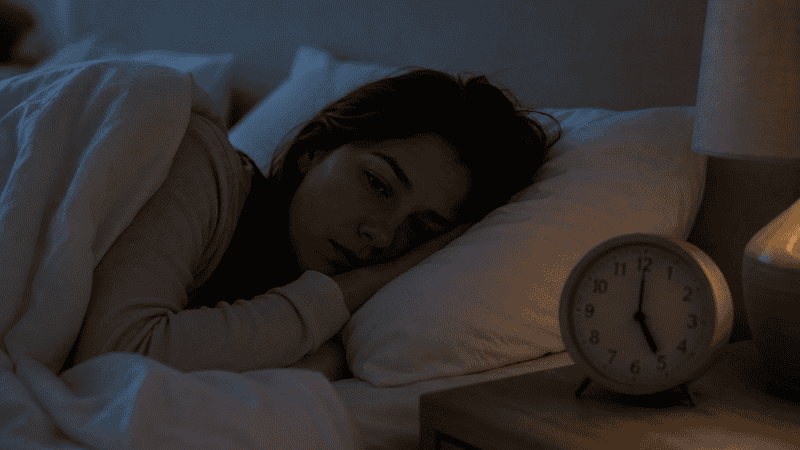
Five hours. You tell yourself it’s fine. You’ve done it before — plenty of times. You functioned. You showed up. You got things done, more or less. And with everything on your plate right now, five hours is honestly the best you can manage.
Maybe it’s the late nights you can’t seem to stop, or the early mornings you can’t avoid. Maybe a baby is making the choice for you. Maybe you’ve convinced yourself you’re one of those people who just doesn’t need as much sleep as everyone else — you’ve read about them, the rare individuals who genuinely thrive on six hours or less.
The honest answer to whether 5 hours of sleep is enough is this: for the vast majority of adults, no — not on a regular basis, and not without consequences that accumulate quietly over time. But how those consequences unfold, what they actually mean for your health, and — most importantly — what you can realistically do about it when five hours is your current reality: that’s what this guide covers.
No judgment. Just the research, plainly explained, and a practical path forward.
Key Takeaways
- The CDC recommends adults get at least 7 hours of sleep per night. Five hours falls below this threshold for virtually all adults, regardless of age.
- Chronically sleeping 5 hours or less is associated with a 14 percentage point increase in depression incidence compared to recommended sleep, according to a 2025 population study of 318,000 U.S. adults published in PLOS ONE.
- Short sleep duration (≤6 hours) is associated with significantly elevated risk of heart disease, type 2 diabetes, obesity, and impaired immune function — effects that build over weeks and months, not just overnight.
- True “short sleepers” — people genetically able to function fully on 5–6 hours — are estimated to make up less than 3% of the population. Most people who believe they’re short sleepers are simply sleep-deprived and have adapted to feeling that way.
- If 5 hours is your current reality, the goal isn’t immediate perfection — it’s identifying your biggest sleep blockers and making one sustainable change at a time.
What the CDC and Sleep Researchers Actually Say About 5 Hours of Sleep
The CDC’s guidance is consistent and clear: adults aged 18–60 should get 7 or more hours of sleep per night. Adults 61–64 should aim for 7–9 hours. Adults 65 and older should get 7–8 hours. These recommendations are shared by the American Academy of Sleep Medicine and the National Sleep Foundation.
Five hours falls short of these thresholds for every adult age group. This doesn’t mean one five-hour night will cause lasting harm — a single short night is something the body can largely recover from. What the research consistently shows is that regularly sleeping five hours or fewer sets in motion a cascade of physiological effects that compound over time.
The gap between five hours and seven isn’t just two hours of lost rest. It’s two hours during which your brain is supposed to be clearing metabolic waste, consolidating memories, regulating hormones, repairing tissue, and resetting your immune defenses. Each night that process is cut short, a small deficit accumulates — one that doesn’t feel dramatic day by day, but shows up months and years later in health outcomes that are hard to trace back to their source.
What Happens to Your Body on 5 Hours of Sleep — The Real Effects

Your brain the next day
Cognitive impairment from sleep deprivation is well-documented and begins after a single night of short sleep. After 5 hours, working memory is compromised, reaction time is measurably slower, and the ability to sustain attention over time — the kind required for driving, complex decisions, and careful work — degrades significantly.
What makes this particularly insidious is that people who are sleep-deprived tend to underestimate how impaired they are. Research from the University of Pennsylvania found that subjects sleeping 6 hours per night for two weeks performed as poorly on cognitive tests as people who had been kept awake for 24 hours straight — but rated their own performance as nearly unaffected. The brain, when chronically sleep-deprived, loses the capacity to accurately assess its own impairment.
Your mood and mental health
A 2025 population study published in PLOS ONE, analyzing data from 318,000 U.S. adults, found that short sleep (≤5 hours) was associated with a 14.1 percentage point increase in depression incidence compared to those sleeping the recommended 6–8 hours. Short sleepers also reported an average of 5.3 more poor mental health days per month and 4.4 more poor physical health days.
These numbers reflect a real pattern: insufficient sleep dysregulates the emotional processing systems in the brain, increases cortisol and inflammatory markers, and reduces the brain’s capacity for emotional regulation. People who are chronically underslept are more reactive to stress, more prone to negative thought patterns, and more likely to interpret neutral situations as threatening.
This isn’t a character issue. It’s neuroscience.
Your cardiovascular health
Short sleep duration has been consistently associated with elevated cardiovascular risk. Research published in PLOS ONE found that sleeping ≤6 hours was associated with elevated cardiometabolic risk scores and increased odds of metabolic syndrome — a cluster of conditions including high blood pressure, elevated blood sugar, excess waist fat, and abnormal cholesterol levels that together raise the risk of heart disease and stroke.
The mechanism involves multiple pathways: elevated cortisol from sleep deprivation increases arterial inflammation, disrupted growth hormone release affects vascular repair, and impaired glucose regulation increases insulin resistance over time.
Your immune function
During sleep — particularly during deep slow-wave sleep — your immune system produces and releases cytokines, the signaling proteins involved in fighting infection and inflammation. Consistently cutting sleep short reduces cytokine production and lowers the effectiveness of the immune response.
One well-known study found that people who slept fewer than 7 hours per night were nearly three times more likely to develop a cold when exposed to the rhinovirus compared to those sleeping 8 or more hours. This isn’t a metaphor for feeling run-down — it’s a measurable reduction in actual immune defense.
Your weight and metabolism
Sleep deprivation disrupts the hormonal regulation of hunger and satiety. Ghrelin (the hunger hormone) increases with sleep loss, leptin (the satiety hormone) decreases, and the reward centers of the brain become more responsive to high-calorie food cues. The result is increased appetite, reduced impulse control around food, and a measurable preference for calorie-dense options — none of which reflects a lack of willpower, but rather a direct hormonal consequence of sleeping too little.
Are You Actually a Short Sleeper — Or Just Adapted to Deprivation?
This is one of the most important questions to honestly answer, because many people who believe they function fine on 5 hours are not short sleepers — they’re chronically sleep-deprived people who have adapted to feeling that way.
True short sleepers — individuals with a specific genetic variant (most commonly in the DEC2 gene) that allows them to fully restore on 5–6 hours — are estimated to make up fewer than 3% of the population. They wake naturally after a short period, feel genuinely rested, perform well on cognitive testing without caffeine, and don’t accumulate apparent health deficits.
The much more common reality is what researchers call “sleep debt adaptation” — a state in which chronic sleep deprivation has normalized. Your subjective sense of tiredness diminishes not because your body no longer needs more sleep, but because it has recalibrated its baseline. You feel okay because your new okay is impaired. Objective cognitive testing in these individuals reliably shows significant deficits that the person themselves doesn’t notice.
A simple self-assessment: if you need an alarm to wake up, rely on caffeine to feel functional, fall asleep easily during passive activities (reading, watching TV, riding in a car), or sleep significantly longer when given the opportunity — you are likely not a natural short sleeper.
What to Do When 5 Hours Is Currently Your Reality
Knowing that 5 hours isn’t ideal is only useful if it comes with a realistic path forward. Here’s what actually helps.

Identify your biggest sleep blocker first
Before adding supplements, tracking devices, or new routines, it’s worth understanding why you’re sleeping five hours. The blockers are different, and so are the solutions:
- You can’t fall asleep early enough → The issue is likely circadian timing, late-night light exposure, or anxiety. The fix involves a consistent wake time, morning light, and a real wind-down window — not just going to bed earlier.
- You fall asleep fine but wake early → This is often cortisol-driven (stress-related early waking) or alcohol-related (which metabolizes and becomes stimulating in the second half of the night). See our guide on waking up at 3am.
- You’re choosing to stay up → Revenge bedtime procrastination, where the late-night hours feel like the only personal time you have. The solution involves protecting personal time earlier in the evening, not just going to bed later.
- Your schedule won’t allow more sleep → Structural constraints (a newborn, shift work, an immovable early start) require different strategies — maximizing sleep quality within the available window rather than extending total time.
Protect the sleep you do have
If you cannot get more hours, improving the quality of the hours you have becomes critically important. The same amount of time in bed produces significantly different outcomes depending on:
- Room temperature — 65–68°F (18–20°C) supports deeper sleep architecture
- Complete darkness — even low light during sleep reduces melatonin and shifts sleep into lighter stages
- No alcohol — alcohol consumed within 3 hours of sleep suppresses deep sleep and fragments the second half of the night
- Consistent timing — sleeping and waking at the same time even on weekends dramatically improves sleep quality within the available window
Build toward 7 hours incrementally
If your current average is 5 hours, jumping to 7 overnight is unlikely to be sustainable. A more realistic approach: move your bedtime 15–30 minutes earlier every few days while maintaining your wake time. This gradual shift respects the pace at which your circadian rhythm can adjust and gives your body time to actually feel sleepy at the new time before you push further.
Over 4–6 weeks of consistent application, most people find they’ve moved their natural sleep window by an hour or more without the difficulty that comes from trying to make a large shift all at once.
Manage the daytime consequences
When you’re sleep-deprived, a few things help minimize the functional impact during the day:
- Strategic caffeine use: caffeine is most effective when timed to block adenosine receptors before drowsiness peaks — typically mid-morning. Consuming it too early has less effect; too late (after 1–2pm for most people) disrupts nighttime sleep and creates a cycle.
- A brief early-afternoon nap (10–20 minutes): if your schedule allows, a nap before 2pm that doesn’t exceed 20 minutes can reduce daytime impairment without significantly affecting nighttime sleep pressure.
- Physical movement: even a 10-minute walk increases alertness and mood via norepinephrine and serotonin modulation — often more effectively than caffeine for the mid-afternoon slump.
When 5 Hours of Sleep Is a Medical Issue, Not Just a Lifestyle Problem
There’s an important distinction between choosing to sleep 5 hours and being unable to sleep more despite trying. If you’re regularly spending 7–8 hours in bed but only sleeping 5 — lying awake, waking repeatedly, or waking too early without being able to return to sleep — that’s a clinical pattern worth addressing.
Talk to a healthcare provider if:
- You’ve had this pattern for more than three months
- The sleep difficulty is causing significant daytime impairment (cognition, mood, function, safety)
- You’re experiencing symptoms that suggest sleep apnea: loud snoring, gasping during sleep, waking with headaches, or excessive daytime sleepiness despite time in bed
- Anxiety or depression is present alongside the sleep difficulty — these conditions bidirectionally worsen each other and often need direct treatment
Cognitive Behavioral Therapy for Insomnia (CBT-I) is the first-line recommended treatment for chronic insomnia and is more effective than sleep medication in long-term outcomes. It specifically addresses the thought patterns and behaviors that keep sleep disrupted even when the person has adequate time available for sleep.
If You Only Have 10 Minutes to Change Something Tonight
Pick one thing from this list and do only that tonight:
- Set your wake time for tomorrow and treat it as fixed — even if tonight goes badly
- Turn off overhead lights one hour before bed and switch to a lamp
- Move your phone charger outside the bedroom
- Skip the nightcap — or at minimum, have your last drink three hours before bed
- Crack the window or lower the thermostat by two degrees
Don’t try to do all of them. One change done consistently for two weeks produces more improvement than five changes attempted simultaneously and abandoned by Wednesday.
Frequently Asked Questions

Is 5 hours of sleep enough for one night?
One night of 5 hours of sleep is unlikely to cause lasting harm for most adults. Cognitive performance will be measurably impaired the next day, and you’ll likely feel the effects in mood and energy, but a single short night doesn’t produce the cumulative health risks associated with chronic short sleep. The concern is when 5 hours becomes a regular pattern rather than an occasional necessity.
Can you survive on 5 hours of sleep?
Functionally, yes — for a period of time. But “surviving” and “functioning well” are different things. Research consistently shows that people sleeping 5 hours per night develop significant impairments in cognition, emotional regulation, immune function, metabolic health, and cardiovascular risk over weeks and months. The adaptive feeling of being okay on 5 hours reflects the brain recalibrating its sense of normal, not an absence of physiological effects.
Is 5 hours of sleep enough if I feel fine?
Possibly — if you are a genuine natural short sleeper, which is genetically possible but affects fewer than 3% of the population. For most people who feel fine on 5 hours, the explanation is adaptation: chronic sleep deprivation reduces the subjective experience of tiredness even as objective cognitive and physiological measures continue to worsen. The honest test is whether you could sleep longer if you allowed yourself to.
What are the long-term effects of only sleeping 5 hours a night?
Long-term chronic short sleep (≤5–6 hours) is associated with increased risk of depression, cardiovascular disease, type 2 diabetes, obesity, weakened immune function, and cognitive decline. A 2025 study of 318,000 adults found a 14 percentage point increase in depression incidence among short sleepers. Multiple studies have linked short sleep to elevated cardiometabolic risk and reduced longevity.
How do I get more sleep when I genuinely don’t have the time?
Start by identifying whether the constraint is structural (a newborn, an immovable early start, shift work) or behavioral (staying up by choice, delayed sleep onset, revenge bedtime procrastination). Structural constraints require optimizing sleep quality within the available window — temperature, darkness, alcohol elimination, consistent timing. Behavioral constraints respond to gradual bedtime shifting, wind-down routines, and addressing the underlying reasons for late-night staying-up.
Is 6 hours of sleep enough?
Better than 5, but still below the CDC’s recommended minimum of 7 hours for most adults. Research suggests that 6 hours shares some, though not all, of the health risks associated with 5-hour sleep. Cognitive impairment is measurably present at 6 hours sustained over time, and cardiometabolic risks are elevated. The 7-hour threshold appears consistently across multiple independent research bodies as the point below which significant health effects begin to accumulate.
The Honest Bottom Line
Five hours of sleep is not enough for most adults — not as a regular pattern, and not without accumulating consequences that become harder to reverse the longer they continue.
But “not enough” doesn’t mean you’re failing, and it doesn’t mean the gap between where you are now and where you want to be has to be crossed all at once. Your sleep situation got where it is gradually. It improves gradually too — one consistent habit at a time, starting with the blocker that matters most in your specific situation.
The research isn’t there to make you feel worse. It’s there so you can make an informed decision about what your nights are worth — and take the first small, realistic step toward something better.
If falling asleep is the main barrier, our guide on how to fix your sleep schedule walks through the step-by-step process. And if night waking is cutting your hours short, our guide on why you wake up at 3am explains the most common causes and what to do about each one.
References
- Centers for Disease Control and Prevention. (2024). Sleep and sleep disorders — How much sleep do I need? https://www.cdc.gov/sleep/about/index.html
- Chung, J., et al. (2025). Associations between sleep duration and depression, mental health, physical health, and general health in U.S. adults: A population-based study. PLOS ONE. https://www.ncbi.nlm.nih.gov/pmc/articles/PMC12803467/
- Beilharz, J. E., et al. (2013). Seven to eight hours of sleep a night is associated with a lower prevalence of the metabolic syndrome and reduced overall cardiometabolic risk in adults. PLOS ONE, 8(9), e74879. https://www.ncbi.nlm.nih.gov/pmc/articles/PMC3764138/
- Cohen, S., Doyle, W. J., Alper, C. M., Janicki-Deverts, D., & Turner, R. B. (2009). Sleep habits and susceptibility to the common cold. Archives of Internal Medicine, 169(1), 62–67.
- Van Dongen, H. P., Maislin, G., Mullington, J. M., & Dinges, D. F. (2003). The cumulative cost of additional wakefulness: Dose-response effects on neurobehavioral functions and sleep physiology from chronic sleep restriction and total sleep deprivation. Sleep, 26(2), 117–126.
NourishDAO publishes sleep and wellness content for informational purposes only. This article is not a substitute for professional medical advice, diagnosis, or treatment. If you have persistent sleep difficulties, please consult a qualified healthcare provider.