
In our modern, hyper-connected world, silence is a disappearing luxury. Even when the house is still, the “mental noise” of a 50-hour work week often continues to echo in our ears. For the 45-year-old executive or the busy parent, the challenge isn’t just falling asleep—it’s staying asleep in an environment that never truly stops.
This is where sleep music transcends simple background noise. When utilized correctly, it acts as an “acoustic shield,” a biological tool that can physically alter your brain chemistry and protect your deepest stages of recovery.
The Science of the “Sound Shield”: Why Your Brain Craves Sleep Music
To understand why sleeping music is so effective, we must look at the “Startle Response.” Your brain doesn’t stop processing sound when you sleep; it remains a sentinel, scanning for threats. A door slamming or a distant siren doesn’t just wake you up—它会激发出皮质醇(Cortisol),彻底破坏你的睡眠循环。
The Auditory Masking Effect
A study from the Journal of Theoretical Biology demonstrates that constant, low-decibel sleep music increases the “arousal threshold” by 15-20 decibels. By creating a consistent floor of sound, the brain no longer perceives sudden noises as “shocks.” Instead, the music “absorbs” the interference, allowing you to maintain the critical Stage 3 Deep Sleep that repairs your cognitive functions.
From Nature to Neuroscience: Choosing Your Perfect Sleeping Music
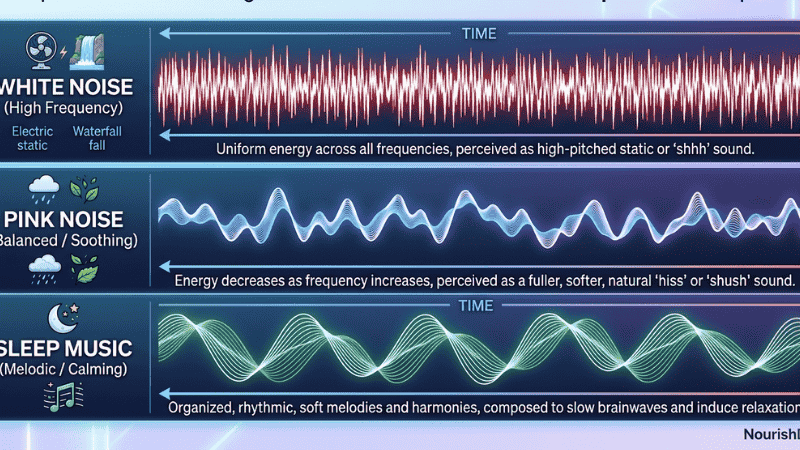
Not all sounds are created equal. Depending on your “Stress Profile,” different frequencies will yield different results.
1. Pink Noise: The Biological Hug
Unlike white noise (which can feel harsh), Pink Noise mimics the rhythmic frequencies found in nature—falling rain, rustling leaves, or a steady wind. Research shows that Pink Noise is particularly effective at memory consolidation.
- Best For: Those who feel “wired but tired.”
- The Tea Pairing: A warm cup of earthy Valerian Root.
2. 432 Hz Solfeggio Frequencies
Known as the “Frequency of Nature,” 432 Hz music is mathematically consistent with the universe’s patterns. It has been shown to lower heart rates more effectively than standard 440 Hz tuning.
- Best For: Emotional unwinding and heart-rate deceleration.
- The Tea Pairing: Lavender-infused Chamomile.
3. Binaural Beats: The Deep Sleep Shortcut
By playing two slightly different frequencies in each ear, the brain creates a third internal frequency. If the difference is between 0.5 and 4 Hz, your brain is “entrained” to enter the Delta wave state—the deepest level of human rest.
- Important: Must be used with high-quality headphones.
The “Steep & Sound” Protocol: A Multi-Sensory Alignment
At NourishDAO, we don’t believe in “quick fixes.” We believe in protocols. To maximize the impact of sleeping music, you must align it with your other senses.
The 30-Minute Sensory Countdown
- T-Minus 30 Minutes: Begin brewing your herbal tea at 90°C (194°F). As the leaves steep, turn on your sleep music at a low volume (around 35-40 dB—the volume of a quiet library).
- The Audio-Taste Link: Take slow sips of your tea while focusing on the lower frequencies of the music. This creates a “cross-sensory anchor.” Over time, your brain will associate the taste of the tea with the sound of the music, triggering a near-instant relaxation response.
- The Fade-Out: Set a 90-minute sleep timer. While music helps you fall asleep, absolute silence is often better for the late-night REM cycles where your brain processes emotions.
Case Study: The “High-Rise” Recovery
The Profile: Elena, a 48-year-old Creative Director living in a bustling city center. Her sleep was fractured by street noise and “mental looping.” The Shift: We moved Elena away from random Spotify playlists to a high-fidelity sleep music setup focused on Pink Noise and 528 Hz frequencies. We paired this with a strictly enforced “Tea-only” hour before bed. The Result: “The music didn’t just block the city,” Elena reported. “It created a boundary. Within two weeks, my Oura ring showed a 22% increase in Deep Sleep density.” For Elena, the music became the “off-switch” her brain had been missing for a decade.
FAQ: Common Concerns About Audio Sleep Aids
Q: Is it good to listen to sleep music all night? A: Generally, no. While it helps with the initial descent into sleep, constant stimulation—even soothing music—can prevent the brain from reaching the quietest stages of memory processing. A 90-minute timer is the “Goldilocks” solution.
Q: Should I use speakers or headphones? A: If you are using Binaural Beats, headphones are mandatory. For ambient sleep music, high-quality bookshelf speakers or a dedicated “sleep headband” are preferable to avoid ear canal irritation.
Q: What is the ideal volume for sleeping music? A: Keep it under 45 decibels. If you can clearly distinguish every single lyric or note, it might be too loud. The music should feel like a “mist” in the room, not a performance.
Conclusion: Compose Your Own Sanctuary
Sleep is not a passive event; it is an active state of recovery. By curating your “Auditory Environment” with high-quality sleep music, you are taking sovereignty over your senses. You are telling the world that its noise no longer has a place in your sanctuary.
Our Gentle Suggestion: Tonight, don’t just “go to bed.” Compose your rest. Choose a frequency that resonates with you, brew a cup of something floral, and let the music weave the blanket that carries you into the morning.