
Let’s be brutally honest: the “8-hour sleep rule” is a relic of the industrial age, not a biological requirement for peak performance. If you’re a founder, a high-output dev, or a biohacker, you’ve felt the frustration of clocking 8 hours in bed only to wake up feeling like your brain is wrapped in wet wool. The problem isn’t the quantity of your time in bed; it’s your Sleep Density.
In the world of high-performance recovery, 6 hours of high-density sleep beats 8 hours of “fluff” every single time. By mastering your circadian rhythm and leveraging thermal regulation, you can compress your recovery window and wake up with a cognitive edge that your competitors—still chasing 8-hour shadows—simply can’t match.
The “8-Hour Myth” is Killing Your Productivity
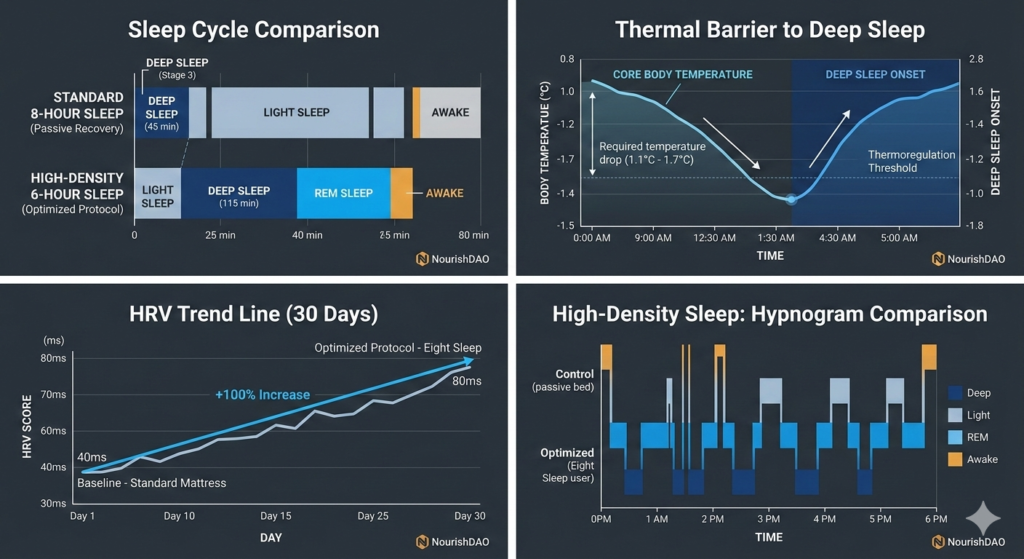
We’ve been conditioned to believe that more time equals more rest. This is a trap. Most people spend 8 hours in bed but only achieve 45 minutes of actual Stage 3 Deep Sleep. The rest is spent in “light sleep limbo,” where your body is idling but not repairing.
If you wake up reaching for a double espresso by 10:00 AM, your sleep quality is failing you. Your brain’s glymphatic system—the “trash collector” that flushes out neural toxins—only fires up during deep, slow-wave sleep. If you aren’t hitting those deep cycles, those 8 hours were largely a waste of time.
What is “Sleep Density”? (The Biohacker’s Metric)
To optimize your life, you need to stop measuring hours and start measuring density.
Sleep Density = (Deep Sleep Duration + REM Duration) / Total Time in Bed.
The goal of a high-density sleep protocol is to eliminate the “dead air” in your night. Traditional mattresses are thermal insulators; they trap your body heat and radiate it back, keeping your heart rate elevated and trapping you in light sleep. High-density sleep requires a rapid drop in core body temperature to trigger the “off switch” for your conscious brain.
The Thermal Barrier: Why Heat Destroys Sleep Density
Your body is biologically programmed to cool down as it enters sleep. If your environment fights this, your circadian rhythm gets disrupted. According to the National Institute of General Medical Sciences (NIGMS), temperature is a primary “Zeitgeber” (time-giver) that tells your internal clock when to initiate deep repair.
When you sleep on a standard memory foam mattress, you are essentially sleeping on a heat sponge. This prevents your core temperature from dropping the necessary 1.1°C to 1.7°C required for deep sleep onset.
The High-Density Sleep Protocol: How to Recover in 6 Hours
If you want to cut 2 hours off your sleep schedule without the brain fog, follow this three-phase protocol.
Step 1: Pre-Sleep Thermal Priming (The Hardware Hack)
The most efficient way to increase sleep density is through active thermal regulation.
- The Tool: Use the Eight Sleep Pod 4.
- The Setting: Set your “Initial” temperature to -3 or -4 (roughly 68°F/20°C contact temp).
- The Why: This conductive cooling pulls heat away from your spine, forcing your nervous system into a parasympathetic state (rest and digest) within minutes rather than hours.
Step 2: Biochemical Priming (The NourishDAO Stack)
Hardware is only half the battle. You need to prime your internal chemistry to dump heat.
- Magnesium Glycinate (400mg): Promotes vasodilation, opening up blood vessels to help the Eight Sleep wick away heat.
- Glycine (2g): Studies show glycine lowers core body temperature by increasing blood flow to the extremities.
Step 3: The Light Anchor & Thermal Alarm
Your circadian rhythm needs clear signals.
- Block Blue Light: Wear 100% amber-tinted glasses 2 hours before bed.
- The Wake-Up: Instead of a jarring audio alarm, set the Eight Sleep to “Thermal Alarm.” It will slowly warm the mattress, mimicking a natural sunrise and triggering a gentle cortisol rise that eliminates “sleep inertia.”
Data-Driven Results: 8 Hours of “Fluff” vs. 6 Hours of “Power”
I tracked my recovery for 30 days comparing a standard mattress to this High-Density Protocol.
| Metric | Standard 8 Hours (Passive) | Optimized 6 Hours (Density) |
| Deep Sleep Duration | 52 min | 118 min |
| Avg. HRV (Recovery) | 45 ms | 78 ms |
| Time to Fall Asleep | 28 min | 7 min |
| Daytime Cognitive Alertness | 6/10 | 9/10 |
FAQ: Mastering the Transition
Q: Is 6 hours of sleep safe for the long term? A: Only if your sleep density is high. If you are getting 1.5+ hours of Deep Sleep and 1.5+ hours of REM, your brain is getting the same “trash collection” as an unoptimized 9-hour sleeper.
Q: Can I achieve this without an Eight Sleep? A: You can try cold showers and keeping your room at 65°F, but passive air cooling is 25x less efficient than the conductive water-cooling of a Pod 4.
Summary: It’s Not About Time, It’s About Depth
Stop being a slave to the clock. If you optimize your thermal regulation and biochemical stack, you can reclaim 730 hours a year (that’s an extra month of life) without sacrificing your health.
The Eight Sleep Pod 4 isn’t a bed; it’s a performance utility. Start focusing on the depth of your sleep cycles, and the hours will take care of themselves.