
The baby is finally asleep. You’ve been waiting for this moment since 6am. You lower yourself into bed, pull the covers up, close your eyes — and nothing happens.
Your body is exhausted in a way that goes beyond tired. But your brain is somewhere else entirely: running through the feeding schedule, listening for sounds from the next room, replaying that thing the pediatrician said, wondering if you’re doing this right, wondering why you can’t just sleep when you clearly need to. Twenty minutes pass. Forty. The baby stirs. The window is gone.
This is postpartum insomnia — and it is one of the most poorly understood and inadequately addressed challenges of new motherhood. Not because it’s rare. Research suggests that up to 67% of women experience postpartum insomnia in the months following birth. It’s poorly addressed because most sleep advice assumes the problem is simply exhaustion plus a wakeful infant, when the reality is considerably more complex.
This guide explains what’s actually happening when you can’t sleep even in the quiet moments, and what — practically, safely, without medication — can begin to change it.

Key Takeaways
- Postpartum insomnia affects an estimated 67% of new mothers and is distinct from the sleep disruption caused by infant care alone — many women cannot sleep even when the opportunity exists.
- The condition is driven by hormonal shifts, hypervigilance, anxiety, circadian disruption, and conditioned arousal — not simply tiredness or newborn demands.
- Research published in BMC Pregnancy and Childbirth shows that sleep quality scores improve meaningfully between two and six months postpartum for most women — but improvement is rarely linear, and untreated insomnia can persist or worsen.
- Cognitive Behavioral Therapy for Insomnia (CBT-I) is the most evidence-based non-pharmacological treatment available and has been specifically studied in postpartum populations.
- If postpartum insomnia is accompanied by persistent low mood, loss of interest in the baby, hopelessness, or intrusive thoughts, it may overlap with postpartum depression or anxiety — both of which are treatable and deserve direct attention.
Why Postpartum Insomnia Is Different From Just Being Tired
The most important thing to understand about postpartum insomnia is that it is not simply the tiredness of new parenthood. It is a distinct sleep disorder — one in which the ability to initiate or maintain sleep is impaired even when sleep is available.
This distinction matters because it changes what helps. If the problem were only exhaustion and infant wakings, the solution would simply be more opportunity to rest. But many women with postpartum insomnia lie awake during naps, cannot fall back asleep after night feeds, or find their minds fully activated the moment the baby quiets. The infant’s sleep schedule is not the primary problem. The mother’s sleep system is disrupted.
Several overlapping mechanisms create this disruption.
The hormonal crash
During pregnancy, progesterone and estrogen reach extraordinary levels. In the days immediately following birth, both hormones drop precipitously — among the most dramatic hormonal shifts the human body experiences. This crash directly affects sleep architecture, melatonin production, mood regulation, and the nervous system’s overall tone. It’s the biological basis for the “baby blues” — and it’s also a primary driver of the sleep difficulty that characterizes the early postpartum weeks.
Prolactin, the hormone that drives milk production in breastfeeding mothers, also affects sleep. It promotes lighter, more fragmented sleep — biologically adaptive for a nursing mother who needs to rouse for feeds, but disruptive for a mother trying to maximize the sleep she can get between them.
Hypervigilance: the nervous system that won’t stand down
Becoming a parent activates an ancient biological protective system. Your nervous system is calibrated to monitor for threat to your infant — and in the early weeks and months, it does this continuously. Every small sound from the next room registers as a potential signal. Every moment of quiet can paradoxically increase arousal, because the silence itself becomes something to monitor.
This hypervigilant state is normal and protective. It is also physiologically incompatible with the nervous system tone required for sleep initiation. Your brain cannot simultaneously scan for threat and allow the gradual disengagement that sleep requires.
Anxiety and “momsomnia”
The term “momsomnia” has emerged informally to describe the pattern in which a mother’s mind becomes most active precisely when she has the opportunity to rest. The feeding is done. The baby is down. And now the mental checklist begins: Did they eat enough? Is the room temperature right? When did they last have a wet diaper? Did I take my vitamins? What do I do if they don’t gain enough weight by the two-week appointment?
This is not weakness or neurosis. It is the cognitive load of new parenthood flooding into the first available quiet space. But it creates and sustains insomnia through the same mechanism as any anxiety-driven sleeplessness: heightened cortisol, an activated nervous system, and a mind that associates the bed with worry rather than rest.
Conditioned arousal
After several weeks of waking at specific times for feeds — or lying awake in the same bed waiting for feeds — the brain begins to anticipate these patterns. Your arousal system starts preparing for a wake-up before it happens. You may find yourself waking at 3am whether or not the baby wakes, because your nervous system has learned to expect a waking at 3am.
This conditioned arousal persists even as feeding schedules change and infant sleep improves. It’s one of the primary reasons some mothers find that their insomnia doesn’t resolve when the baby starts sleeping longer — the learned pattern remains even after its original trigger has changed.
What Postpartum Insomnia Looks Like at Different Stages
Weeks 1–6
This period is the most acute. Hormonal shifts are at their most extreme. Infant feeding is most frequent. Sleep opportunity is most fragmented. Most new mothers are experiencing sleep deprivation during this period by any definition. The focus in these early weeks is less on “fixing” sleep and more on maximizing recovery within whatever windows exist.
The key strategies: dark, cool, and quiet sleep environment; minimizing arousal during night feeds; resting (even without sleeping) when the baby rests; and — critically — not trying to force sleep, which increases the anxiety that prevents it.
Weeks 6–12
As hormones begin to stabilize and feeding intervals lengthen, some mothers find sleep improving. Others find that insomnia persists or worsens — because the conditioned patterns that developed in the early weeks are now self-sustaining. A mother who spent eight weeks lying awake between feeds has, inadvertently, trained her brain to associate the bed with wakefulness.
This is when behavioral intervention becomes particularly valuable.
Months 3–6 and beyond
Research from the Journal of Obstetric, Gynecologic & Neonatal Nursing found that average sleep quality scores improve significantly between two and six months postpartum. But improvement is not universal, not linear, and not guaranteed. Untreated postpartum insomnia can become chronic — persisting well beyond the postpartum period as a fully established insomnia disorder.
If you’re still struggling significantly at three months postpartum, the passage of time alone is unlikely to resolve it. Targeted intervention makes a meaningful difference.
What Actually Helps Postpartum Insomnia

Maximize sleep quality in every available window
When total sleep time is structurally limited by infant care demands, the quality of the sleep you do get becomes disproportionately important. Small adjustments to sleep environment and timing can make each window more restorative.
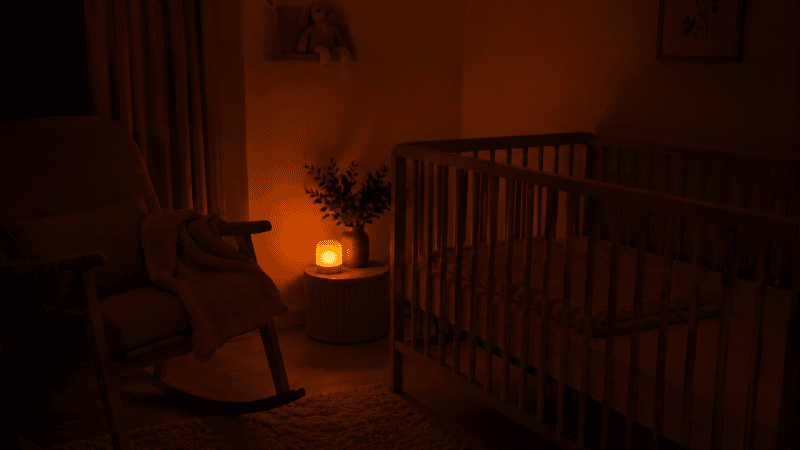
Light management at night feeds: Use the dimmest possible light for nighttime feeds and diaper changes. Red-spectrum night lights preserve melatonin better than white or blue light, making it meaningfully easier to return to sleep after a feed. Avoid your phone during night feeds — the screen brightness and the cognitive engagement both suppress melatonin and increase arousal.
Keep the bedroom cool and dark: The optimal sleep temperature is 65–68°F (18–20°C). Darkness during sleep — even the ambient glow of a baby monitor or charging device — can shift sleep into lighter stages. Blackout curtains or a sleep mask, and a cool room, protect the depth of the sleep you do get.
Rest without pressure: If you lie down during the baby’s nap and sleep doesn’t come, stay still with eyes closed and allow your body to rest passively. Passive rest — even without sleep — reduces physiological fatigue. And removing the pressure to sleep reduces the anxiety that prevents it.
Address hypervigilance directly
For the nervous system to allow sleep, it needs to feel safe. Some of the hypervigilance of early parenthood is unavoidable, but there are things that help.
Structured handoffs: If you have a partner or support person, agree on a specific feeding window that is yours versus theirs — and genuinely let go of responsibility during your window. Wearing earplugs during your designated off-duty period (while your partner monitors) gives your nervous system permission to disengage in a way that hearing range doesn’t.
A deliberate closing ritual: Before each sleep attempt, write down anything that’s circling in your mind — feeding times, concerns about the baby, tomorrow’s tasks — on a notepad. This externalization of the mental load gives the brain partial permission to release it. It doesn’t solve the worries; it parks them somewhere other than your working consciousness.
Progressive muscle relaxation: A brief body scan (systematically tensing and releasing muscle groups from feet to face) before sleep attempts has research support for reducing the physical component of hypervigilance — the tension that accumulates in the jaw, shoulders, and chest and signals the brain to stay alert.
Build a minimal but consistent sleep signal
You don’t have the luxury of a complete wind-down routine in the newborn period. But even a three-to-five-minute consistent sequence before sleep attempts begins to create a conditioned response over time.
A workable minimal sequence: dim the room, spend two minutes with slow breathing (four counts in, six or eight counts out), put your phone face-down out of reach, and lie down with eyes closed without agenda. The consistency of the sequence matters more than its length.
As your schedule stabilizes even slightly, adding a warm drink (chamomile tea is generally considered safe during breastfeeding in moderate amounts — confirm with your provider), a brief stretch, or a few journal lines builds the signal strength.
Use the 15-minute rule for nighttime waking
If you’re awake at 3am and haven’t returned to sleep within 15–20 minutes, get out of bed. Sit somewhere dim and quiet — not in bed. Do something genuinely low-stimulation: slow breathing, a few sips of water, brief journaling. Return to bed when you feel drowsy.
This is the behavioral core of stimulus control — the technique with the strongest evidence base for breaking the conditioned arousal that sustains postpartum insomnia. It feels counterintuitive when you’re exhausted and the baby could wake at any moment. But lying in bed awake and anxious trains your brain that the bed is a place to be awake and anxious. Getting out briefly and returning when drowsy gradually reverses that association.
Consider CBT-I
Cognitive Behavioral Therapy for Insomnia (CBT-I) is a non-pharmacological intervention that targets underlying cognitive and behavioral factors that perpetuate insomnia. It is shown to be a safe treatment option and highly effective for reducing insomnia, including in pregnant and postpartum women.
CBT-I in the postpartum context addresses both the behavioral patterns (stimulus control, sleep scheduling, limiting time in bed awake) and the cognitive ones (catastrophizing about sleep loss, hypervigilance about the baby, anxiety about functioning on insufficient sleep). Research specifically examining CBT-I in postpartum populations has found meaningful improvement in insomnia symptoms even while external factors — infant wakings — continue to disrupt sleep.
CBT-I is available through therapists trained in sleep medicine, and increasingly through validated digital programs that can be accessed at any hour — which matters when you have limited time and unpredictable windows.
If You Only Have 10 Minutes Right Now
Before your next sleep attempt, do just this:
Take the notepad on your nightstand (put one there if you don’t have one) and write down whatever is circling in your mind — baby concerns, tomorrow’s tasks, anything. Don’t organize it, don’t solve it. Just write it. Put the pen down.
Then dim the room as much as possible, put your phone face-down, and take ten slow breaths with a longer exhale than inhale.
That’s it. The writing parks the mental load. The breathing begins shifting your nervous system out of high alert. Neither takes more than five minutes combined, and both have research backing for improving sleep initiation in anxiety-driven insomnia.
Do it before every sleep attempt — including naps — for two weeks, and notice whether the transition to sleep begins to feel slightly easier.
When Postpartum Insomnia Becomes Something More
Postpartum insomnia and postpartum mood disorders are closely intertwined. Poor sleep worsens mood; mood difficulties worsen sleep. They can be difficult to disentangle.
Speak with your healthcare provider if:
- Sleep difficulty is accompanied by persistent low mood, loss of pleasure, hopelessness, or tearfulness that extends beyond the first two weeks postpartum — these may indicate postpartum depression, which responds well to treatment and does not resolve on its own
- You experience intrusive thoughts about harm coming to the baby, or significant anxiety that feels uncontrollable — these are symptoms of postpartum anxiety or OCD and deserve direct therapeutic support
- Sleep difficulty is accompanied by elevated mood, racing thoughts, reduced need for sleep, and increased energy — these may indicate postpartum mania, which requires urgent evaluation
- Your insomnia is severely impairing your ability to function — to care for the baby, to drive safely, to maintain basic daily function — and has not responded to behavioral changes over several weeks
- You are considering using sleep medication — many sleep aids have not been adequately studied for safety during breastfeeding, and any pharmacological approach should be guided by your provider
Postpartum mood disorders are among the most common and most treatable complications of the postpartum period. They are not signs of failure. Getting support is an act of care for both you and your baby.
Frequently Asked Questions

How long does postpartum insomnia last?
For most women, sleep quality improves meaningfully between two and six months postpartum as hormones stabilize and infant sleep patterns develop. However, improvement is not guaranteed and not always linear. Women who develop conditioned arousal patterns — whose brains have learned to be awake in the bed — may find that insomnia persists beyond the early postpartum period without targeted intervention. If you’re still significantly struggling at three months, behavioral treatment (particularly CBT-I) is worth pursuing rather than waiting for time alone to resolve it.
Why can’t I sleep even when the baby is sleeping?
Several reasons: hormonal shifts affecting sleep architecture, a hypervigilant nervous system that won’t fully disengage even in quiet moments, anxiety that floods the mind during the first available silence, and conditioned arousal from weeks of lying awake between feeds. The baby sleeping doesn’t automatically switch off the physiological and psychological activation that is preventing your sleep. This is why postpartum insomnia is a distinct condition, not just the result of infant care demands.
Is it safe to take sleep aids while breastfeeding?
Most standard sleep aids — including melatonin, antihistamines like diphenhydramine, and prescription sleep medications — have limited safety data during breastfeeding. Some are likely to pass into breast milk; others are less studied. Any pharmacological sleep support during the breastfeeding period should be discussed with your healthcare provider, who can weigh the specific risks and benefits for your situation. Behavioral approaches are both safer and more effective in the long term.
What is “momsomnia”?
“Momsomnia” is an informal term for the pattern in which new mothers find their minds most active precisely when they have the opportunity to rest. Feeding is done, the baby is down, and the mental checklist begins. It reflects the cognitive hyperactivation of new parenthood — the brain has no “off” setting for parental monitoring — and it’s one of the primary drivers of postpartum insomnia in the weeks when infant care demands would otherwise allow more sleep.
Can postpartum insomnia cause postpartum depression?
The relationship is bidirectional: poor sleep worsens mood, and mood difficulties worsen sleep. Research shows that sleep disruption during the perinatal period is associated with increased risk of postpartum depression and anxiety — and that poor sleep can worsen existing depressive symptoms. This is why addressing postpartum insomnia is not just about rest; it’s a meaningful component of maternal mental health.
Is CBT-I safe during the postpartum period?
Yes. CBT-I is a non-pharmacological treatment with no medication risks — it’s safe during breastfeeding and has been specifically studied in postpartum populations. Standard CBT-I techniques (stimulus control, sleep restriction, cognitive restructuring) may require some adaptation for the postpartum context (sleep restriction, for example, is typically modified given the infant care constraints). A provider familiar with perinatal sleep can tailor the approach appropriately.
When should I seek professional help for postpartum insomnia?
If insomnia is significantly impairing your daily function after two to three months postpartum, if it is accompanied by symptoms of postpartum depression or anxiety, or if behavioral self-management hasn’t produced meaningful improvement after consistent effort, it’s time to involve a healthcare provider. You deserve support — and effective help is available.
You Are Not Failing at Rest. You Are Recovering From Something Enormous.
Postpartum insomnia is one of the loneliest experiences of new motherhood — the exhaustion is visible to everyone, but the inability to sleep when you finally can is invisible and often dismissed. “Sleep when the baby sleeps,” people say, as if your nervous system would simply comply.
It may not comply. And that’s not a failure of will or discipline. It’s a nervous system that has been through one of the most significant biological events of a human life and is still recalibrating.
The recalibration takes time. But it is helped — meaningfully — by consistent behavioral signals, by addressing the anxiety that keeps the mind active, and by not waiting indefinitely for time alone to solve what has become a learned pattern.
You will sleep again. More than you believe right now.
For the foundational behavioral approach that supports sleep improvement at every stage, read our guide on building a night routine for better sleep. And if middle-of-the-night waking has become a recurring pattern regardless of the baby, our guide on why you keep waking up at 3am explains the mechanisms and what breaks the cycle.

References
- Bhati, S., & Richards, K. (2015). A systematic review of the relationship between postpartum sleep disturbance and postpartum depression. Journal of Obstetric, Gynecologic & Neonatal Nursing, 44(3), 350–357.
- Swanson, L. M., Pickett, S. M., Flynn, H., & Armitage, R. (2011). Relationships among depression, anxiety, and insomnia symptoms in perinatal women seeking mental health treatment. Journal of Women’s Health, 20(4), 553–558.
- Kempler, L., Sharpe, L., & Bartlett, D. (2012). Do perceptions of infant sleep problems affect the daytime wellbeing of new mothers? Archives of Women’s Mental Health, 15(3), 205–211.
- Felder, J. N., et al. (2017). Randomized controlled trial of digital cognitive behavioral therapy for insomnia in pregnant women. Health Psychology, 36(9), 871–880.
- National Institutes of Health, Office on Women’s Health. (2021). Postpartum depression. https://www.womenshealth.gov/mental-health/mental-health-conditions/postpartum-depression
NourishDAO publishes sleep and wellness content for informational purposes only. This article is not a substitute for professional medical advice, diagnosis, or treatment. If you are experiencing symptoms of postpartum depression, anxiety, or persistent sleep difficulty, please speak with your healthcare provider.