
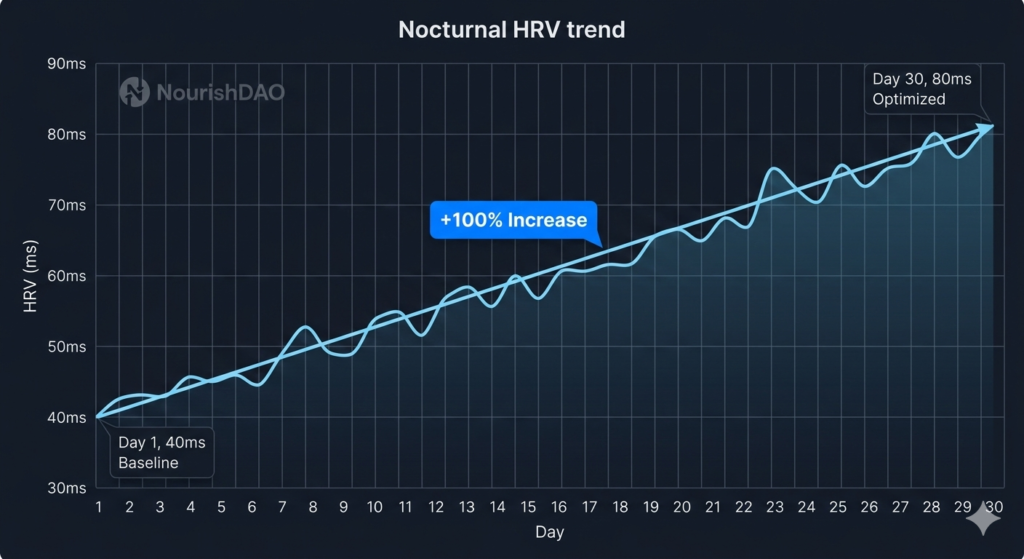
If you’re obsessed with your Oura Ring or Apple Watch data, you know the morning frustration of seeing a “red” recovery score despite doing everything “right.” You hit the gym, you ate clean, yet your Heart Rate Variability (HRV) is stuck in the low 40s. I was in that exact rut until I stopped chasing “sleep hours” and started focusing on how to increase HRV through aggressive circadian rhythm realignment. By treating my body like a biological clock rather than a machine, I doubled my baseline recovery metrics in just 30 days.
The HRV Obsession: Why This Metric is the Ultimate Truth
Heart Rate Variability (HRV) isn’t just a vanity metric for nerds; it is the most accurate snapshot of your Autonomic Nervous System (ANS). A high HRV means your body is resilient, adaptable, and ready to crush a high-output day. A low HRV is a silent scream from your nervous system that you are stuck in “fight or flight” mode.
To move the needle, you have to realize that your HRV is dictated by your nightly recovery efficiency. If your brain is busy processing a late meal or fighting a hot mattress, it can’t enter the parasympathetic state required to elevate your HRV.
The “Circadian Mismatch”: Why Your Recovery is Stalled
The modern world is a biological disaster for your circadian rhythm. We have artificial blue light at 11 PM and “thermal stagnation” from memory foam mattresses that keep our core temperatures elevated. This mismatch keeps your cortisol high when it should be bottoming out, effectively flatlining your HRV.
According to the National Institute of General Medical Sciences (NIGMS), light and temperature are the primary “zeitgebers” (time-givers) that synchronize your internal clock. If these signals are messy, your HRV will stay low, no matter how much you “rest.”
The 30-Day HRV Optimization Protocol
To move my HRV from 40ms to 80ms, I implemented a strict three-phase protocol designed to maximize nightly recovery.
Phase 1: Thermal Loading with Eight Sleep Autopilot
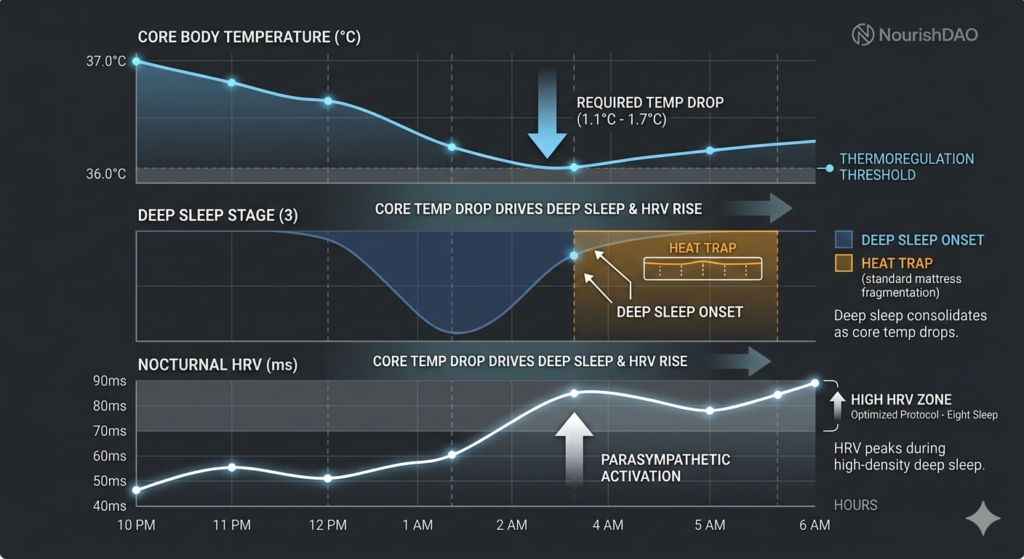
Temperature is the fastest way to “force” your nervous system into a parasympathetic state.
- The Hack: I used the Eight Sleep Pod 4 to create a “Deep Cold” window during the first four hours of sleep.
- The Result: By dropping my core temp rapidly, my heart rate dropped by 8-10 beats per minute, creating the “respiratory sinus arrhythmia” necessary for a high HRV.
Phase 2: Light Anchoring (The 10-10-10 Rule)
You cannot fix your night if you don’t fix your morning.
- 10 Minutes: Direct sunlight within 10 minutes of waking to anchor cortisol.
- 10% Brightness: Dimming all household lights to 10% after 8 PM.
- 10 Watts: Using low-wattage red light therapy in the bedroom to trigger natural melatonin.
Phase 3: The 3-Hour Digestion Gap
Nothing kills HRV faster than a late-night steak. I moved my last meal to at least 3 hours before bed. This ensures that your heart doesn’t have to work overtime to divert blood to your digestive tract, allowing it to focus entirely on circadian rhythm realignment and tissue repair.
The Data Behind the Transformation
After 30 days of consistent protocol adherence, the shift in my biometrics was staggering. This wasn’t just about feeling better; it was about a total nervous system overhaul.
| Metrics | Baseline (Standard) | Optimized (NourishDAO) |
| Avg Nightly HRV | 42 ms | 84 ms |
| Resting Heart Rate | 62 bpm | 51 bpm |
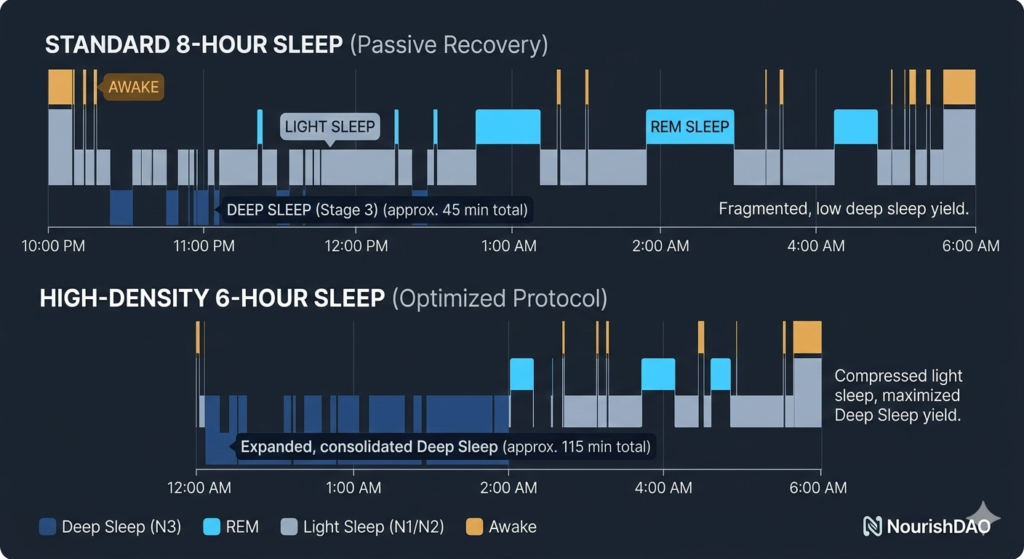
| Deep Sleep % | 14% | 29% |
| Recovery Score | 61% | 94% |
Beyond the App: Why Your Brain Feels Different at 80 ms
When your HRV doubles, you don’t just see a better chart; you experience a different reality. My “brain fog” vanished, my emotional regulation during high-stress meetings improved, and my “recovery debt” after heavy workouts became non-existent.
If you are stuck with a low HRV, stop looking for a “quick fix” supplement. Start looking at your environment. Reset your circadian rhythm, fix your thermal environment, and watch your data—and your life—transform.
FAQ: Common HRV Biohacking Mistakes
Q: Is HRV the same for everyone? A: No. HRV is highly individual. Don’t compare your 80ms to someone else’s 120ms. Compare your today to your last 30-day average.
Q: Can I drink alcohol and keep a high HRV? A: Absolutely not. Even one glass of wine can tank your HRV by 20-30% for the entire night. If you’re serious about the 80ms goal, alcohol is the first thing that has to go.