In our experience working with R&D labs and tea startups, the question “Does chamomile tea have caffeine?” is rarely about simple biology. For a brand owner, it’s a question of batch integrity. If your “Caffeine-Free” label ends up on a product with even trace amounts of alkaloids due to poor supply chain hygiene, you aren’t just looking at a customer complaint—you’re looking at a potential recall and a breach of consumer trust. At NourishDao, we treat Chamomile (Matricaria chamomilla) not as a commodity filler, but as a technical botanical.
The Botanical Reality: Beyond the “Tisane” Label
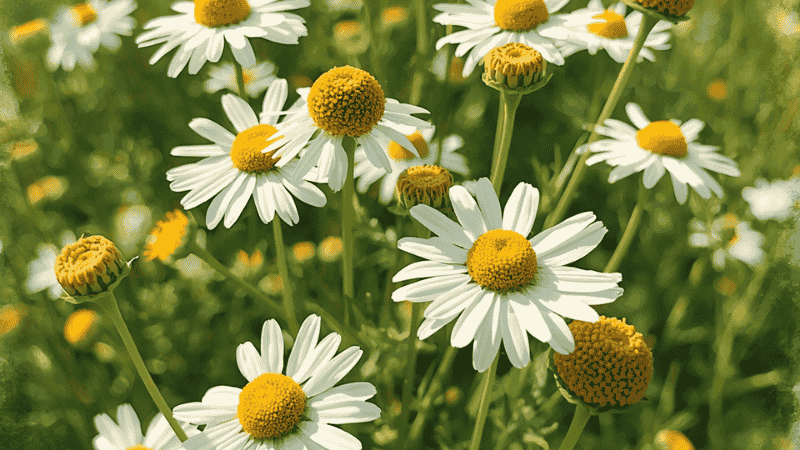
Technically, chamomile is a member of the Asteraceae family, entirely unrelated to the Camellia sinensis plant that produces black and green teas. It is naturally caffeine-free.
However, as a supplier, we know that “naturally caffeine-free” at the farm doesn’t always mean “caffeine-free” in the cup.
The Problem of Cross-Contamination in Origin
Many low-cost wholesalers source from regional “collection centers” where chamomile flowers are dried on the same floors or processed through the same sifting machinery as caffeinated teas.
When we evaluate a batch, we look for more than just the absence of caffeine. We look for purity markers:
- Apigenin Content: The primary flavonoid responsible for chamomile’s calming reputation.
- Chamazulene Levels: The essential oil that gives high-quality German Chamomile its slight blue tint.
- Total Ash and Acid-Insoluble Ash: This indicates how well the herb was cleaned of soil and sand during the harvest.
Sourcing Reality: What Separates Premium Bulk from “Dust”
In the B2B world, you get what you pay for. If you source purely on price, you typically receive “siftings”—the broken petals and dust left over from the flower harvest.
Identifying Quality in the Supply Chain
- Origin Matters: We prioritize Egyptian chamomile for its bright, honey-like sweetness and Croatian chamomile for its high essential oil concentration.
- The “Yellow Head” Ratio: A premium wholesale batch should consist of intact yellow florets. Stems and leaves add weight but dilute flavor.
- Drying Precision: Over-dried chamomile becomes brittle; under-dried batches are a breeding ground for mold during sea freight.
B2B Use Cases: Strategic Product Development
We help our partners move beyond basic tea bags into high-margin functional products:
1. The Clean-Label Sleep Blend
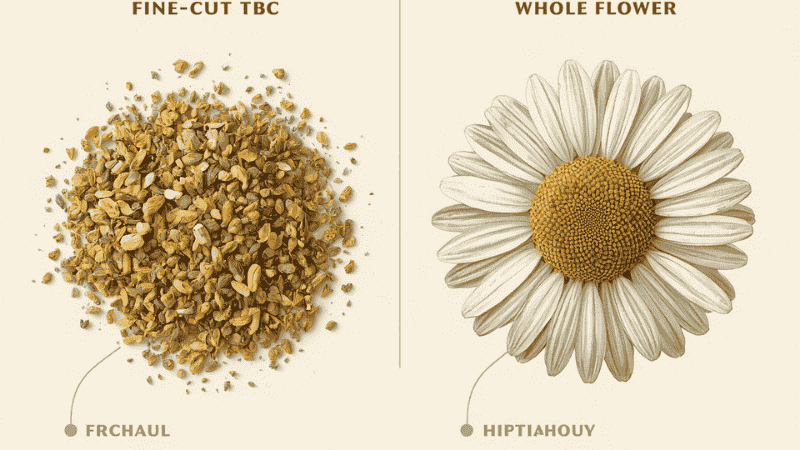
For brands formulating “PM” blends, we recommend a TBC (Tea Bag Cut) that maintains a specific particle size (1–3mm). This ensures that when mixed with ingredients like Valerian, the chamomile doesn’t settle at the bottom of your hopper.
2. Ready-to-Drink (RTD) Extractions
Beverage manufacturers often struggle with chamomile because it can turn bitter if over-steeped. We supply high-grade Whole Flowers that provide a cleaner, sweeter extract profile for bottled botanical waters.
Case Studies: Solving Supply Chain Friction
Case A: Eliminating “Off-Notes” for a Luxury Brand
The Issue: A national wellness brand found their chamomile tea had a persistent “hay-like” smell. The Fix: We traced the issue to “poly-bagging” at the origin. We switched their supply to vacuum-sealed, foil-lined bulk units and moved sourcing to a high-altitude harvest in Egypt.
Case B: The Verification Victory
The Issue: A startup was rejected from a “Clean Label” retail chain because their previous supplier couldn’t provide a Caffeine-Free Guarantee. The Fix: NourishDao provided full traceability documentation. We utilized our dedicated “Herbal Only” milling line to eliminate cross-contact risks.
What Most Herbal Tea Suppliers Don’t Tell You
Most wholesale brokers never visit the processing facility. They buy “Chamomile” as a generic commodity. Here is the reality of the industry:
- The Filler Secret: Many “bulk” chamomile shipments contain up to 30% stems and leaf material to lower the price point.
- Old Crop Risk: Chamomile loses its essential oils rapidly. If your supplier is selling you “last year’s harvest” at a discount, your product will lack potency.
- Pesticide Drift: Even “natural” chamomile can fail lab tests if grown near conventional cotton or grain fields. We demand 5km buffer zones for our organic lots.
Conversion: Scale Your Brand with NourishDao
We don’t just ship boxes; we help you engineer a product that scales.
Bulk Supply Options
- Whole Flowers: Hand-picked for premium loose-leaf aesthetics.
- Tea Bag Cut (TBC): Precision-milled for high-speed automated packing.
- Powders & Extracts: For use in supplements, gummies, or cosmetic applications.
Private Label Services
Launch your brand faster with our turnkey solutions. We handle the sourcing, sifting, and nitrogen-flushed packaging to ensure your product hits the shelf with maximum freshness.
Custom Formulation
Work with our in-house herbalists to create a proprietary blend. We can combine our caffeine-free chamomile with over 50+ other botanicals to meet your specific functional goals.
Trust & Quality Assurance
Your brand’s reputation is built on the data behind the leaf. NourishDao provides:
- Sourcing Transparency: Full farm-to-warehouse traceability.
- Quality Control: Every batch undergoes organoleptic testing and microbial screening.
- Certifications: Available lots include USDA Organic, Kosher, and Halal-compliant options.
- CoA Standards: We provide a comprehensive Certificate of Analysis with every shipment covering heavy metals and purity.

FAQ
1. How do you guarantee the chamomile is 100% caffeine-free?
We utilize dedicated herbal-only processing lines. Unlike multi-commodity facilities, our chamomile never shares equipment with black or green tea, preventing microscopic cross-contamination.
2. What is the MOQ for wholesale chamomile?
Our bulk supply typically starts at 20kg (one standard bale), though we offer smaller volumes for custom formulation trials and R&D phases.
3. Can chamomile tea be used in RTD beverages?
Yes. However, the extraction process requires a specific “Whole Flower” grade to avoid the cloudiness and bitterness associated with lower-grade dust and fannings.
4. Do you offer “Caffeine-Free” certification support?
While we provide the technical data (COA) and lab results proving the absence of caffeine, we recommend brands work with third-party certifiers to display specific “Caffeine-Free” seals on their retail packaging.
Final Sourcing Checklist
- [ ] Does the supplier provide a Batch-Specific COA?
- [ ] Is the milling equipment dedicated to caffeine-free botanicals?
- [ ] What is the “Yellow Head” to “Stem” ratio?
- [ ] Is the harvest from the current calendar year?
Ready to secure a cleaner supply chain? Contact NourishDao today to request a specification sheet or a sample of our current Egyptian or Croatian harvests.